


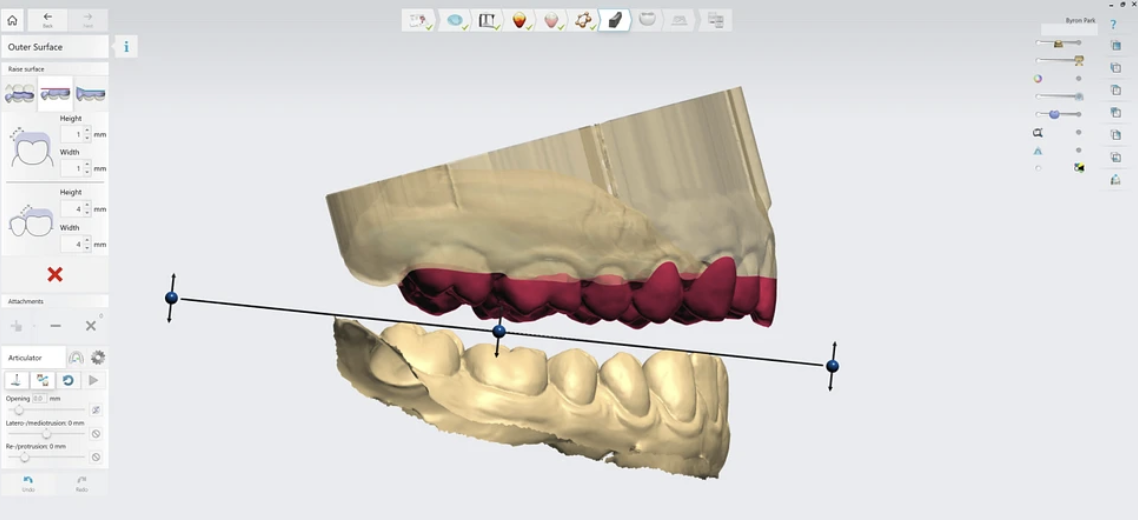
The Rise of Digital Twins in Dentistry – Predicting Outcomes Before Milling Begins
Dentistry has always balanced art and anatomy, but the next decade will add another dimension — simulation. As design and manufacturing become increasingly digital, the industry is entering an era where every restoration can exist twice: once virtually and once physically.
This concept, known as the digital twin, is reshaping how dental labs, clinicians, and patients understand success. Instead of discovering problems after milling, labs can now predict them before production even starts.
At VCAD Dental Outsourcing Lab, digital twins aren’t theoretical. They are woven into daily workflow, guiding decisions, validating designs, and ensuring every restoration behaves as beautifully as it looks.
1. What a Digital Twin Really Is
The term “digital twin” originated in aerospace engineering — a complete virtual replica of a physical asset that mirrors its condition, behavior, and lifecycle. In dentistry, the principle is the same: create a virtual version of the patient’s oral environment and simulate how a restoration will perform under real conditions.
At VCAD, a digital twin isn’t just a 3D model. It’s a living simulation composed of:
- Anatomical data: intraoral scans, CBCT bone structures, soft-tissue topography.
- Material data: mechanical properties of zirconia, lithium disilicate, or resin.
- Functional data: occlusal dynamics, muscle force vectors, and bite motion paths.
This multidimensional model allows technicians to test restorations virtually — applying pressure, light, and even aging scenarios — before a single toolpath is generated.
Digital twins bridge imagination and reality. They replace assumption with analysis, turning “I think it will fit” into “we know it will fit.”
2. How VCAD Builds the Digital Twin
Creating a true digital twin requires integration between disciplines that rarely speak the same language: scanning, CAD/CAM engineering, and biomechanics. VCAD unites them into a coherent digital architecture called the VCAD Simulation Matrix.
1. Data Fusion
The process starts with merging intraoral STL files and CBCT DICOM data. AI-based alignment matches bone landmarks with surface anatomy at a tolerance under 40 µm. This generates a hybrid dataset that includes both soft and hard tissue geometry.
2. Material Profiling
Each chosen material in VCAD’s library carries a profile — density, elastic modulus, fracture resistance, and translucency. These values feed into the simulation to predict stress and deformation.
3. Functional Mapping
Jaw-motion data captured from digital articulators or facial scanners is imported to simulate realistic movement. The twin doesn’t just sit in occlusion; it moves through it.
4. AI Validation Layer
Before milling, algorithms analyze the twin for weak zones, sharp internal corners, or thin connectors that could fail under load. Designers receive corrective suggestions instantly.
By the time a restoration reaches the CAM stage, every geometric decision has already been stress-tested in silico.
3. Predictive Manufacturing – Seeing the Future of Fit
Traditional workflows confirm quality after production; predictive manufacturing flips the sequence. With digital twins, VCAD predicts the outcome before the machine starts.
1. Virtual Fit Testing
The twin simulates cement space, margin adaptation, and proximal contacts at micron accuracy. The system projects how the restoration will seat on the prepared tooth, factoring in adhesive film thickness.
2. Force Simulation
Finite Element Analysis (FEA) visualizes occlusal pressure as a color-coded heatmap. Technicians can redistribute cuspal contacts digitally, avoiding high-stress areas that might lead to chipping or screw loosening.
3. Thermal and Hydrothermal Aging
Software models temperature cycles and moisture exposure equivalent to years of oral use. Weak points appear before they can exist physically.
4. Machine Readiness Check
The twin also verifies whether the chosen milling block and toolset can reproduce the geometry without overcutting. If a risk appears, the CAM planner adjusts toolpaths automatically.
Predictive manufacturing transforms trial-and-error into trial-and-truth — producing restorations that arrive pre-validated rather than merely polished.
4. From Simulation to Clinical Reality – The Collaboration Loop
A digital twin has no value unless it informs the clinician. VCAD turns simulation data into practical insight through its Clinical Feedback Interface.
When a case is complete, clinicians receive:
- A Fit Report: 3D visuals showing predicted versus actual seating.
- Force Distribution Map: a snapshot of functional pressure zones.
- Material Stress Summary: recommendations for future cases with similar anatomy.
During follow-up, dentists can upload post-treatment scans. The system overlays them on the original twin to measure real-world deviation. These differences train VCAD’s AI models, improving prediction accuracy over time.
This creates a virtuous circle: simulation → production → clinical feedback → smarter simulation.
Clinicians gain confidence, technicians gain foresight, and patients gain restorations that simply fit.
The more the network grows, the smarter the twins become — because each case teaches the next how to succeed.
5. The Future – Intelligent Ecosystems, Not Individual Cases
Digital twins are not the end goal; they are the beginning of an intelligent dental ecosystem. As AI and cloud connectivity expand, these virtual replicas will interact across global networks.
Imagine a world where:
- A clinician’s scan in Toronto automatically compares with thousands of prior twins to suggest optimal design parameters.
- Material databases update themselves based on worldwide performance data.
- Predictive systems forecast how a crown will age under a patient’s specific bite force and diet profile.
VCAD is already building this foundation. The lab’s Twin Analytics Hub aggregates anonymized case data, creating a collective intelligence that benefits every partner clinic. Each new case refines the global model, making dentistry less reactive and more anticipatory.
Yet amid this technological leap, VCAD preserves a guiding truth: technology should enhance, not eclipse, human judgment. A twin can simulate muscle motion, but only a clinician can read emotion — the smile, the relief, the trust.
The future of digital dentistry belongs to this partnership: artificial precision guided by authentic perception.
Conclusion
Digital twins mark the transition from measurement to foresight. They allow dental professionals to see the outcome before it exists, merging design, biology, and data into one predictive framework.
For VCAD Dental, the goal isn’t merely faster production; it’s certainty — restorations that function as expected because their performance was already proven in the virtual world.
Every patient deserves that assurance. Every clinician deserves that confidence. And every technician deserves tools that let science and art move in unison.
In a few years, asking whether a lab uses digital twins will sound as outdated as asking if it uses CAD/CAM. The technology will be invisible — woven into every smile, every crown, every quiet moment when precision meets peace of mind.