


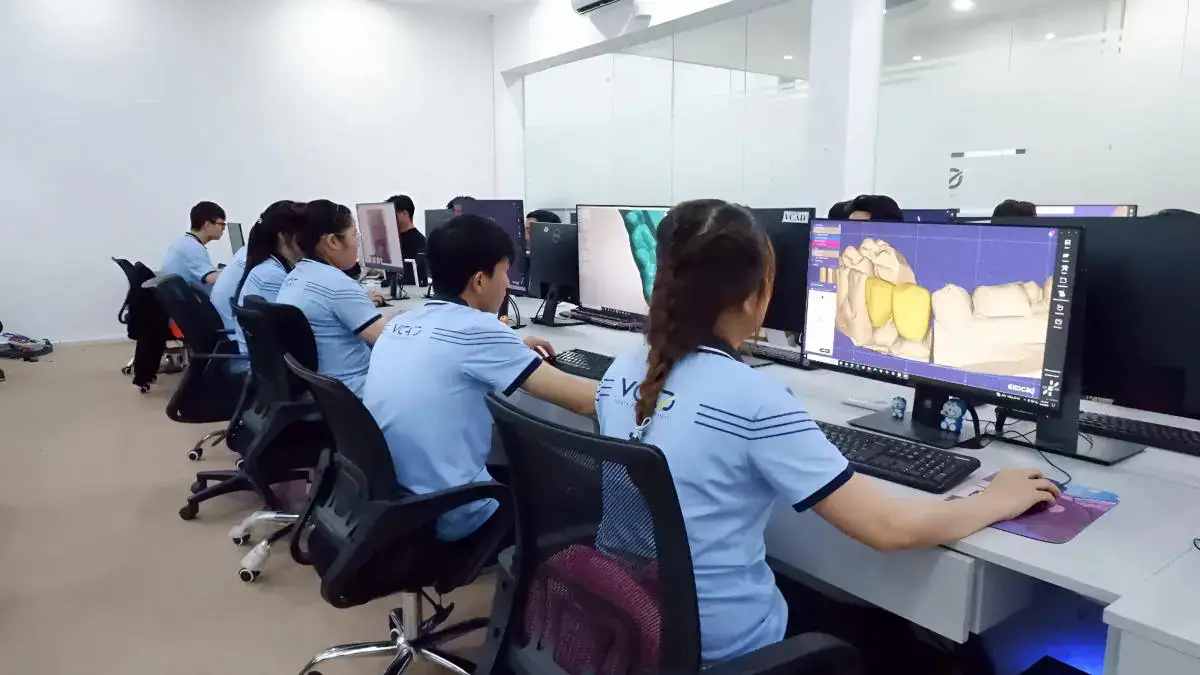
The Patient Behind the Pixels – Humanizing Technology in Digital Dentistry
Digital dentistry speaks in numbers: microns of precision, megabytes of data, milliseconds of processing. Yet behind every scan and simulation lies something infinitely complex — a person.
In the race toward automation and AI, it’s easy to forget that each restoration represents not a dataset, but a life — someone who will speak, smile, and share themselves through that work.
At VCAD Dental Outsourcing Lab, this truth anchors everything. Technology is the language, but humanity is the purpose.
For VCAD, digital innovation is not about replacing people; it’s about amplifying care. Every file, every algorithm, every machine hums in service of one quiet promise: to make someone’s tomorrow feel better than their yesterday.
Here’s how the lab keeps humanity at the heart of precision — and why the future of digital dentistry must always begin with empathy.
1. Beyond the Screen – Remembering the Human Story
When technicians receive a new case, they don’t just see STL files and bite scans — they imagine the person behind them.
A fractured molar might mean a professional who hasn’t smiled in photos for years. A full-arch case might belong to someone regaining confidence after illness. These unseen stories are what turn a routine design into an act of restoration in every sense of the word.
VCAD encourages designers and technicians to adopt what it calls the “Patient Perspective Principle.”
Before starting a case, they ask: Who is this for? What might they feel when they first see themselves again?
This mindset transforms repetition into responsibility. It gives meaning to precision.
Because when the technician sees the patient — not just the pixels — they design differently. They add softness to curves, warmth to translucency, balance to form. The outcome is not just a crown that fits the mouth, but one that fits the person.
Behind every restoration is a story waiting to smile again. VCAD never lets that story fade into code.
2. The Role of Empathy in Digital Workflows
Empathy is not a word often used in engineering meetings, yet it is the foundation of clinical success.
When clinicians and labs understand each other’s challenges, patient experience improves. That’s why VCAD designs its digital systems around empathetic engineering — technology built to listen.
1. Human-Centric Interfaces
VCAD’s portal doesn’t just manage data; it mirrors the clinician’s real workflow. Intuitive navigation, visual feedback, and instant previews reduce frustration and allow clinicians to focus on patients, not software.
2. Predictive Support
AI assistants suggest materials or designs that minimize chairside time, respecting both clinician efficiency and patient comfort.
3. Compassion in Communication
Even emails and notifications are written in human tone — concise, polite, and reassuring. VCAD believes communication design is part of patient care, because stress-free clinicians deliver better experiences.
Empathy in a digital context means removing friction, adding clarity, and respecting emotion even in technical exchanges.
The most advanced system is the one that understands feelings, not just files.
3. Data with Dignity – The Ethics of Digital Care
Every patient’s mouth is a map of personal identity — biological, medical, and emotional. When that data becomes digital, it demands protection not just as information, but as intimacy.
VCAD’s Data Dignity Framework extends far beyond cybersecurity. It recognizes that trust is not built on encryption alone, but on respect.
Key principles include:
- Consent & Ownership: Patients and clinicians retain ownership of all case data. VCAD acts solely as custodian.
- Anonymization Protocols: All datasets used for AI training are stripped of identifiable details.
- Right to Forget: Upon request, patient files can be securely erased from all servers — not archived indefinitely.
- Ethical AI: Algorithms are trained for function, never for profiling or marketing.
In a time when data can be traded as currency, treating digital anatomy with dignity becomes a moral act.
VCAD’s message is simple: precision without ethics is not progress — it’s regression disguised as innovation.
4. Technology as an Extension of Care, Not a Replacement
Digital dentistry often raises a quiet fear — that machines will replace human touch. But in VCAD’s ecosystem, technology exists to extend care, not to erase it.
AI detects margins, but a human checks the story behind them.
Robots mill frameworks, but human hands polish the final surface with intuition machines cannot replicate.
Technology’s greatest strength lies not in autonomy, but in augmentation.
At VCAD, this principle takes form through:
- AI-Assist, Human-Approve: Every automated process ends with a designer’s sign-off.
- Digital Feedback Loops: Data from clinical outcomes helps technicians learn and empathize more deeply with real-world results.
- Virtual Collaboration: Real-time communication tools connect clinicians and designers — restoring the “conversation” that early outsourcing models lost.
Machines process information; humans process meaning.
That combination — empathy guided by intelligence — creates dentistry that is not only efficient, but emotionally intelligent.
5. Designing the Future – The Symbiosis of Humanity and Technology
Looking forward, digital dentistry will not be defined by who has the newest scanner or the fastest printer. It will be defined by who uses technology most humanely.
The coming wave of innovation — AI diagnostics, bioactive materials, neural modeling — will make restoration more personalized than ever. But personalization must never become depersonalization.
VCAD’s vision for the next decade is clear:
- Empathy embedded in algorithms. Systems that learn patient comfort preferences, not just occlusal data.
- Inclusive design education. Training technicians to understand cultural, aesthetic, and emotional diversity across patients worldwide.
- Transparent innovation. Ensuring new technologies explain their function clearly to clinicians and patients alike.
The future lab will not be a factory of files, but a studio of empathy — a space where biology, technology, and humanity coexist in precise harmony.
Dentistry’s greatest innovation won’t be digital. It will be deeply human.
Conclusion
Digital dentistry began as a technological movement. Now it’s becoming a human one.
At VCAD Dental Outsourcing Lab, every algorithm, every procedure, every scan is designed to serve the same goal — helping people feel whole again.
Precision, for VCAD, isn’t about perfection of shape. It’s about perfection of purpose.
Because behind every dataset is a person. Behind every byte, a breath. Behind every crown, a smile waiting to return to the world.
And when technology remembers that — when the machine remembers the human — that’s when true innovation begins.