


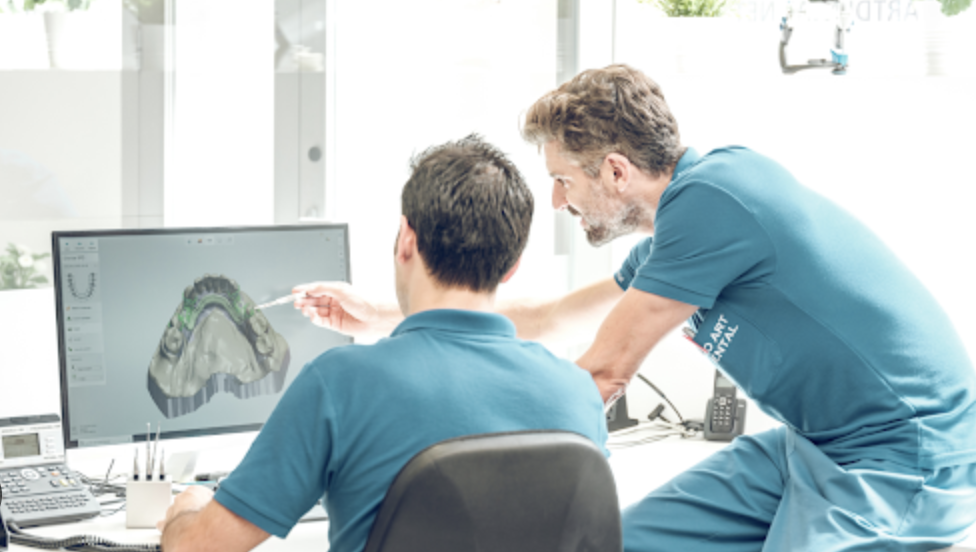
Inside the Mind of a CAD Designer – Turning Clinical Vision into Digital Reality
Every beautiful restoration begins with an invisible act of translation. A clinician imagines the perfect fit, the ideal shade, the right balance between form and function — and a CAD designer must turn that imagination into reality.
Digital dentistry often focuses on machines and materials, but the heart of precision still beats inside the mind of the designer. Behind every case file on a server is a human being interpreting, adjusting, and refining — bridging clinical intent and computational logic.
At VCAD Dental Outsourcing Lab, that process happens thousands of times each day. The lab’s CAD designers transform raw data into anatomy that not only fits but feels alive. Their workflow embodies the delicate balance between technology and intuition — a process as methodical as it is imaginative.
Let’s step into that mindset and see how digital artistry becomes scientific precision.
1. The Designer’s First Canvas – Understanding Intent
When a new case arrives at VCAD, the designer doesn’t start by opening software — they start by listening.
Every scan, photo, and note carries clues about the patient’s needs and the clinician’s expectations. Before touching a digital tool, the designer reviews the clinical prescription like a composer studying a musical score.
Key questions shape their first impression:
- What was the treatment goal — esthetic enhancement, structural repair, or occlusal correction?
- What is the patient’s facial morphology and smile line?
- Which material will best serve both strength and beauty?
The designer builds a mental 3D model long before launching Exocad or 3Shape. This cognitive preparation is crucial — it prevents the design from becoming a blind mechanical task.
At VCAD, each case begins with a 5-minute “intent briefing.” Designers read the SmartRx, study reference images, and note any special instructions. By aligning with intent first, they ensure that every design choice serves a clinical purpose, not a digital default.
As one senior VCAD artist says: “The computer can calculate fit, but only humans can calculate meaning.”
2. Shaping Function – Where Anatomy Meets Engineering
Once intent is clear, the designer’s next mission is functional logic. Every tooth must interact harmoniously with its neighbors, the opposing arch, and the dynamic motion of the jaw.
In the analog era, technicians relied on experience and articulator models. In the digital world, designers rely on physics-based simulation — but the principle remains the same: anatomy must obey mechanics.
Functional Workflow at VCAD:
- Margin Detection & Cement Gap Calibration – Automated tools detect preparation lines within ±10 µm accuracy. Designers then adjust cement space according to material behavior (e.g., zirconia vs. e.max).
- Occlusal Mapping – Software overlays pressure zones using color gradients. Designers adjust cusp height and central groove depth to equalize force distribution.
- Articulation Simulation – Virtual jaw movements replicate real chewing paths, allowing designers to confirm disclusion and balance.
- Connector Optimization – In bridges or implant cases, finite element simulation ensures connectors resist bending and tensile forces.
Each step blends engineering logic with biological empathy. Designers constantly ask: “How will this move, flex, and age in the mouth?”
The result is not just a crown that fits perfectly today — but one that continues to fit after thousands of bites.
3. Sculpting Aesthetics – The Art Hidden in Microns
After function comes the soul of the restoration: esthetics. This is where design transcends precision to evoke emotion.
Digital sculpting is both science and storytelling. The designer must recreate the subtle asymmetries that make real teeth beautiful.
At VCAD, this process involves:
- Contour Language: Every patient’s facial structure informs the curvature of the tooth. A strong jawline may call for sharper cusp transitions; a softer face may harmonize with rounded edges.
- Light Dynamics: Designers simulate how light will reflect on polished surfaces. Proper curvature determines how brightness travels across enamel-like layers.
- Texture Mapping: Microgrooves and natural wear lines are digitally engraved to avoid a “too perfect” artificial look.
- Shade Interpretation: Using clinician photos, designers balance translucency and chroma, ensuring color transitions mimic dentin depth.
Each of these adjustments happens in increments smaller than a hair’s width, yet their combined effect defines realism.
A skilled designer doesn’t copy anatomy — they interpret it. They understand that beauty in dentistry isn’t symmetry; it’s believability.
That’s why VCAD designers are trained not only in dental anatomy but also in visual arts — to see like sculptors, not just operators.
4. The Dance Between Human and Machine
CAD design is not a solo performance; it’s a duet between human intuition and machine intelligence.
At VCAD, AI assists but never replaces the designer. Algorithms detect margins, align bites, and suggest anatomical templates. Yet the final refinement — the softening of cusp, the subtle rotation of an incisor — always comes from human judgment.
This interplay creates what VCAD calls “Augmented Artistry.”
- AI provides speed. It reduces repetitive manual steps.
- Human designers provide nuance. They understand emotion, proportion, and context.
Together, they achieve what neither could alone — precision that feels natural.
To maintain this harmony, VCAD limits automation to 70% of the process. The remaining 30% is deliberate craftsmanship — the time designers use to inspect, compare, and perfect.
In complex cases like full-arch implants or smile reconstructions, this balance is even more vital. Designers conduct multiple “fit rehearsals” in simulation before sending files to CAM.
It’s like an orchestra — AI keeps the tempo, but the designer conducts the music.
5. Quality Reflection – Learning from Every Design
The final step in a designer’s process is reflection. Every finished case is reviewed not as a task completed, but as a dataset of knowledge.
VCAD’s Design Performance Tracker measures how each designer’s output performs clinically:
- Average chairside adjustment time.
- Fit accuracy variance per tooth type.
- Feedback ratings from partner clinics.
These metrics feed into an internal dashboard where designers analyze their patterns. If one technician consistently achieves tighter fits in posterior crowns, they share their workflow insights with others.
This transforms competition into collaboration. The lab evolves collectively, learning from its own precision.
For designers, reflection closes the loop between digital creation and real-world consequence. It’s a constant reminder that behind every polygon and pixel lies a person — smiling, eating, and living with their work.
In VCAD’s culture, mastery doesn’t mean “no more to learn.” It means always learning from what you’ve made.
Conclusion
Inside the mind of a CAD designer lies a rare balance of logic and artistry. They think like engineers, sculpt like artists, and collaborate like scientists.
At VCAD Dental Outsourcing Lab, these designers form the heartbeat of the digital workflow — turning clinical vision into digital precision that survives real-world physics and human emotion.
Their process is proof that technology alone doesn’t make excellence; interpretation does.
Every scan tells a story. Every margin line is a sentence. And every crown, bridge, or veneer becomes the final paragraph of that collaboration — where the clinician’s idea meets the designer’s imagination and the patient’s reality.
In the age of automation, the human mind remains the most sophisticated design tool ever created.