


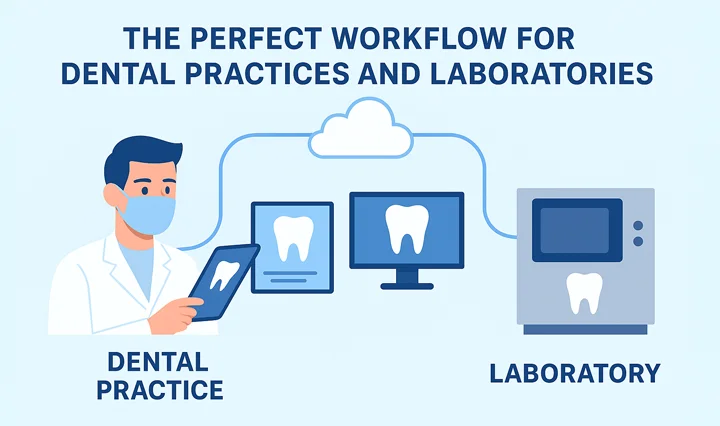
Long-term growth in dentistry does not come from volume alone. It comes from building a workflow that can handle more cases without losing control of quality, turnaround stability, communication clarity, or manufacturing consistency. For dental labs, clinics, prosthodontists, and oral surgeons, this is where a Professional Dental outsourcing lab becomes strategically important. The role of an outsourcing partner is not limited to case overflow. In a mature digital environment, the right partner supports growth by making the workflow more scalable, more repeatable, and less vulnerable to operational friction.
This matters because growth creates pressure in several directions at once. More case volume increases design demand. A broader case mix adds technical complexity. Faster clinical scheduling reduces tolerance for delay. Digital workflows introduce more file handling requirements, more software dependencies, and more coordination across teams. If these pressures are absorbed through improvisation alone, the system becomes unstable. A professional outsourcing lab helps prevent that instability by introducing structure where expansion would otherwise create inconsistency.
That is why long-term growth should not be discussed only in terms of sales, new accounts, or production numbers. In technical dentistry, growth is sustainable only when the workflow can expand without quietly increasing remake risk, communication failure, or design-to-manufacturing mismatch. A strong outsourcing partner supports exactly that kind of growth.
Growth becomes fragile when workflow capacity grows slower than case demand
Many dental businesses assume growth problems will appear mainly at the business development level. In practice, the first real strain often appears inside production. A lab may gain more clients, a clinic may increase digital case submissions, or a specialist may broaden the range of implant and restorative work being handled. At first, this looks positive. Then the internal design queue becomes congested, communication slows, turnaround becomes uneven, and routine cases start competing for attention with complex ones.
This is one of the clearest reasons a Professional Dental outsourcing lab supports long-term growth. It expands functional capacity without requiring every increase in demand to be absorbed immediately by internal hiring, retraining, or rushed process changes. More importantly, it does so within a technical workflow rather than outside it. The partner becomes part of the case pathway, helping manage intake, design support, fabrication logic, and coordination under higher volume conditions.
From one angle, outsourcing may seem like a temporary solution for busy periods. From another, more operationally useful angle, it is a structural solution for growth management. The second view is usually more accurate when the goal is not simply to survive a busy month, but to support growth over years without degrading consistency.
Long-term growth depends on repeatable systems, not heroic effort
In small or early-stage operations, growth can sometimes be sustained by extra individual effort. A technician stays late. A designer handles more cases than usual. A case manager manually resolves file problems one by one. This can work for a while. But it is not a scalable model. Growth supported only by human improvisation eventually becomes vulnerable to fatigue, inconsistency, and preventable errors.
A professional outsourcing structure helps replace heroic effort with repeatable process. That is one of the deeper advantages of a Professional Dental outsourcing lab. The partner does not merely add hands. It adds systems: file intake rules, case categorization logic, CAD design protocols, communication checkpoints, and production-aware review steps. These systems make the workflow less dependent on individual rescue behavior and more capable of handling sustained volume.
This distinction matters because long-term growth is not just an increase in demand. It is an increase in exposure to small operational failures. Every unclear prescription, incomplete scan, delayed clarification, or unstable design choice becomes more costly as volume rises. Repeatable systems reduce this risk. And in dentistry, risk reduction is often what allows growth to remain profitable rather than merely busy.
A professional outsourcing lab helps stabilize turnaround as volume increases
One of the first things growth tends to disrupt is turnaround consistency. When more cases arrive, design queues lengthen. When case complexity rises, routine units may wait behind larger or more technical cases. When internal teams are stretched, priorities become harder to manage. This is where a professional partner can create real operational value.
A Professional Dental outsourcing lab supports long-term growth by helping stabilize the early and middle stages of production. Standard cases can be routed efficiently. Overflow design can be absorbed without collapsing internal schedules. More complex categories can be triaged properly instead of forcing every case through the same bottleneck. This improves not only speed, but schedule predictability.
That point is important. Long-term growth does not benefit from occasional bursts of fast performance if the workflow remains unstable overall. What matters more is dependable rhythm. Clinics and labs need to know how work moves under normal conditions, under busy conditions, and under mixed case conditions. A professional outsourcing workflow supports that rhythm by smoothing capacity fluctuations before they become systemic delays.
File quality and intake discipline become more important as operations expand
Growth multiplies the consequences of weak submission habits. A small number of incomplete scans or vague prescriptions may be manageable in a low-volume setting. In a growing operation, those same problems can create repeated interruption across many cases. That is why one of the most valuable contributions of an outsourcing partner is stronger intake discipline.
A mature outsourcing lab does not simply receive files and start designing. It reviews whether the case is ready. It checks whether the digital package is complete. It identifies missing information early. In the context of long-term growth, this is extremely useful because it prevents expansion from being built on bad intake habits. A Professional Dental outsourcing lab helps the sending team become more disciplined as well, because the relationship encourages cleaner file preparation, clearer prescriptions, and more structured communication.
This creates a two-sided benefit. The outsourcing lab works more efficiently because incoming data is more usable. The sending lab or clinic also becomes operationally stronger because its own submission standards improve over time. That is one of the subtle ways outsourcing supports growth: it strengthens the upstream process, not only the downstream workload.
Consistent CAD design supports scalable quality
As operations grow, variability becomes more dangerous. If similar cases are designed differently from one week to the next, manufacturing becomes less predictable, adjustment time increases, and confidence in the workflow starts to erode. This is why consistency in CAD design matters so much for sustainable expansion.
A professional outsourcing lab helps by applying more stable design logic across routine and moderately complex cases. Contact strategy, occlusal balance, emergence control, connector behavior, internal fit planning, and production-aware anatomy can be managed with repeatable standards. A Professional Dental outsourcing lab supports growth not because it removes judgment from design, but because it reduces unnecessary variation in how judgment is applied.
From one perspective, design consistency sounds like a quality issue. From another, it is also a growth issue. A business cannot scale effectively if every additional case introduces new unpredictability into production. Stable design standards allow larger case volume to move through the system with less friction. That is one of the quiet foundations of long-term operational growth.
Broader case capability supports strategic expansion
Growth is not always about more of the same work. Often it involves handling a wider range of cases. A lab may expand from routine crown and bridge work into implants, removable prosthetics, night guards, or surgical guides. A clinic may move from standard restorations into more digitally integrated prosthetic and surgical workflows. These shifts require more than capacity. They require technical breadth.
This is another reason a Professional Dental outsourcing lab can support long-term growth. A capable partner allows an operation to broaden its service range without building every specialty entirely in-house at the beginning. That does not mean internal expertise becomes unimportant. It means the path to expansion becomes more manageable. The business can enter new technical categories with support from a partner already structured around those workflows.
This approach reduces growth risk. Instead of overcommitting internal resources before demand is stable, the operation can expand more selectively. It can test workflow compatibility, refine communication patterns, and understand the demands of each new category while still protecting daily operations.
Manufacturing awareness matters when growth increases case complexity
Many scaling problems do not begin in design alone. They begin when design and manufacturing drift apart. As volume increases, a workflow becomes more vulnerable to designs that are technically acceptable on screen but less stable in milling, printing, finishing, or assembly. Long-term growth requires stronger connection between digital planning and production behavior.
A professional outsourcing lab supports this by designing with fabrication in mind. That matters for crowns, bridges, implants, removable cases, and guides alike. Thickness, fit strategy, access planning, connector safety, insertion logic, and material behavior all affect whether a design will move cleanly into production. A Professional Dental outsourcing lab with real manufacturing awareness helps prevent growth from increasing this design-to-production gap.
That matters especially in high-volume settings, where small technical mismatches get repeated many times. One awkward workflow quirk may be tolerable at low volume. At scale, it becomes a tax on the whole operation.
Reliable communication becomes a growth asset, not just a service feature
As businesses grow, communication breakdown becomes more expensive. A missing implant detail, an unclear prescription, or a delayed design clarification may affect not just one case, but scheduling, staffing, and patient coordination across multiple teams. This is why communication should be treated as infrastructure rather than courtesy.
A strong outsourcing lab supports long-term growth by making case communication more structured. It identifies missing data clearly. It separates routine handling from exception handling. It creates a cleaner channel between intake, design review, and technical support. In practical terms, a Professional Dental outsourcing lab helps reduce the amount of interpretive chaos in the workflow.
There are two kinds of growth environments. One grows in volume while communication becomes noisier and more reactive. The other grows while communication becomes more structured and technically precise. Only the second environment scales well. The first one simply gets louder.
Quality control protects growth from becoming expensive
A fast-growing operation can look healthy on the surface while quietly accumulating risk underneath. Remakes, redesigns, inconsistent fit behavior, and unstable turnaround may not immediately stop growth, but they make it more costly and less durable. This is where quality control becomes central to long-term strategy.
A professional outsourcing lab supports growth by applying quality checks at intake, during design, before production, and in final case handling. This layered approach reduces the chance that flawed input or weak design logic moves unchecked through the system. A Professional Dental outsourcing lab does not merely help produce more work. It helps ensure that additional work does not create proportionally more correction and waste.
This is critical because growth without quality discipline is often fake efficiency. Cases move, but hidden costs rise. Teams get busier, but not stronger. Quality control is what prevents scaling from turning into organized self-sabotage.
Outsourcing can improve internal maturity over time
One of the most overlooked benefits of a strong outsourcing relationship is that it often makes the internal organization better. File preparation improves. Case notes become clearer. Triage becomes more disciplined. Designers and technicians gain better understanding of what information matters at each stage. In short, the operation becomes more mature because the outsourcing workflow demands maturity.
That is why a Professional Dental outsourcing lab can support long-term growth even beyond the cases it directly handles. It influences the structure of the sending business. Over time, the internal workflow becomes more scalable because it has adapted to clearer external standards. This kind of operational learning is one of the most valuable forms of support a partner can provide.
What long-term growth actually requires from an outsourcing partner
If growth is the goal, the right outsourcing partner should offer more than broad case acceptance. The workflow should include disciplined intake, stable CAD design standards, production-aware planning, reliable file compatibility, strong communication, category-specific technical support, and layered quality control. These are the conditions that allow a business to expand without losing consistency.
Labs and clinics should not evaluate a Professional Dental outsourcing lab only by whether it can handle more cases today. They should ask whether the partner helps the workflow become more scalable, more predictable, and less risky over time. That is the standard that matters in long-term growth.
Conclusion
Long-term growth in dental production depends on more than attracting more case volume. It depends on building a workflow that can expand without increasing operational instability. A Professional Dental outsourcing lab supports that goal by adding structured capacity, stabilizing turnaround, improving intake discipline, supporting consistent CAD design, strengthening manufacturing alignment, clarifying communication, and protecting quality as complexity grows.
For dental labs, clinics, prosthodontists, and oral surgeons, the real value of outsourcing is not simply external support. It is the ability to grow with more control. A professional partner does not remove complexity from the business. It helps manage complexity with better systems, better consistency, and lower workflow risk over time.
That is what makes outsourcing strategically useful in the long run. Not just more output, but a stronger foundation for sustainable growth.