


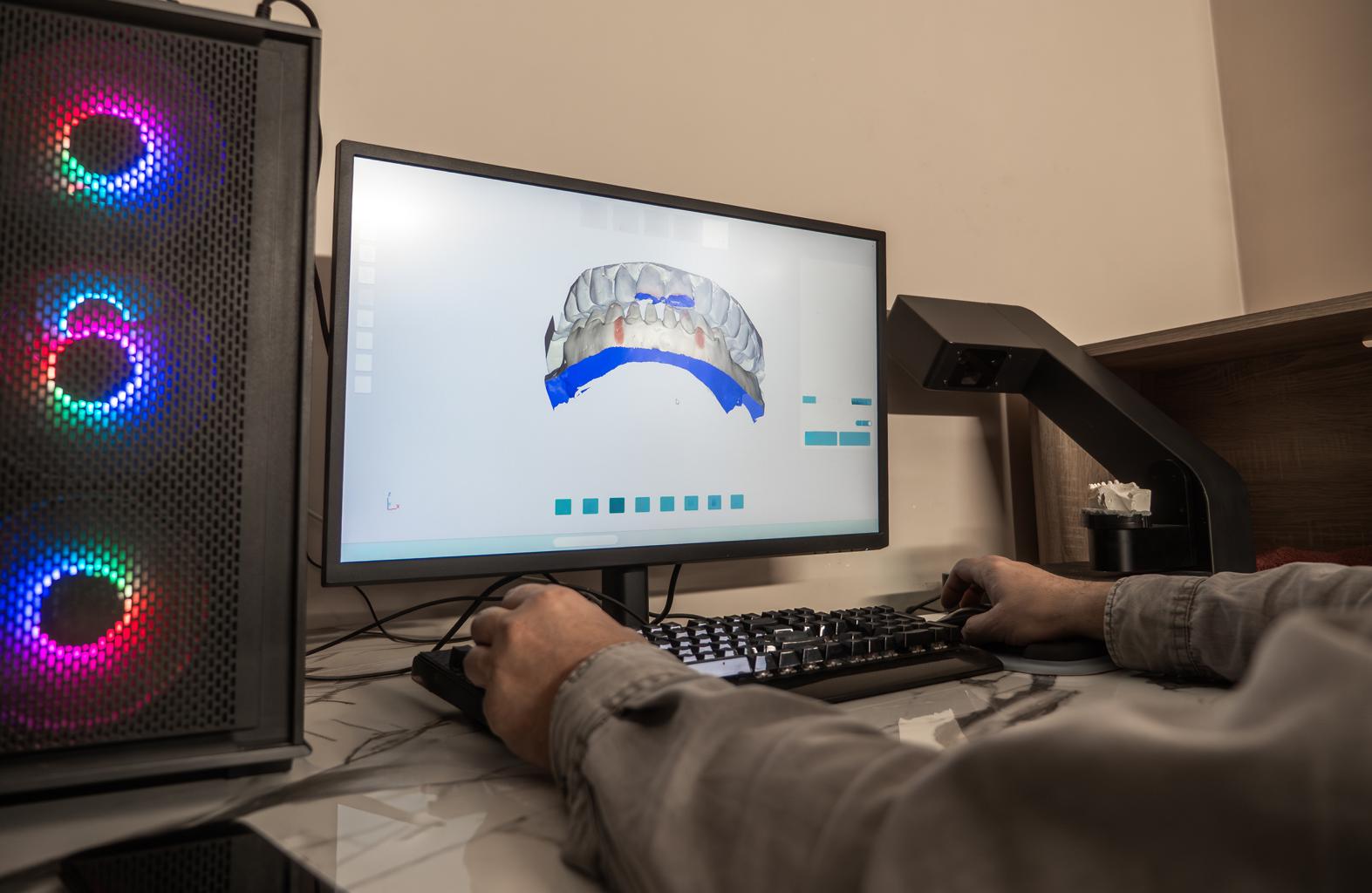
In a digital restorative environment, speed is only useful when it supports accuracy. For dental labs and clinics, outsourcing CAD Design is not simply a staffing decision. It is a workflow decision that affects case intake, communication, design consistency, manufacturing predictability, and remake risk. When the design stage becomes a bottleneck, everything behind it slows down: milling, printing, fitting, delivery, and chairside scheduling.
For this reason, CAD Design outsourcing has become a practical extension of the modern lab and clinic workflow. It allows technical teams to move cases forward without overloading internal designers, while still maintaining control over restoration parameters, software compatibility, and production outcomes. In a well-managed system, outsourced design does not sit outside the workflow. It becomes part of it.
Why CAD design is often the true workflow bottleneck
Most delays in digital dentistry do not begin at milling or finishing. They begin earlier, when a case arrives with incomplete scans, unclear prescriptions, inconsistent occlusal expectations, or missing manufacturing instructions. A restoration cannot be designed properly if the digital inputs are weak. Even highly experienced teams lose time when they must pause for clarification, request additional files, or redesign after reviewing the production pathway.
This is where outsourced CAD Design can improve workflow efficiency for both labs and clinics. A dedicated design team can review incoming files immediately, identify missing information, confirm the correct software pathway, and push valid cases forward without waiting for internal design capacity to open up. In practice, the design partner becomes an active checkpoint between data intake and fabrication.
A mature outsourcing workflow does not treat every case equally. Straightforward units can move quickly, while larger rehabilitations, implant cases, or full-arch restorations receive more structured review. That distinction matters, because faster workflow does not come from rushing all cases. It comes from assigning the right level of technical attention to the right case type.
Faster workflows begin with cleaner case submission
Outsourcing only improves speed when the incoming case is organized well. Poor submissions create friction no matter who handles the design. For crown and bridge work, the design team typically needs a clear preparation scan, antagonist scan, and bite scan to proceed efficiently. For more complex full-arch work, additional patient information such as gender and frontal image may also be required, depending on the restorative objective and design expectations. The workflow also benefits from clear instructions on parameters, thickness, special notes, and the intended software version, such as Exocad or 3Shape. These requirements are consistent with standard outsourced design intake processes described in the provided service information.
VCAD_BANG GIA NK DOLY
That intake discipline matters for a simple reason: incomplete information stops production before it starts. According to the workflow information provided, cases are first reviewed through quality control, and only cases with complete information proceed immediately. If information can be supplied quickly, the case may continue the same day; if not, it is deferred. That is not administrative rigidity. It is a technical safeguard against poor design assumptions and downstream manufacturing errors.
VCAD_BANG GIA NK DOLY
From one angle, this may seem like outsourcing adds another step. From another angle, it removes hidden delays by forcing case readiness earlier. The second view is usually the more accurate one. Internal teams often absorb bad submissions informally, which creates rework later. Outsourced CAD Design makes those problems visible at intake, where they are cheaper to solve.
Where outsourced CAD design creates measurable operational value
The strongest workflow benefit of outsourced CAD Design is not just labor relief. It is operational continuity. When internal design teams are overloaded, even technically simple cases may wait in queue. That creates an artificial delay unrelated to clinical complexity. An external design team can absorb overflow, maintain case movement across time zones, and reduce idle time between scan receipt and manufacturing release.
The service information provided indicates a typical design turnaround of about 8 hours for design items under seven units, and roughly 10 to 12 hours for more complex cases once complete information is confirmed. In urgent situations, accelerated turnaround may also be possible. These timelines show why outsourcing is attractive for labs and clinics that need design throughput without expanding permanent internal staffing.
VCAD_BANG GIA NK DOLY
There are two practical interpretations of this. The optimistic view is that outsourcing creates a near-continuous design pipeline, helping labs keep mills and printers active. The more cautious view is that turnaround targets only matter when prescription quality and scan quality are high. Both are true. A fast design partner improves workflow only when the submission process is disciplined enough to support that speed.
CAD design outsourcing is not only for large labs
A common assumption is that outsourced CAD Design mainly serves high-volume production centers. That is only partly true. Large labs certainly benefit from overflow support, but smaller labs and clinics may gain even more from technical flexibility. A smaller operation may not have a full-time designer for every restoration category, implant library, or software environment. Outsourcing allows access to wider technical coverage without building every capability in-house.
For clinics, the benefit is slightly different. Clinics that operate chairside scanning and depend on external manufacturing often need more than file transfer. They need structured review of margin clarity, occlusal feasibility, emergence profile design, and restorative manufacturability. In that setting, outsourced CAD Design is not replacing the clinician’s judgment. It is translating clinical data into a production-ready design file that can be manufactured with fewer revisions.
This is where a lab-driven workflow matters. A design partner with manufacturing awareness works differently from a purely software-focused designer. The question is not only whether the anatomy looks acceptable on screen. The question is whether the file will mill cleanly, print consistently, seat as intended, and reduce friction at adjustment.
Manufacturing consistency depends on design discipline
There is a persistent misconception that design is a separate digital phase, independent from the physical result. In reality, design decisions directly shape manufacturing stability. Connector dimensions, cement space, occlusal anatomy, insertion path, wall thickness, contact intensity, and margin interpretation all influence whether a restoration moves smoothly into fabrication and delivery.
That is why outsourced CAD Design works best when the design team understands production limitations, not just software tools. A crown designed with idealized anatomy but poor material awareness can create weak areas or unnecessary finishing time. An implant restoration designed without attention to screw channel position, emergence contour, or restorative clearance may force redesign before production. A removable case designed without respecting insertion logic or tissue adaptation can waste time at the try-in stage.
From a workflow perspective, consistent design is more valuable than flashy design. Labs and clinics need files that behave predictably in manufacturing. A stable workflow depends on repeatable decisions across many cases, not on artistic variation between designers.
Software compatibility is a workflow issue, not just an IT issue
Many labs underestimate how much time is lost through poor software coordination. File compatibility, import behavior, version mismatch, and incomplete export settings can slow down the design cycle before technical design even begins. The provided service information notes compatibility with common formats such as STL and PLY, along with support for other file types and version-specific workflows, including Exocad and 3Shape environments.
VCAD_BANG GIA NK DOLY
This matters because CAD Design outsourcing is only efficient when the partner can enter the workflow without conversion friction. Every unnecessary file correction, platform mismatch, or unclear library reference adds delay. For clinics and labs, this means the real outsourcing question is not “Can they design the case?” but “Can they design the case inside the digital conditions we already use?”
There are two operational models here. One model prioritizes broad compatibility to accept many file types. The other prioritizes standardized intake rules to reduce variability. The best workflows usually combine both: flexible import capability supported by strict submission requirements.
Case communication is part of design speed
Speed without communication is a trap. Many remakes and late adjustments happen because case instructions were interpreted rather than confirmed. In outsourced CAD Design, communication must be specific enough to avoid assumption-based design. That includes restoration type, material pathway, anatomical expectations, occlusal scheme, margin priorities, contact preference, and any clinical limitations that may affect the result.
A strong design workflow should also make prioritization visible. The service document indicates that larger or urgent case groups should be identified clearly so processing order aligns with the desired timeline.
VCAD_BANG GIA NK DOLY
That sounds simple, but it solves a common production problem: not every urgent case is truly urgent, and not every complex case can be treated like a single-unit posterior crown.
In other words, faster workflows come from better triage. When communication is structured, the design partner can allocate effort properly. When communication is vague, even a fast team burns time chasing certainty.
Quality control is what turns speed into reliability
The most important point in outsourced CAD Design is this: faster does not mean skipping review. It means moving from intake to validated design with fewer interruptions. The provided workflow information states that cases are quality-checked first and only processed once the required information is complete.
VCAD_BANG GIA NK DOLY
That kind of QC discipline is essential because design speed without validation simply relocates errors downstream.
For labs and clinics, QC at the design stage should focus on several practical questions. Are the margins readable? Is the bite usable? Are the scan relationships stable? Are restorative parameters compatible with the intended material and manufacturing pathway? Is the case missing instructions that could change the design outcome? These are not administrative details. They determine whether the restoration proceeds cleanly or returns later as a problem case.
A mature outsourced workflow therefore reduces not only turnaround time but also correction loops. That is the real efficiency gain. The strange little gremlin in many digital workflows is not lack of speed. It is repeated interruption.
What labs and clinics should expect from a CAD design partner
A useful outsourcing relationship should produce more than design files. It should provide a stable extension of the lab workflow. That means clear intake rules, software compatibility, technically grounded communication, defined turnaround expectations, and design decisions that respect manufacturing reality.
The service information provided describes a design-centered process with secure file exchange, QC before processing, format flexibility, and defined turnaround windows for standard and complex cases, alongside broader production support for fabricated restorations with longer in-lab timelines depending on case complexity.
VCAD_BANG GIA NK DOLY
Those are the kinds of operational details that matter more than generic claims about digital excellence.
For labs and clinics evaluating outsourced CAD Design, the practical standard is simple. The partner should help cases move faster because the workflow becomes cleaner, not because corners are cut. If the outsourcing process increases clarity at intake, maintains consistency in design decisions, supports common software ecosystems, and reduces avoidable back-and-forth, then it is serving its purpose.
Conclusion
Outsourced CAD Design is no longer just a backup option for overloaded teams. In many digital workflows, it is a strategic production layer that improves throughput, protects consistency, and helps labs and clinics manage technical volume without sacrificing control. The real value is not speed alone. The value is structured speed: complete case intake, precise file handling, disciplined communication, and design output that supports predictable manufacturing.
For labs and clinics working in a high-demand digital environment, faster workflows are built at the design stage. When CAD Design is handled with technical discipline, the rest of the workflow becomes easier to scale, easier to coordinate, and far more reliable. That is where outsourcing becomes useful—not as a shortcut, but as a controlled extension of professional dental production.