


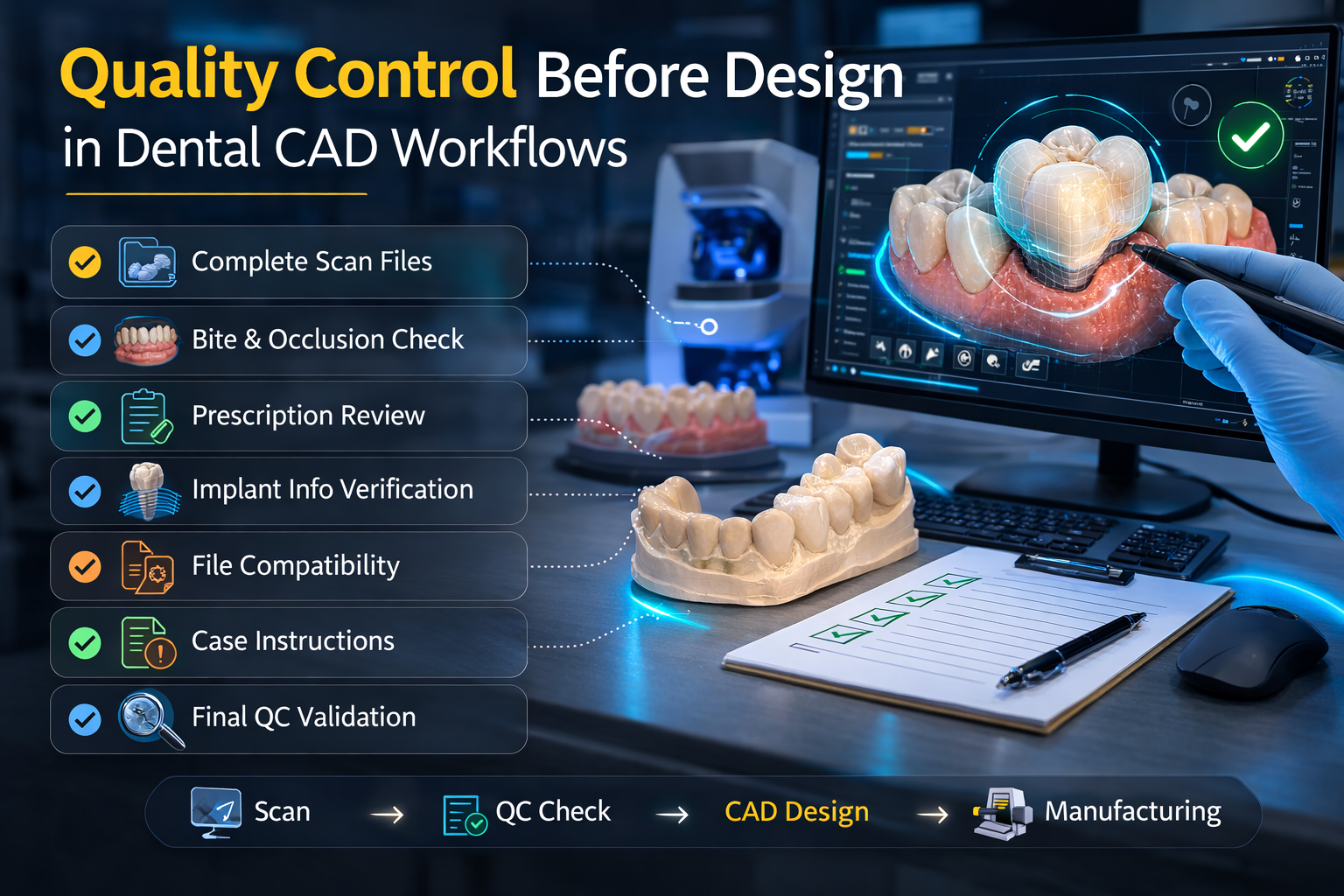
In digital dentistry, design speed often gets more attention than intake discipline. Yet in a professional production environment, the stability of a case is usually determined before the first restoration contour is drawn. This is where Quality Control becomes essential. In dental CAD workflows, pre-design quality control is not an optional checkpoint added for caution. It is a technical stage that determines whether the submitted case is ready for design, whether the digital inputs are trustworthy, and whether the workflow can move forward without avoidable correction.
For dental labs, dental clinics, prosthodontists, and oral surgeons, the practical value of pre-design Quality Control is straightforward. It reduces design interruption, protects manufacturing consistency, improves communication accuracy, and lowers the risk of remakes caused by weak case input. A design team can only work as predictably as the case information allows. If scan quality is poor, if instructions are incomplete, or if implant details are unclear, design becomes a guessing exercise instead of a controlled technical process.
That is why quality-focused CAD workflows begin with validation, not with modeling. The objective is not to delay the case. The objective is to prevent unstable cases from moving deeper into the workflow where errors become more expensive to fix.
Design problems often start before design begins
A common misconception in digital production is that design errors are mostly created during the design stage itself. In reality, many design problems originate earlier. They begin when a case is submitted with incomplete scans, unstable bite records, unclear restoration instructions, or incompatible digital files. By the time these issues become visible in the design stage, the workflow has already lost efficiency.
This is exactly why pre-design Quality Control matters. It allows the lab to evaluate whether the case is complete enough to support accurate CAD work before time is invested in designing contacts, occlusion, anatomy, or interfaces. If the case is weak at the input level, even a highly experienced designer will be working under unnecessary uncertainty.
From one angle, it may seem faster to begin designing immediately and solve problems along the way. From another, more operationally honest angle, that approach usually creates rework. A case that passes through design with unresolved intake problems often returns later through clarification, revision, or manufacturing interruption. In a real lab workflow, those loops cost more than an early intake review.
Pre-design quality control protects the workflow from false speed
Fast turnaround only has value when the case moves forward correctly. A design returned quickly is not truly efficient if it later needs revision because the bite was unreliable, the prep margin was unreadable, or the restoration type was not clearly stated. This is where pre-design Quality Control plays a surprisingly important role in speed. It slows the wrong kind of movement so the right kind of movement can happen later.
There are two ways to think about workflow speed. One focuses on how early the case enters design. The other focuses on how smoothly the case moves from submission to production with minimal interruption. The second is the more meaningful measure. A lab that designs weak cases immediately may appear fast at first, but often loses time in redesign, clarification, and downstream correction.
Pre-design review filters out this false speed. It checks whether the case should proceed now, whether it needs clarification, or whether it requires stronger file support before design begins. That discipline helps the workflow behave more predictably, especially in outsourcing environments where the design team cannot casually fill in missing details by walking across the room and asking a colleague.
Scan quality is the first foundation of reliable CAD work
The most basic function of pre-design Quality Control is to verify whether the scan data is suitable for design. This includes evaluating the preparation scan, antagonist scan, bite scan, and any additional records relevant to the case type. The goal is not merely to confirm that files were uploaded. The goal is to confirm that the files support technical interpretation.
For fixed restorative work, that means readable margins, clear preparation boundaries, reliable occlusal relationships, and enough adjacent anatomy to evaluate contacts and emergence. For implant cases, it means adequate scan body capture, stable soft tissue representation where relevant, and compatibility with the intended digital pathway. For removable prosthetics, guides, or appliances, the QC standard must reflect the specific design logic of those cases.
This is an important distinction. File presence is not the same as file usability. A scan can exist and still be poor enough to disrupt design. In many labs, delayed cases are not caused by missing files at all. They are caused by files that technically arrived but did not provide enough clarity to support accurate CAD work. That is precisely the kind of issue pre-design Quality Control is meant to catch.
Prescription clarity matters as much as scan accuracy
A technically strong scan still does not create a stable workflow if the prescription is vague. Before design begins, the lab needs to know what is being requested. A crown, bridge, veneer, coping, screw-retained implant crown, custom abutment, surgical guide, or night guard each follows a different design logic. If the restoration type is unclear, the design team may stop the case or proceed on assumption. Neither option is ideal.
This is why pre-design Quality Control should verify prescription completeness alongside scan quality. The lab should confirm the restoration category, units involved, relevant material direction when known, and any special instructions that materially affect design. Implant cases require even tighter control because implant system identification, retention pathway, and component references may determine whether the design is valid at all.
From a practical standpoint, this prescription review reduces one of the most common sources of avoidable delay: interpretive back-and-forth after the case has already entered production. A case with clear digital files but unclear restorative intent is not actually ready. It is simply waiting to become a problem later.
File compatibility review prevents invisible workflow loss
In digital dentistry, many inefficiencies are not dramatic enough to look like obvious errors. They appear as small interruptions: a case imports incorrectly, a bite relationship does not align, a linked file is missing, or an implant case arrives without the information needed for library validation. These issues often begin at intake, which makes them ideal targets for pre-design Quality Control.
A strong QC process checks whether the file package is complete and compatible with the intended CAD environment. That may include STL, PLY, XML, DICOM-related files, or platform-linked digital records depending on the case type. The point is not to treat compatibility as an IT problem. It is to determine whether the case can enter design without manual reconstruction or unsafe interpretation.
This matters especially in outsourced CAD workflows. When a case is transferred from one lab or clinic to another, small compatibility issues can quietly consume time before the first technical design step even begins. Pre-design review helps surface those problems early so they can be resolved before they distort turnaround expectations.
Implant cases show why early quality control is not optional
If any category proves the value of pre-design Quality Control, it is implant work. Implant restorations are less forgiving than routine fixed cases because the design depends on more than surface geometry. The workflow may require scan body accuracy, implant system confirmation, correct library selection, restorative pathway clarity, and a stable understanding of emergence, access, and component relationships.
Without intake QC, implant cases can move into design with hidden structural weakness. A designer may begin building the restoration before realizing that the implant reference is incomplete or that the digital records do not support the intended component pathway. By that point, the workflow is already spending effort on unstable ground.
This is why implant QC before design should be specific, not generic. The lab should verify that the implant information is not only present, but usable and consistent with the requested restoration type. In implant CAD workflows, small intake mistakes do not stay small. They tend to travel downstream and become much more expensive.
Pre-design quality control improves communication, not just accuracy
Many people think of Quality Control as purely technical, but in dental CAD workflows it also improves communication. A structured intake review forces the case information to become clearer before active design starts. Missing details are identified earlier. Questions are asked earlier. Expectations are aligned earlier. This reduces the number of vague mid-process conversations that often slow digital workflows.
For outsourced labs, this is particularly valuable. Clear intake QC provides a common language between the sending team and the receiving design team. Instead of discovering problems during design review or production release, both sides address them at the point where correction is fastest and least disruptive.
There are two communication styles in dental workflows. One waits for problems to surface naturally and then reacts. The other uses pre-design Quality Control to expose likely issues before they cause technical delay. The second style is usually quieter, less dramatic, and much more efficient.
Manufacturing consistency depends on what is approved before design
A common mistake is to think of pre-design QC as something only relevant to designers. In reality, it directly affects manufacturing consistency. If the case enters CAD with weak information, the resulting design may include compromises that later create difficulty in milling, printing, finishing, or seating. A crown designed on a questionable bite may require occlusal correction. A bridge designed from unclear instructions may need anatomical revision. An implant restoration built on incomplete references may fail much later, after more time and cost have been invested.
Pre-design Quality Control helps prevent this by asking an early question that protects the entire workflow: is the case ready to become a production file? That question matters because once a case is designed and released, it starts accumulating technical commitment. Manufacturing resources, technician attention, and turnaround planning all begin to align around that design.
If the intake was weak, the rest of the workflow becomes fragile. If the intake was strong, the case has a better chance of moving predictably from design to fabrication. In that sense, quality control before design is not just about reviewing the case. It is about protecting the integrity of everything that follows.
Pre-design review helps labs reduce remake risk without overpromising
In any production system, remake reduction is a major quality objective. But remake risk is rarely controlled by one final inspection step alone. It is managed through multiple upstream decisions, and one of the most influential is whether the case was validated before design. Weak inputs create weak outputs. That principle is brutally simple and annoyingly true.
Pre-design Quality Control reduces remake risk by blocking cases that depend too heavily on assumption. It does not eliminate all errors, and no honest lab should pretend otherwise. But it does reduce the likelihood that a preventable intake issue becomes a costly downstream failure.
From one perspective, this is caution. From another, it is production maturity. Mature CAD workflows do not wait for a case to fail before questioning whether it was ready. They ask that question early, while correction is still relatively cheap and straightforward.
What a practical pre-design quality control process should include
A strong pre-design QC stage should be structured enough to be repeatable, but flexible enough to reflect different case types. At a practical level, that means reviewing scan completeness, scan readability, occlusal reliability, prescription clarity, case identification, file compatibility, and any category-specific information such as implant system details or guide-planning requirements.
For routine cases, the review may be fast because the workflow is standardized. For complex cases, it may require deeper evaluation before design begins. The objective is not to make every case slower. The objective is to make every case more technically honest at entry.
This is also where labs can gain operational leverage. When QC is performed consistently before design, internal capacity is used more effectively. Designers spend less time chasing missing information. Manufacturing teams receive more stable files. Communication becomes more specific. Turnaround becomes easier to predict because the intake stage has already filtered much of the hidden instability out of the system.
Why quality-focused labs review first and design second
Labs that prioritize reliability understand a simple but powerful truth: design amplifies whatever it is given. If the input is clear, design becomes a strong technical tool. If the input is weak, design can become a polished version of uncertainty. That is why pre-design Quality Control is so important in modern CAD workflows. It determines whether the design stage will operate as controlled engineering or as educated guesswork.
For dental professionals sending cases to an external lab, this is also a trust issue. A lab that reviews before it designs is showing that it values predictability over appearance of speed. That approach may feel stricter at intake, but it often produces a smoother workflow overall because problems are surfaced before they multiply.
Conclusion
Pre-design Quality Control matters in dental CAD workflows because it determines whether the case entering design is complete, usable, and technically stable enough to support predictable production. It protects the workflow from false speed, reduces communication noise, improves file reliability, supports manufacturing consistency, and lowers the risk of avoidable redesign or remake.
For dental labs, clinics, prosthodontists, and oral surgeons, the practical lesson is clear. Quality in digital dentistry does not begin when the restoration is finished, and it does not even begin when design starts. It begins earlier, when the case is reviewed critically enough to decide whether design should start at all.
That is what strong quality systems do. They do not just inspect outcomes. They protect the workflow before the outcome is created.