


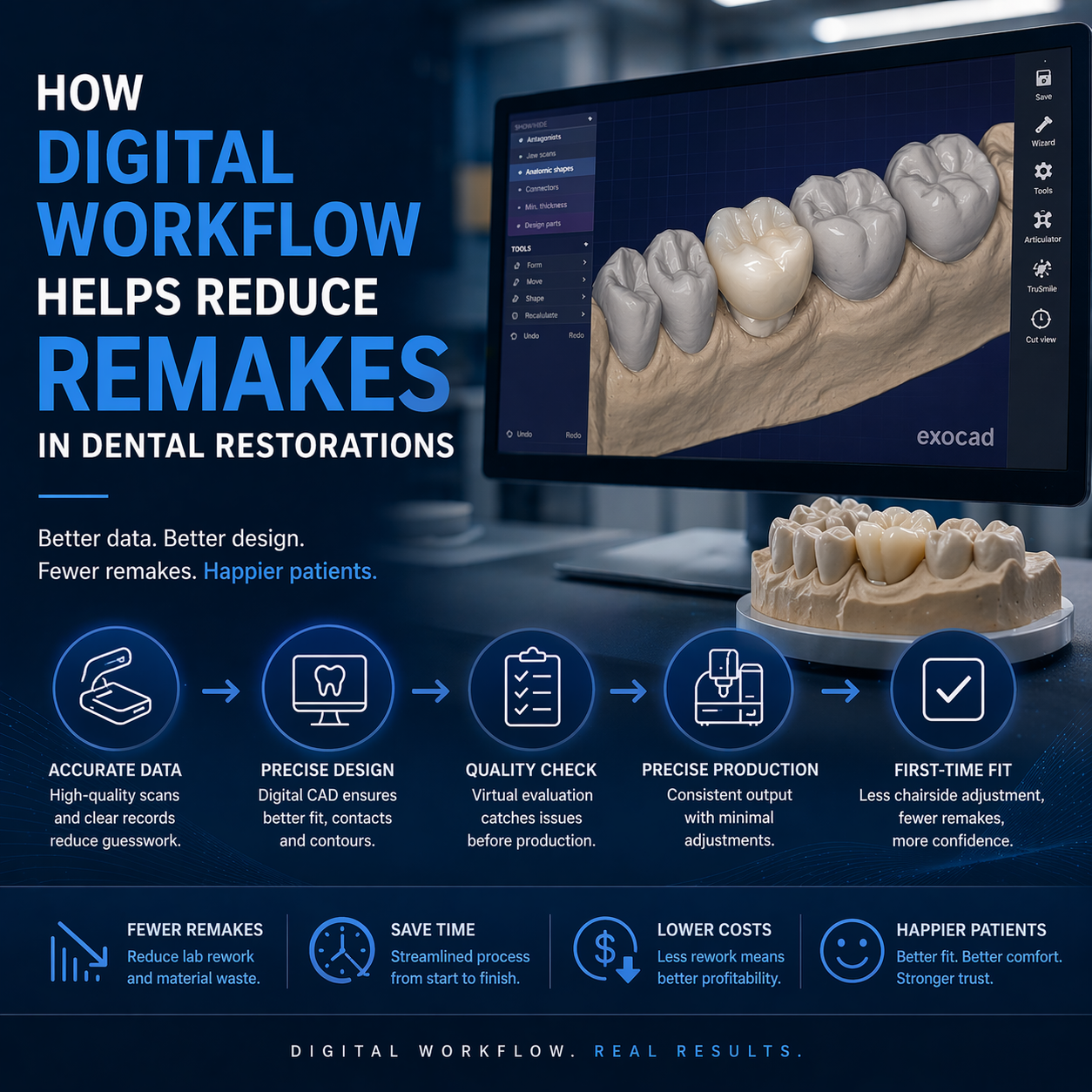
Remakes are one of the most persistent inefficiencies in dental laboratory workflows. They consume design time, material resources, production capacity, and coordination effort between clinic and lab. While individual remake cases may appear isolated, they are typically symptoms of systemic issues within the workflow.
To reduce dental remakes, the focus must shift from correcting errors after they occur to structuring processes that prevent those errors from entering the system. Digital workflows provide the framework for this shift by enabling control over data quality, design consistency, communication, and production alignment.
This article analyzes the root causes of remakes and explains how a structured digital workflow reduces error rates across the entire restoration process.
Understanding Remakes as a System-Level Outcome
Remakes are often attributed to specific issues such as poor fit or occlusal discrepancies. However, these are surface-level manifestations of deeper workflow problems.
Common observable causes include:
- Open or inaccurate margins
- Improper occlusion
- Inconsistent internal fit
- Aesthetic mismatches
From a laboratory perspective, these issues rarely originate at a single stage. Instead, they result from misalignment between stages—intake, design, and production.
A digital workflow does not eliminate complexity, but it allows these stages to be structured and controlled, which is essential to reduce dental remakes.
Where Remakes Typically Originate in the Workflow
To understand how digital workflows reduce remakes, it is necessary to identify where errors are introduced.
Intake-Related Errors
- Incomplete scan data (missing antagonist or bite)
- Poor margin visibility
- Incorrect or unclear prescription
These issues limit the accuracy of CAD design from the outset.
Design-Related Errors
- Incorrect margin placement
- Improper occlusal contact distribution
- Inconsistent parameter application
These errors often stem from unclear input or lack of standardized design protocols.
Production-Related Errors
- Material mismatch with design parameters
- Inaccurate reproduction due to misaligned settings
- Assembly inconsistencies in multi-component restorations
Even with accurate design, production misalignment can lead to remakes.
Digital Workflow as a Structured Control System
The primary advantage of a digital workflow is its ability to introduce control points at each stage.
Instead of relying on individual corrections, the workflow is structured to:
- Validate input data before design
- Standardize design execution
- Align design with manufacturing constraints
- Apply quality control at multiple stages
This systematic approach reduces variability and supports efforts to reduce dental remakes.
Intake Validation: Preventing Errors Before Design Begins
The most effective way to reduce remakes is to prevent flawed cases from entering the design stage.
Role of Intake Quality Control
A structured intake process verifies:
- Completeness of scan data
- Clarity of margin definition
- Accuracy of bite registration
- Consistency of prescription details
Cases that do not meet these criteria are paused until corrected.
Impact on Remake Reduction
By enforcing intake QC:
- Design errors caused by incomplete data are minimized
- Cases proceed with a stable foundation
- Downstream corrections are reduced
This is one of the most direct ways to reduce dental remakes at a system level.
Standardized CAD Design: Reducing Variability
Digital workflows enable the use of consistent design protocols across cases.
Key Elements of Standardization
- Defined margin handling procedures
- Controlled occlusal contact settings
- Consistent thickness and spacing parameters
Effect on Design Accuracy
When design is standardized:
- Variability between cases decreases
- Outcomes become more predictable
- Adjustments and remakes are reduced
Without standardization, design quality depends heavily on individual interpretation, increasing the likelihood of error.
Margin and Occlusion Control in Digital Design
Two of the most common causes of remakes—margin inaccuracies and occlusal discrepancies—are directly influenced by digital design control.
Margin Control
- Clear digital margins allow precise boundary definition
- Consistent margin placement improves seating and adaptation
Occlusal Control
- Digital articulation enables controlled contact design
- Contact intensity and distribution can be standardized
By controlling these variables within the CAD environment, digital workflows reduce the need for post-production adjustments.
Alignment Between Design and Manufacturing
A critical factor in remake reduction is how well design translates into production.
Design for Manufacturability
Digital workflows ensure that:
- Material constraints are considered during design
- Minimum thickness and connector dimensions are respected
- Production tolerances are integrated into CAD parameters
Impact on Remakes
When design and manufacturing are aligned:
- Restorations are produced as intended
- Fit and function are consistent
- Remake rates decrease
Misalignment between design and production is a common cause of remakes in less structured workflows.
Multi-Level Quality Control in Digital Systems
Digital workflows incorporate quality control at multiple stages rather than relying on final inspection.
Intake-Level QC
- Validates input data
- Prevents flawed cases from entering the system
Design-Level QC
- Reviews margin integrity and occlusion
- Ensures adherence to design protocols
Production-Level QC
- Verifies physical output against design
- Identifies discrepancies before delivery
This layered approach reduces cumulative error and supports efforts to reduce dental remakes.
Communication as a Remake Prevention Tool
Many remakes are caused not by technical limitations but by miscommunication.
Role of Structured Communication
- Clear case instructions reduce ambiguity
- Defined parameters guide design decisions
- Feedback loops improve submission quality over time
When communication is structured:
- Fewer assumptions are made during design
- Errors are identified earlier
- Workflow interruptions are minimized
Continuous Improvement Through Feedback
Digital workflows allow for:
- Documentation of recurring issues
- Identification of error patterns
- Refinement of submission and design protocols
This iterative process contributes to long-term reduction in remakes.
Turnaround Time and Its Relationship to Remakes
Turnaround time and remake rates are closely linked.
Speed vs Stability
- Rapid processing without validation increases error risk
- Controlled workflows may take longer initially but reduce rework
Hidden Time Costs of Remakes
Remakes introduce:
- Additional design cycles
- Reproduction and material usage
- Extended delivery timelines
Reducing remakes improves overall efficiency, even if individual steps are more controlled.
Managing Variability Across Cases
Digital workflows do not eliminate variability but provide tools to manage it.
Sources of Variability
- Differences in scan quality
- Case complexity
- Clinical technique
System-Level Management
- Standardized intake criteria
- Consistent design protocols
- Structured communication
By controlling how variability is handled, workflows become more stable and predictable.
From Reactive Correction to Preventive Systems
Traditional workflows often rely on correcting errors after they occur.
Reactive Approach
- Identify issues during try-in
- Adjust or remake restorations
- Repeat cycle for similar cases
Preventive Digital Approach
- Validate input before design
- Standardize design execution
- Align production with design
This shift from reactive to preventive systems is essential to reduce dental remakes effectively.
Limitations of Digital Workflows
While digital workflows improve control, they depend on:
- Quality of input data
- Consistency of process implementation
- Effective communication between clinic and lab
Without these elements, digital systems cannot achieve their full potential.
Conclusion: Reducing Remakes Through Workflow Design
To reduce dental remakes, the focus must move beyond individual corrections to system-level improvements. Digital workflows provide the structure needed to control input quality, standardize design, align production, and integrate quality control across all stages.
By addressing the root causes of errors—rather than their symptoms—laboratories and clinics can achieve more predictable outcomes, improved efficiency, and reduced operational disruption.
In modern dental workflows, remake reduction is not a result of isolated improvements. It is the outcome of a structured system designed to prevent errors before they occur.