


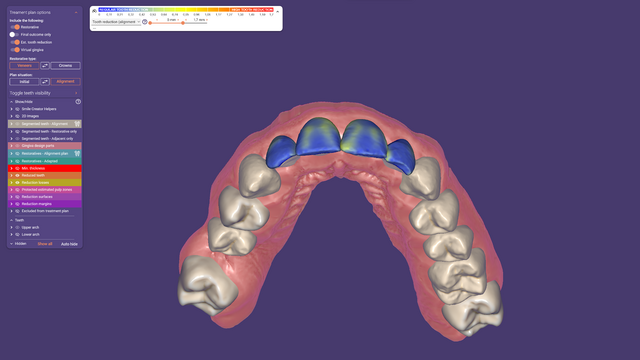
Chairside adjustment is one of the most common friction points in crown and bridge workflows. Whether it presents as tight contacts, high occlusion, incomplete seating, or marginal discrepancies, the need for adjustment is rarely random. From a laboratory perspective, dental crown adjustment problems are typically the visible outcome of upstream inconsistencies across intake, design, and production.
In digital workflows, restorations are fabricated with high geometric precision. When adjustments are required, it is not because the system lacks accuracy, but because the input, parameters, or process alignment introduced variability before fabrication. Understanding these root causes is essential to reducing adjustment frequency and improving overall workflow efficiency.
This article analyzes the underlying reasons why dental cases require adjustment and outlines how structured workflows prevent these issues.
Adjustment as a Symptom, Not a Root Cause
Chairside adjustment is often treated as a final-stage correction. In reality, it is a downstream symptom of earlier decisions or missing information.
Common adjustment scenarios include:
- Crowns that do not fully seat
- High occlusal contacts
- Tight or open proximal contacts
- Marginal discrepancies
Each of these issues originates from a specific stage in the workflow. Addressing them effectively requires identifying where the deviation occurred rather than focusing solely on the final outcome.
To reduce dental crown adjustment problems, the workflow must be analyzed as a system.
Where Adjustment Issues Originate in the Workflow
Intake-Related Causes
At intake, incomplete or unclear data introduces uncertainty into the design process:
- Missing or unstable bite registration
- Incomplete margin capture
- Lack of antagonist data
- Ambiguous prescription parameters
When these variables are not validated, designers must compensate, increasing the likelihood of adjustment later.
Design-Related Causes
During CAD design, variability arises from:
- Inaccurate margin placement
- Improper occlusal contact settings
- Inconsistent internal spacing
- Misinterpretation of clinical intent
Even small deviations at this stage can result in significant chairside adjustments.
Production-Related Causes
Although less common in structured workflows, production can contribute through:
- Material-specific distortions
- Tolerance misalignment
- Assembly inconsistencies in multi-component restorations
However, most adjustment issues originate before production begins.
Incomplete Seating: A Margin and Internal Fit Issue
One of the most frequent dental crown adjustment problems is incomplete seating.
Root Causes
- Unclear or distorted margin definition
- Inconsistent cement space settings
- Internal contact points caused by scan artifacts
When margins are not clearly defined, the CAD system cannot establish a precise boundary. This leads to uneven internal adaptation.
Workflow Impact
- Time spent identifying internal interference
- Repeated seating attempts
- Potential need for remakes if margins are compromised
Prevention Through Workflow Control
- Intake validation of margin clarity
- Consistent internal spacing parameters in CAD
- Design-level quality control before production
High Occlusion: A Bite Registration and Design Control Issue
High occlusal contacts are another common adjustment scenario.
Root Causes
- Inaccurate bite registration
- Misalignment of upper and lower scans
- Overcompensation during occlusal design
In digital workflows, occlusion is entirely dependent on input data. If the bite relationship is unstable, occlusal design becomes an estimation.
Workflow Impact
- Chairside occlusal reduction
- Increased clinical time
- Potential impact on restoration longevity
Prevention Strategies
- Verification of bite scan stability at intake
- Controlled occlusal contact settings in CAD
- Simulation of articulation during design
By stabilizing input data and standardizing design parameters, occlusal discrepancies can be minimized.
Proximal Contact Issues: Tight or Open Contacts
Proximal contacts must balance retention and ease of seating. Deviations in either direction lead to adjustment.
Root Causes
- Inaccurate adjacent tooth geometry in scan data
- Inconsistent contact strength settings
- Lack of standardization in contact design
Workflow Impact
- Adjustment of contact points chairside
- Risk of compromising contact integrity
- Additional clinical time
Prevention Through Standardization
- Consistent contact parameter settings
- Verification of scan accuracy for adjacent teeth
- Design-level QC for contact distribution
Structured workflows reduce variability in contact design across cases.
Margin Discrepancies and Their Consequences
Marginal accuracy directly affects both fit and long-term stability.
Root Causes
- Poor margin visibility in scan data
- Inconsistent margin placement during design
- Overextension or underextension of margins
Workflow Impact
- Chairside margin adjustment
- Increased risk of remake
- Compromised restoration performance
Prevention
- Strict intake QC for margin clarity
- Standardized margin marking protocols
- Design validation before production
Margin accuracy is one of the most critical factors in reducing dental crown adjustment problems.
The Role of File Quality in Adjustment Reduction
Digital workflows rely on scan data as the foundation for all design decisions.
Effects of Poor File Quality
- Distorted geometry
- Missing data points
- Inaccurate occlusal relationships
These issues force designers to make assumptions, increasing variability.
Workflow Control
- Validation of file completeness at intake
- Rejection or correction of low-quality scans
- Standardization of acceptable file formats
High-quality input reduces the need for downstream correction.
Design Parameter Consistency and Its Impact
Variability in design parameters is a major contributor to adjustment issues.
Common Inconsistencies
- Variation in cement space settings
- Differences in occlusal contact intensity
- Inconsistent thickness control
Impact on Workflow
- Unpredictable fit across cases
- Increased adjustment rates
- Reduced efficiency
Standardization as a Solution
- Defined parameter sets for different restoration types
- Consistent application across all cases
- Regular QC checks to ensure compliance
Consistency in design is essential to reducing variability.
Communication Gaps as a Hidden Cause of Adjustments
Many adjustment issues originate from unclear communication between clinic and lab.
Common Communication Issues
- Missing instructions for occlusal preferences
- Lack of clarity on margin location
- Incomplete case information
Workflow Impact
- Designers rely on default assumptions
- Increased variability in outcomes
- Higher likelihood of adjustment
Prevention Through Structured Communication
- Standardized case submission forms
- Clear documentation of requirements
- Feedback loops for improving communication
Effective communication reduces ambiguity and supports accurate design.
Quality Control as a Preventive System
Quality control is often applied after production. In structured workflows, it is integrated throughout the process.
Multi-Level QC Approach
- Intake QC: Validates input data
- Design QC: Reviews digital output
- Pre-production QC: Ensures manufacturability
Impact on Adjustment Reduction
- Early detection of potential issues
- Prevention of errors entering production
- Improved consistency across cases
This layered approach is critical for minimizing dental crown adjustment problems.
Balancing Speed and Accuracy
In high-volume environments, there is often pressure to prioritize speed.
Speed-Driven Workflow
- Faster processing with minimal validation
- Higher risk of adjustment
- Increased rework
Accuracy-Driven Workflow
- Controlled intake and design processes
- Reduced need for chairside correction
- More predictable outcomes
From a workflow perspective, prioritizing accuracy reduces total time spent on adjustments and corrections.
From Adjustment to Prevention: A Workflow Shift
Reducing adjustments requires a shift in how workflows are structured.
Reactive Approach
- Adjust issues at the clinical stage
- Accept variability as unavoidable
- Focus on correcting errors
Preventive Approach
- Validate input data before design
- Standardize design execution
- Align production with design parameters
This shift transforms adjustment from a routine requirement into an exception.
Conclusion: Adjustment Reflects Workflow Quality
Dental crown adjustment problems are not isolated issues. They are indicators of how well the workflow is controlled from intake through production.
By addressing root causes—input quality, design consistency, communication clarity, and quality control—laboratories and clinics can significantly reduce the need for chairside adjustments.
In digital workflows, the goal is not to eliminate adjustment entirely, but to minimize it through structured processes that ensure consistency and predictability across all cases.