


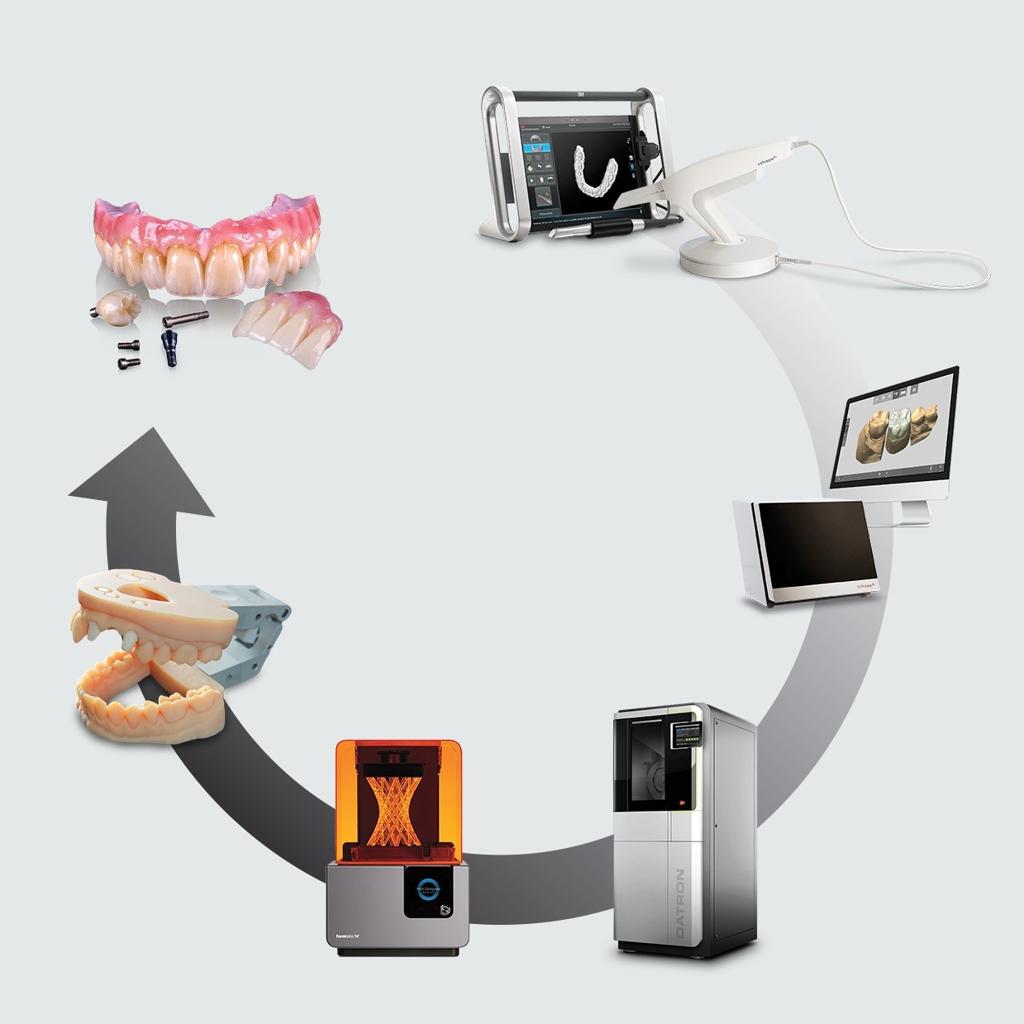
In digital dental laboratories, productivity is not defined solely by how many cases are completed per day. It is determined by how consistently cases move through the workflow without interruption, rework, or bottlenecks. As case volume increases and restoration types become more complex, CAD design often becomes the limiting stage within the production chain.
Dental CAD design outsourcing has emerged as a workflow strategy to address this constraint. Rather than expanding internal capacity linearly, outsourcing redistributes design workload, stabilizes processing flow, and allows laboratories to scale throughput without proportionally increasing internal resources.
This article analyzes how outsourcing CAD design improves operational efficiency, focusing on workflow continuity, capacity management, and system-level productivity.
CAD Design as the Primary Bottleneck in Digital Workflows
In a typical digital workflow, CAD design sits between intake and manufacturing. While scanning and production technologies can operate at high speed, design requires:
- Interpretation of case data
- Application of clinical parameters
- Adjustment for material and manufacturing constraints
As case volume grows, internal design teams often reach capacity limits. This leads to:
- Queue accumulation
- Delays in case initiation
- Increased variability in turnaround time
From a workflow perspective, design becomes the bottleneck that restricts throughput.
Redistributing Design Load to Stabilize Workflow Flow
The primary operational benefit of dental CAD design outsourcing is workload redistribution.
Separation of Fixed and Variable Capacity
Internal design teams represent fixed capacity. Outsourcing introduces variable capacity that can expand or contract based on demand.
- In-house team: Handles core cases, complex adjustments, and communication-intensive work
- Outsourced team: Absorbs overflow and standardized cases
This separation prevents internal teams from being overloaded during peak periods.
Continuous Case Flow
By offloading excess volume, cases can move through the workflow without waiting for internal availability. This reduces idle time between intake and design initiation.
Improving Case Throughput Without Expanding Internal Resources
Increasing throughput traditionally requires hiring additional designers. However, this approach has limitations:
- Recruitment and training time
- Increased management complexity
- Fixed costs regardless of demand fluctuations
Outsourcing as a Scalable Alternative
With outsourcing:
- Additional design capacity can be accessed immediately
- Case volume can increase without internal expansion
- Throughput scales in response to demand
This enables laboratories to handle higher volumes while maintaining operational stability.
Reducing Design Queue Congestion
Queue management is a critical factor in workflow efficiency.
Internal Queue Limitations
When all cases are processed internally:
- Cases accumulate during peak submission periods
- Designers must prioritize tasks dynamically
- Workflow becomes fragmented due to interruptions
Outsourced Queue Distribution
Outsourcing distributes cases across a broader processing capacity:
- Fewer cases remain in internal queues
- Designers work on prioritized or complex cases
- Workflow becomes more structured and predictable
This directly improves dental CAD design outsourcing efficiency by reducing congestion at the design stage.
Enhancing Turnaround Predictability
Turnaround time is often influenced by variability rather than absolute speed.
Sources of Variability
- Fluctuating case volume
- Differences in case complexity
- Interruptions due to incomplete data
Structured Processing in Outsourced Workflows
Outsourced design environments typically:
- Begin processing only after intake validation
- Allocate time based on case complexity
- Maintain consistent processing windows
For example, design timelines may be defined within specific ranges depending on case size and requirements.
This structured approach reduces variability and improves predictability.
Allowing Internal Teams to Focus on High-Value Tasks
When design workload is partially outsourced, internal teams can shift their focus.
From Volume Processing to Workflow Control
Internal designers can prioritize:
- Complex or high-risk cases
- Quality control and verification
- Communication with clinicians
This improves overall workflow quality and reduces the likelihood of errors.
Impact on Productivity
By reducing time spent on repetitive or high-volume tasks, internal teams operate more efficiently, contributing to higher overall productivity.
Standardization and Its Effect on Output Consistency
Consistency is a key factor in productivity. Variability increases adjustment rates and reduces throughput.
Role of Outsourced Standardization
Outsourced workflows often rely on:
- Defined design protocols
- Consistent parameter application
- Structured quality control processes
This reduces variability across cases.
Impact on Throughput
Consistent design output leads to:
- Fewer adjustments
- Reduced remake rates
- Faster progression to production
These factors collectively improve case throughput.
Minimizing Workflow Interruptions Through Intake Discipline
Interruptions are a major source of inefficiency in design workflows.
Internal Workflow Interruptions
When cases enter design without validation:
- Designers must pause to request clarification
- Cases are reworked mid-process
- Productivity decreases due to task switching
Outsourced Intake Control
Outsourced workflows typically enforce intake validation:
- Cases are reviewed for completeness before design
- Incomplete cases are paused
- Designers work only on validated cases
This reduces interruptions and supports continuous workflow execution.
Supporting Multi-Format File Handling at Scale
Modern workflows involve multiple file formats and scanner systems.
Internal Challenges
- Limited compatibility with certain file types
- Need for manual conversion
- Increased processing time
Outsourced Flexibility
Outsourced partners often support:
- Multiple file formats (STL, PLY, XML, DCM, etc.)
- Standardized conversion processes
- Integrated handling of diverse data inputs
This reduces delays caused by file compatibility issues and improves workflow efficiency.
Managing Case Prioritization More Effectively
Not all cases have the same urgency or complexity.
Internal Prioritization Challenges
- Designers must balance multiple priorities
- Urgent cases may disrupt standard workflows
- Scheduling becomes reactive
Outsourced Prioritization Support
Outsourcing allows:
- Segmentation of cases based on priority
- Allocation of urgent cases to available capacity
- Maintenance of standard workflows for non-urgent cases
This improves overall case management and reduces disruption.
Improving Production Alignment Through Consistent Design Output
Production efficiency depends on the consistency of design output.
Effects of Inconsistent Design
- Adjustments during manufacturing
- Increased rejection rates
- Delays in production scheduling
Benefits of Outsourced Consistency
When design output is standardized:
- Production processes remain stable
- Material usage is optimized
- Throughput increases due to fewer disruptions
This alignment between design and production is a key benefit of dental CAD design outsourcing.
Reducing Remakes and Their Impact on Throughput
Remakes are one of the most significant constraints on productivity.
Impact of Remakes
- Additional design cycles
- Reproduction and material usage
- Delayed delivery timelines
Outsourcing Contribution
By enforcing:
- Intake validation
- Standardized design protocols
- Multi-level quality control
outsourced workflows reduce the likelihood of remakes.
This directly improves throughput by eliminating rework cycles.
Operational Flexibility in High-Volume Environments
Laboratories often experience fluctuations in case volume.
Internal Limitations
- Fixed capacity cannot adapt quickly
- Peak periods create bottlenecks
- Low-volume periods result in underutilization
Outsourced Flexibility
Outsourcing allows:
- Dynamic adjustment of design capacity
- Efficient handling of peak demand
- Balanced workload distribution
This flexibility supports consistent productivity across varying conditions.
Balancing Control and Efficiency
A common concern with outsourcing is the perceived loss of control.
Maintaining Workflow Control
Effective outsourcing does not eliminate control; it redistributes it:
- Intake and communication remain structured
- Design protocols are clearly defined
- Quality control is integrated across stages
Efficiency Gains
By delegating volume processing, laboratories can focus on workflow management rather than task execution.
When Outsourcing Delivers the Most Value
The impact of dental CAD design outsourcing is most evident in:
- High-volume production environments
- Laboratories with limited internal design capacity
- Workflows requiring consistent turnaround
- Operations handling diverse case types
In these scenarios, outsourcing functions as a stabilizing layer within the workflow.
Conclusion: Productivity as a Function of Workflow Design
Productivity and case throughput in dental laboratories are determined by how effectively workflows are structured, not by individual task speed.
Dental CAD design outsourcing improves productivity by:
- Redistributing workload
- Reducing bottlenecks
- Standardizing design output
- Supporting scalable operations
By integrating outsourcing into the workflow, laboratories can maintain continuous case flow, improve consistency, and increase throughput without compromising control.
In digital dental production, efficiency is achieved not by accelerating isolated steps, but by ensuring that the entire system operates without interruption.