


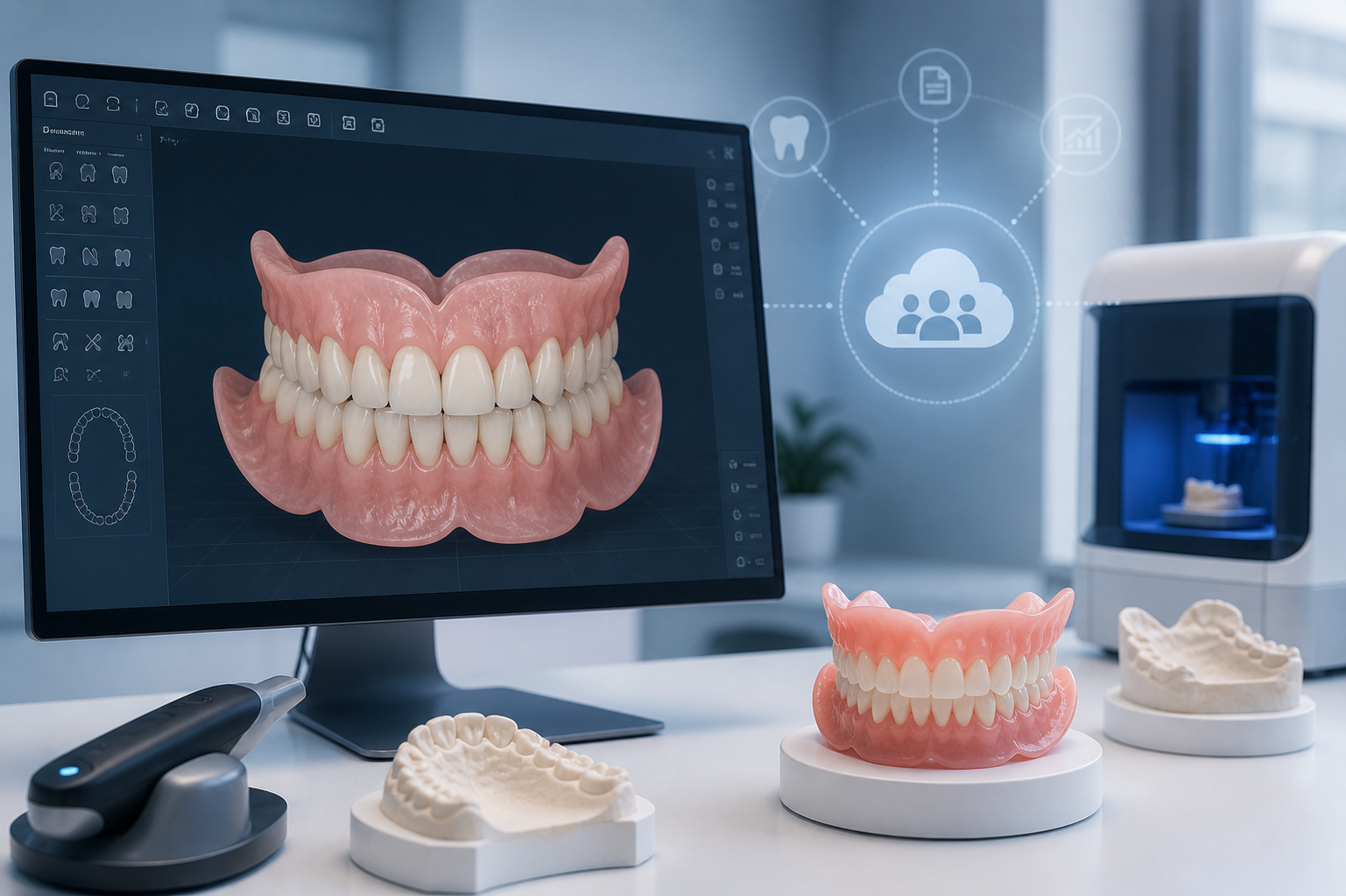
Removable denture cases present a different set of challenges compared to fixed restorations. While crown and bridge workflows rely heavily on margin precision and occlusal control, removable prosthetics require coordinated management of anatomy, support areas, occlusion, retention, and base adaptation across a larger and more variable surface.
As digital workflows expand into removable prosthetics, removable denture outsourcing has become a practical approach for managing design complexity and stabilizing production. However, the effectiveness of outsourcing depends on how well the workflow is structured—from intake and design to manufacturing alignment and case control.
This article examines the removable denture workflow from a laboratory perspective and explains how outsourcing contributes to accuracy, consistency, and operational efficiency.
Why Removable Denture Workflows Require Structured Design Control
Unlike single-unit restorations, removable dentures involve:
- Large-area tissue interaction
- Complex occlusal relationships across full arches
- Dependence on anatomical landmarks rather than fixed margins
- Variability in edentulous ridge morphology
These factors make removable denture design less deterministic and more sensitive to input quality and design decisions.
In this context, removable denture outsourcing is not simply about delegating design tasks. It is about introducing structure into a workflow that inherently contains more variability.
Intake Requirements: Establishing the Foundation for Accurate Design
The success of any removable denture case begins at intake.
Key Data Requirements
For digital denture workflows, intake typically requires:
- Upper and lower arch scans
- Bite registration or articulation data
- Functional or anatomical references (where available)
- Clear prescription for denture type and design approach
Unlike crown and bridge cases, there is no defined margin line. Instead, the design depends on how well anatomical surfaces are captured.
Intake Validation in Outsourced Workflows
In removable denture outsourcing, intake is structured to ensure:
- Completeness of scan data
- Adequate coverage of edentulous areas
- Stability of bite registration
- Clarity of design instructions
Cases that lack sufficient information are paused until clarified.
Impact on Workflow
- Reduces ambiguity during design
- Prevents iterative corrections
- Supports predictable case progression
Digital Denture Design: Translating Anatomy into Functional Geometry
The design stage in removable denture workflows involves more than geometric modeling. It requires balancing multiple functional parameters.
Base Adaptation
The denture base must:
- Conform accurately to tissue surfaces
- Maintain stability during function
- Avoid pressure points
This depends heavily on scan quality and mesh integrity.
Tooth Setup and Occlusion
Tooth arrangement must consider:
- Occlusal balance
- Arch form
- Functional articulation
In digital workflows, occlusion is defined through bite data and virtual articulation, which must be accurate to avoid adjustment.
Retention and Support
Design must incorporate:
- Appropriate extension of the base
- Balanced distribution of support areas
- Stability during insertion and removal
Design Control in Outsourcing
In structured removable denture outsourcing workflows:
- Design protocols are standardized
- Parameters for base thickness, tooth positioning, and occlusion are defined
- Output is aligned with manufacturing constraints
This reduces variability across cases.
Managing Variability in Edentulous Anatomy
One of the primary challenges in removable denture design is anatomical variability.
Sources of Variability
- Differences in ridge resorption
- Irregular tissue contours
- Variations in arch relationships
Impact on Design
Without structured control:
- Base adaptation may be inconsistent
- Occlusal relationships may be unstable
- Retention may vary between cases
Outsourcing Approach
Outsourced workflows manage variability through:
- Standardized design frameworks
- Consistent parameter application
- Defined handling of anatomical deviations
This ensures that variability is controlled rather than amplified.
Workflow Transition: From Design to Manufacturing
The transition from design to production is critical in removable denture workflows.
Design-Manufacturing Alignment
Design must account for:
- Material properties (e.g., acrylic, resin)
- Manufacturing method (milling or printing)
- Shrinkage or distortion during processing
Risks of Misalignment
- Poor base fit
- Occlusal discrepancies
- Increased need for adjustment
Integrated Workflow in Outsourcing
In removable denture outsourcing:
- Design parameters are aligned with production methods
- Output is optimized for fabrication
- Consistency is maintained across cases
This reduces errors introduced during manufacturing.
Quality Control Across the Denture Workflow
Quality control in removable denture workflows must address multiple variables.
Intake-Level QC
- Verification of scan completeness
- Assessment of anatomical coverage
- Validation of bite data
Design-Level QC
- Review of base adaptation
- Verification of tooth setup and occlusion
- Consistency with prescribed parameters
Pre-Production QC
- Simulation of fit and articulation
- Validation of manufacturability
This multi-stage QC approach reduces cumulative error and improves overall accuracy.
Case Communication and Its Role in Denture Design
Communication is particularly important in removable denture cases due to the subjective nature of certain design elements.
Required Communication Elements
- Denture type (complete, partial, flexible, etc.)
- Occlusal scheme preferences
- Aesthetic considerations (if applicable)
- Functional requirements
Impact on Workflow
When communication is unclear:
- Designers must rely on default assumptions
- Variability increases
- Adjustment rates rise
Structured Communication in Outsourcing
Outsourced workflows typically define:
- Standard submission formats
- Required case parameters
- Feedback mechanisms for clarification
This reduces ambiguity and supports consistent design outcomes.
Turnaround Time and Case Stability
Turnaround time in removable denture workflows is influenced by:
- Case complexity
- Completeness of input data
- Design and production alignment
Structured Turnaround in Outsourcing
Outsourced workflows:
- Begin processing after intake validation
- Allocate time based on case requirements
- Maintain consistent processing windows
Workflow Impact
- Predictable timelines
- Reduced delays due to rework
- Improved coordination with clinical schedules
Reducing Adjustment and Remake Rates
Adjustment and remakes in removable dentures often result from:
- Poor base adaptation
- Occlusal imbalance
- Inconsistent retention
Role of Outsourcing in Reduction
By enforcing:
- Intake validation
- Standardized design protocols
- Integrated QC processes
outsourcing reduces the frequency of these issues.
Impact on Workflow
- Fewer rework cycles
- Improved production efficiency
- More predictable outcomes
Case Control in High-Volume Denture Workflows
As case volume increases, maintaining control becomes more challenging.
Internal Limitations
- Fixed design capacity
- Increased variability under load
- Difficulty maintaining consistency
Outsourced Workflow Control
Outsourcing provides:
- Scalable design capacity
- Standardized processing
- Consistent output across cases
This improves case control and supports stable production.
When Removable Denture Outsourcing Delivers the Most Value
Removable denture outsourcing is particularly effective in:
- High-volume denture production environments
- Laboratories with limited internal design capacity
- Workflows requiring consistent turnaround
- Operations handling diverse case inputs
In these scenarios, outsourcing stabilizes the workflow and reduces variability.
Limitations and Implementation Considerations
While outsourcing improves workflow stability, it depends on:
- Quality of input data
- Clarity of communication
- Consistency of process implementation
Without these elements, variability cannot be fully controlled.
Conclusion: Structuring Removable Denture Workflows for Consistency
Removable denture design involves a high degree of variability, making workflow structure essential for achieving consistent results.
Removable denture outsourcing improves accuracy and efficiency by:
- Standardizing intake and design processes
- Aligning design with manufacturing
- Integrating quality control across stages
By treating outsourcing as a structured workflow component rather than a standalone service, laboratories can maintain control over complex denture cases while improving productivity and predictability.