


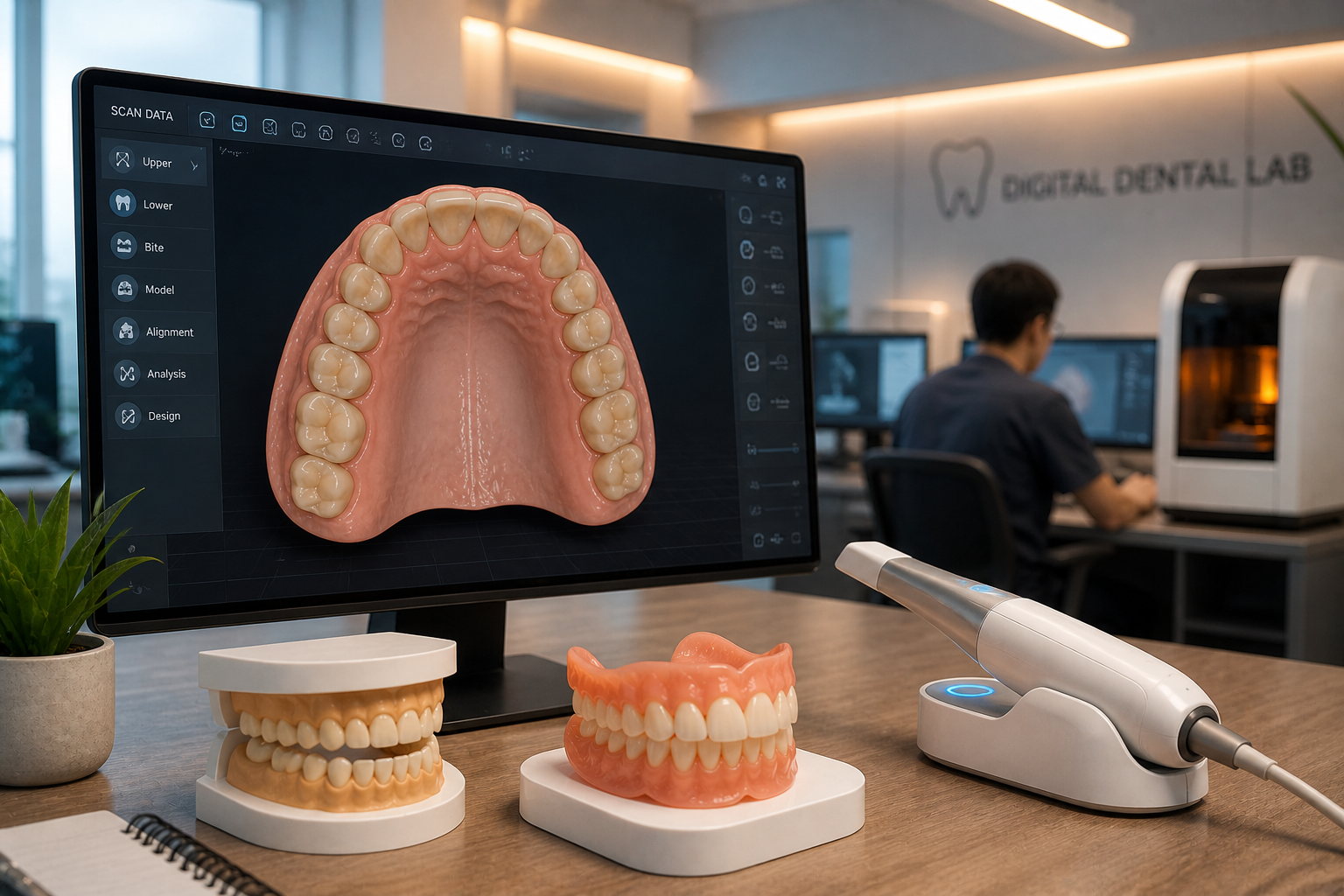
First-time fit is one of the most reliable indicators of a stable digital workflow. When a restoration seats without adjustment, it reflects alignment across multiple stages—scan quality, case communication, CAD design, and manufacturing. Among these variables, dental crown margin definition is one of the most critical and most frequently underestimated factors.
Article content
ToggleFrom a laboratory perspective, margin definition is not just a design step. It is the point at which the boundary between preparation and restoration is established. Every downstream decision—internal fit, emergence profile, occlusal alignment, and manufacturability—depends on how accurately that boundary is defined.
This article examines the role of margin definition in achieving first-time fit restorations, focusing on how margin clarity, interpretation, and workflow control influence final outcomes.
Margin Definition as the Reference for All Design Parameters
In CAD-based workflows, the margin line defines the interface between the restoration and the prepared tooth. Unlike traditional workflows, where technicians may rely on physical cues, digital design depends entirely on how this boundary is identified within scan data.
Once the margin is set, it becomes the reference for:
- Internal spacing (cement gap)
- Restoration thickness
- Emergence profile
- Edge adaptation
If the margin is inaccurate, all dependent parameters are affected.
This is why dental crown margin definition is not an isolated step—it is the structural foundation of the entire design.
The Relationship Between Margin Accuracy and First-Time Fit
First-time fit requires precise seating of the restoration without interference. Margin definition plays a direct role in this outcome.
When Margin Definition Is Accurate
- Internal fit aligns with preparation geometry
- Seating is consistent and complete
- Marginal adaptation is stable
When Margin Definition Is Inaccurate
- Internal surfaces may contact prematurely
- Seating is incomplete or uneven
- Margins may be open or overextended
These issues lead to chairside adjustment or, in some cases, remakes.
From a workflow perspective, accurate dental crown margin definition reduces variability and supports predictable fit.
How Scan Quality Influences Margin Visibility
Margin definition begins with scan data. If the margin is not clearly captured, it cannot be accurately defined.
Common Scan-Related Challenges
- Subgingival margins that are not fully visible
- Blurred or noisy scan surfaces
- Incomplete capture of preparation edges
Impact on CAD Design
When margin visibility is compromised:
- Designers must estimate the margin location
- Variability increases between cases
- Consistency in fit is reduced
Workflow Implication
Even advanced CAD systems cannot compensate for missing or unclear margin data. The accuracy of dental crown margin definition is directly dependent on scan clarity.
Margin Interpretation: From Data to Design Decision
Margin definition is not purely automatic. It involves interpretation by the designer.
Factors Affecting Interpretation
- Scan resolution and clarity
- Presence of artifacts or distortions
- Consistency of preparation geometry
Risks of Inconsistent Interpretation
- Variation in margin placement between cases
- Differences in restoration extension
- Increased adjustment at delivery
Standardization in Design
Structured workflows address this by:
- Defining protocols for margin marking
- Applying consistent interpretation criteria
- Using design-level quality control to verify margins
This reduces variability and improves reliability.
Internal Fit and the Margin Reference
Internal fit is calculated relative to the defined margin.
Role of Margin in Internal Spacing
- Cement gap is applied from the margin inward
- Any deviation in margin placement affects the entire internal surface
Consequences of Margin Errors
- Overextended margins may create open edges
- Underextended margins may result in tight internal fit
- Uneven margin definition leads to inconsistent seating
Workflow Impact
Accurate dental crown margin definition ensures that internal spacing is applied correctly, supporting stable seating and reducing adjustment.
Margin Definition and Manufacturing Accuracy
The relationship between margin definition and manufacturing is often overlooked.
Design-to-Production Translation
Manufacturing processes reproduce the CAD design precisely. This means:
- Margin errors in design are replicated in the final restoration
- Production cannot correct design inaccuracies
Material Considerations
Different materials have specific requirements:
- Minimum thickness at margins
- Edge strength and durability
- Compatibility with milling or printing processes
Integrated Workflow Requirement
Margin definition must account for these factors to ensure that the restoration can be produced accurately.
Quality Control at the Margin Level
Given its importance, margin definition is a key focus of quality control.
Intake-Level QC
- Verification of margin visibility in scan data
- Identification of areas requiring clarification
Design-Level QC
- Review of margin continuity and accuracy
- Confirmation of alignment with preparation geometry
Pre-Production QC
- Validation that margin definition supports manufacturability
This multi-level QC approach reduces errors before they reach production.
Communication and Margin Clarity
Margin definition is influenced not only by scan data but also by communication between clinic and lab.
Common Communication Gaps
- Lack of clarity on margin location
- Missing instructions for challenging cases
- No indication of preparation limitations
Impact on Workflow
- Designers rely on assumptions
- Variability increases
- Adjustment rates rise
Structured Communication
Workflows that define:
- Clear submission requirements
- Documentation of case details
- Feedback loops for improving input quality
help ensure that margin definition is accurate and consistent.
Margin Definition in High-Volume Workflows
In high-volume environments, small variations in margin definition can scale into significant inefficiencies.
Effects of Variability
- Increased adjustment rates across multiple cases
- Reduced predictability in turnaround time
- Higher remake rates
Importance of Standardization
By standardizing dental crown margin definition:
- Consistency is maintained across cases
- Workflow becomes more stable
- Production efficiency improves
Managing Subgingival and Complex Margins
Certain cases present additional challenges for margin definition.
Subgingival Margins
- Limited visibility in scans
- Higher risk of incomplete capture
Irregular Preparations
- Non-uniform geometry
- Increased difficulty in defining a continuous margin
Workflow Approach
These cases require:
- Enhanced intake validation
- Clear communication of limitations
- Careful design interpretation
Structured workflows ensure that these challenges are managed consistently.
Margin Errors and Their Downstream Effects
Margin inaccuracies affect multiple aspects of the restoration.
Immediate Effects
- Poor marginal adaptation
- Incomplete seating
Secondary Effects
- Occlusal discrepancies due to seating issues
- Increased chairside adjustment
Long-Term Effects
- Reduced restoration longevity
- Increased likelihood of remake
These cascading effects highlight the importance of precise dental crown margin definition.
From Adjustment to First-Time Fit: A Workflow Perspective
Achieving first-time fit requires alignment across all workflow stages.
Key Requirements
- Clear margin capture at scan stage
- Accurate and consistent margin definition in CAD
- Alignment with manufacturing constraints
- Integrated quality control
Workflow Outcome
When these elements are controlled:
- Restorations seat without adjustment
- Clinical time is reduced
- Workflow efficiency improves
Limitations and Practical Considerations
Despite structured workflows, certain limitations remain:
- Dependence on scan quality
- Variability in clinical preparation
- Challenges in capturing subgingival margins
These factors must be managed through consistent processes rather than eliminated entirely.
Conclusion: Margin Definition as a Determinant of Fit
Dental crown margin definition is a central factor in achieving first-time fit restorations. It defines the boundary for all design parameters and directly influences seating, adaptation, and overall restoration accuracy.
By controlling margin definition through clear scan data, standardized design protocols, and structured quality control, laboratories and clinics can reduce variability, minimize adjustments, and improve workflow efficiency.
In digital dental workflows, first-time fit is not the result of isolated precision. It is the outcome of a system where margin definition is treated as a critical control point from the beginning of the process.