


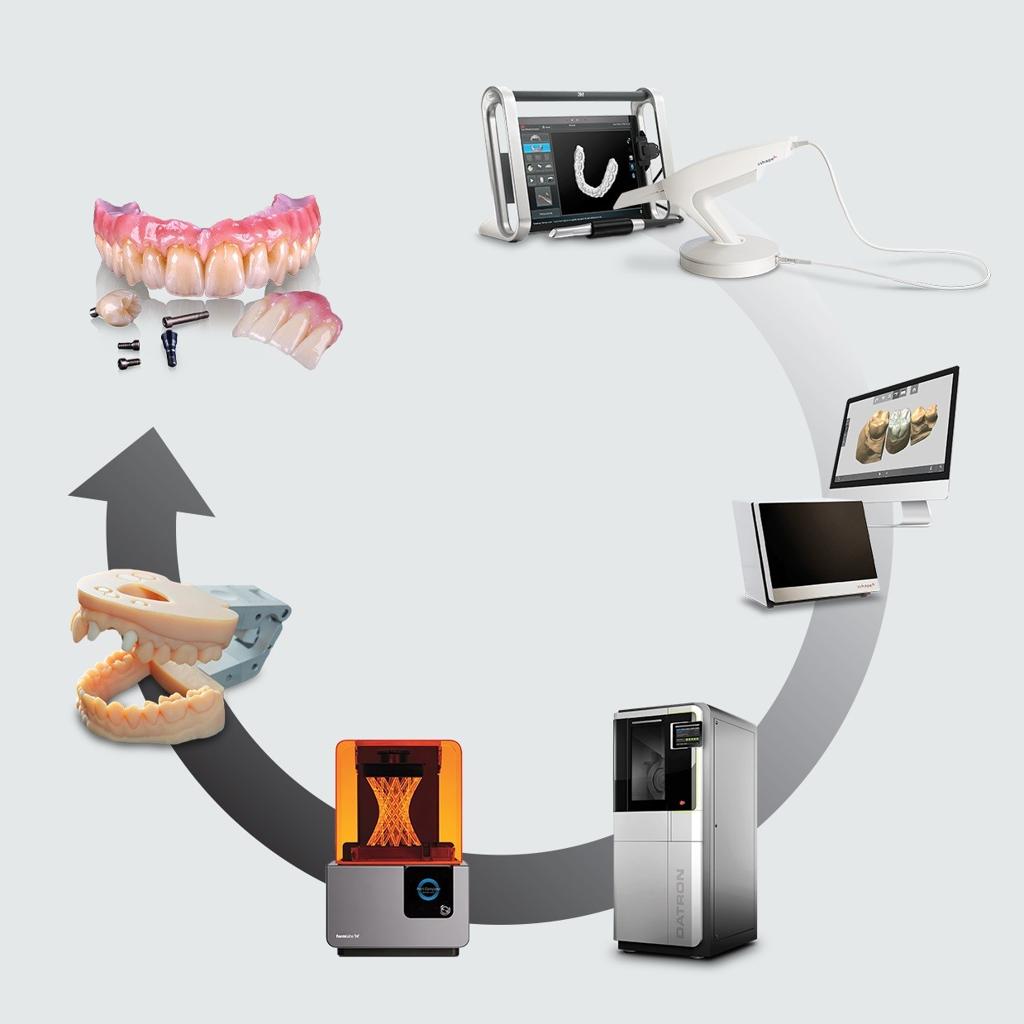
Material selection in digital dentistry is not a downstream decision. It directly shapes how restorations are designed, how parameters are applied in CAD, and how consistently results can be produced. Among the most widely used materials, zirconia and lithium disilicate (commonly referred to as e.max) require fundamentally different design approaches.
From a laboratory perspective, zirconia vs emax CAD design is not simply a comparison of strength and aesthetics. It is a workflow consideration that affects margin handling, thickness control, occlusion, and manufacturing alignment.
This article examines how CAD design strategies differ between zirconia and e.max and how these differences influence restoration accuracy, efficiency, and predictability.
Material Behavior as a Design Constraint
In CAD workflows, design is not created in isolation. It is constrained by the physical properties of the selected material.
Zirconia Characteristics
- High flexural strength
- Resistance to fracture under load
- Lower translucency compared to glass ceramics
- Requires sintering after milling, with shrinkage compensation
E.max Characteristics
- Lower flexural strength compared to zirconia
- Higher translucency and aesthetic potential
- Brittle under tensile stress
- Minimal shrinkage compared to zirconia
These material properties define the boundaries within which CAD design must operate. In zirconia vs emax CAD design, ignoring these constraints leads to inconsistent outcomes.
Margin Design: Strength vs Precision
Margin design is one of the first areas where material differences become evident.
Zirconia Margin Considerations
- Can support slightly thicker margins due to strength
- More tolerant of minor variations in margin geometry
- Often designed with durability in mind
E.max Margin Considerations
- Requires precise, clean margin definition
- Sensitive to thin or unsupported edges
- Greater emphasis on marginal integrity for aesthetics and longevity
Workflow Implication
In zirconia design, margin durability is prioritized. In e.max design, margin precision becomes critical. This difference affects how margins are interpreted and finalized in CAD.
Thickness Requirements and Structural Design
Material strength directly influences thickness parameters.
Zirconia Design Approach
- Allows thinner restorations due to high strength
- Suitable for posterior regions with higher occlusal load
- Connector design in bridges can be more conservative
E.max Design Approach
- Requires greater thickness for strength
- Limited tolerance for thin sections
- Connector dimensions must be carefully controlled
Impact on CAD Workflow
Design parameters must be adjusted based on material:
- Minimum thickness settings differ
- Internal spacing may be modified
- Occlusal morphology must account for material limits
Inconsistent application of these parameters leads to structural failure or adjustment issues.
Occlusal Design: Load Distribution vs Aesthetic Form
Occlusal design is influenced by both functional and material considerations.
Zirconia Occlusion
- Designed to withstand higher occlusal forces
- Contact points may be slightly more robust
- Focus on durability under load
E.max Occlusion
- Requires controlled contact distribution
- Excessive force concentration increases fracture risk
- Greater emphasis on balanced occlusion
Workflow Consideration
In zirconia vs emax CAD design, occlusal parameters must be adapted:
- Zirconia tolerates broader contact zones
- E.max requires more precise contact control
Failure to adjust these parameters increases the likelihood of adjustment or fracture.
Internal Fit and Cement Space Strategies
Internal fit is another area where material-specific design decisions are critical.
Zirconia Internal Fit
- Slightly more forgiving due to strength
- Can tolerate minor variations in cement space
- Designed to maintain retention under load
E.max Internal Fit
- Requires precise adaptation
- Sensitive to uneven internal spacing
- Over-tight fit increases risk of fracture during seating
CAD Parameter Differences
- Cement gap settings may differ between materials
- Internal relief must be applied consistently
- Margin transition must be smooth and accurate
These differences directly affect seating and fit.
Design for Manufacturing: Shrinkage and Processing Behavior
Material behavior during manufacturing must be incorporated into CAD design.
Zirconia Processing
- Milled in pre-sintered state
- Undergoes shrinkage during sintering
- Requires scaling factors in CAD
E.max Processing
- Typically milled or pressed with minimal shrinkage
- More predictable dimensional stability
- Less need for compensation in design
Workflow Impact
In zirconia workflows:
- CAD systems must apply accurate shrinkage compensation
- Any error in scaling affects final fit
In e.max workflows:
- Design must focus more on structural integrity than dimensional compensation
This distinction is central to zirconia vs emax CAD design.
Surface Morphology and Aesthetic Design
Material choice influences how surface anatomy is designed.
Zirconia Morphology
- Often designed with simplified anatomy for strength
- Surface detail may be adjusted during finishing
- Aesthetic layering may be applied post-production
E.max Morphology
- Allows for more detailed anatomical design
- Surface texture and translucency are integral to final result
- CAD design must account for aesthetic outcome
Workflow Consideration
Design complexity may increase for e.max cases, particularly in anterior restorations.
Sensitivity to Input Data Quality
Both materials are affected by scan quality, but in different ways.
Zirconia Tolerance
- More forgiving of minor scan inconsistencies
- Strength compensates for slight design deviations
E.max Sensitivity
- Highly dependent on precise scan data
- Margin clarity and geometry must be accurate
- Small errors have greater impact on outcome
Workflow Implication
High intraoral scan quality dental CAD standards are particularly critical for e.max cases.
Quality Control Adjustments Based on Material
Quality control processes must account for material differences.
Zirconia QC Focus
- Verification of structural integrity
- Confirmation of thickness and connector design
- Validation of shrinkage compensation
E.max QC Focus
- Margin accuracy and continuity
- Occlusal contact precision
- Surface morphology and adaptation
Multi-Level QC Integration
- Intake validation
- Design review
- Pre-production checks
These steps ensure that material-specific requirements are met consistently.
Adjustment and Remake Risk Profiles
Material selection influences the type and frequency of issues encountered.
Zirconia Risks
- Overly tight fit due to incorrect scaling
- Occlusal adjustment due to robust contact design
E.max Risks
- Fracture during seating
- Margin discrepancies due to precision requirements
- Sensitivity to occlusal imbalance
Workflow Perspective
Understanding these risk profiles allows designers to adjust parameters proactively, reducing adjustment and remake rates.
Case Selection and Material-Driven Design Decisions
Not all cases are equally suited for both materials.
Zirconia Preference
- Posterior restorations
- High-load environments
- Multi-unit bridges
E.max Preference
- Anterior restorations
- Cases requiring high aesthetics
- Situations with controlled occlusal load
CAD Workflow Implication
Material selection should be defined at intake, as it determines all subsequent design parameters.
Managing Mixed Material Workflows
Laboratories often handle both zirconia and e.max cases simultaneously.
Challenges
- Different parameter sets for each material
- Risk of applying incorrect design settings
- Increased complexity in workflow management
Structured Workflow Solution
- Standardized protocols for each material
- Clear case labeling and communication
- Consistent QC processes
This ensures that zirconia vs emax CAD design differences are managed systematically.
Conclusion: Material-Driven Design as a Workflow Requirement
The difference between zirconia and e.max is not limited to physical properties. It extends into every aspect of CAD design and workflow execution.
Zirconia vs emax CAD design requires:
- Material-specific parameter control
- Alignment with manufacturing processes
- Consistent quality control
- Clear communication at intake
By integrating these considerations into the workflow, laboratories can achieve more predictable outcomes, reduce variability, and maintain efficiency across diverse case types.
In digital dental workflows, material selection is not a final step—it is a defining factor that shapes the entire design process from the beginning.