


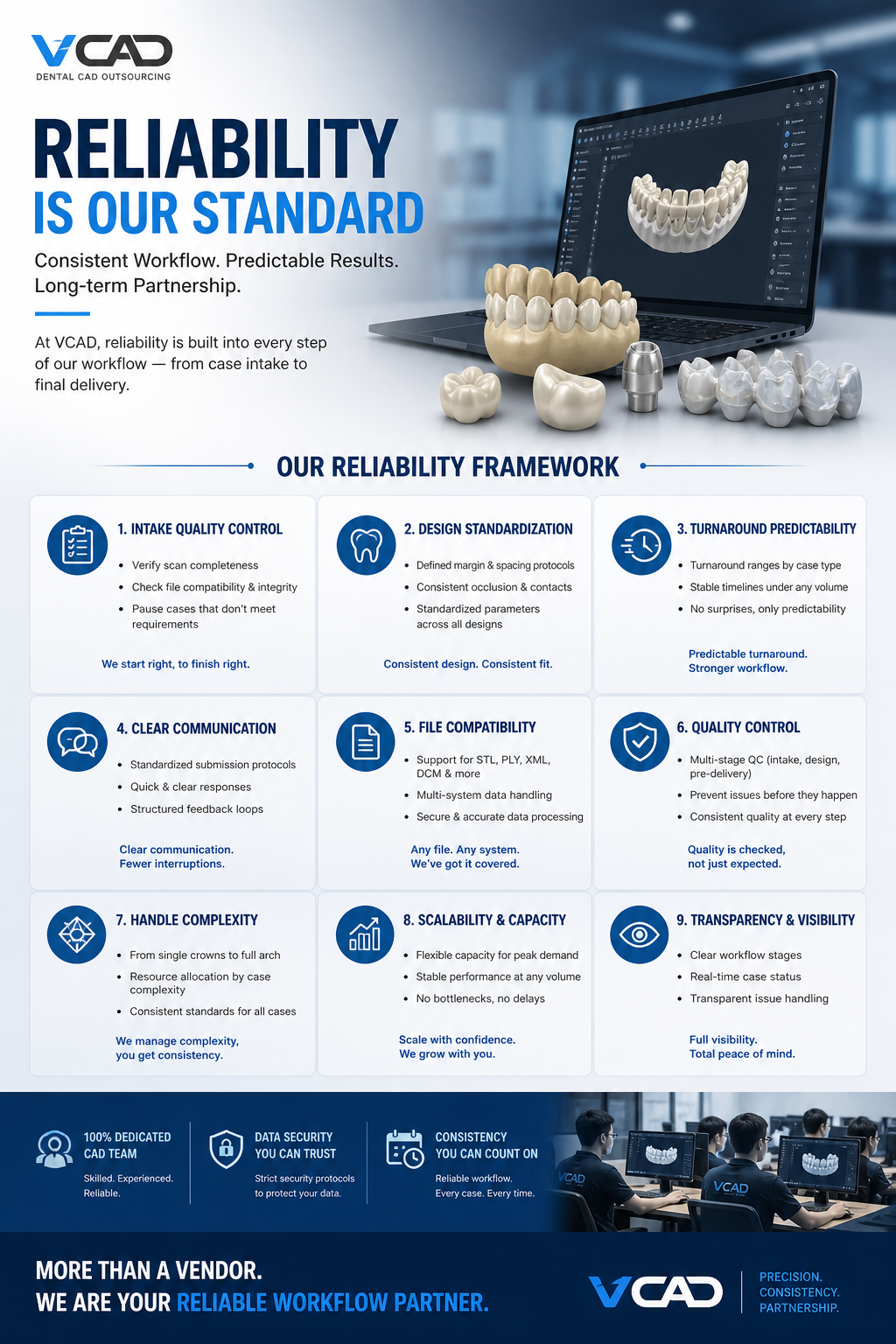
As digital workflows become more integrated into dental laboratories and clinics, outsourcing CAD design is no longer an occasional solution—it is a structural component of production. However, the effectiveness of outsourcing depends not on availability, but on reliability.
From a laboratory perspective, dental outsourcing reliability is not defined by a single metric such as turnaround time or design quality. It is the consistency with which a partner can process cases, maintain standards, and operate without introducing variability into the workflow.
This article presents a structured framework for evaluating reliability in a dental CAD outsourcing partner, focusing on workflow behavior, process control, and long-term performance stability.
Reliability as a Function of Workflow Consistency
Reliability in CAD outsourcing is often misunderstood as speed or responsiveness. In practice, it is determined by how consistently a partner performs across multiple variables:
- Case intake quality control
- Design execution standards
- Communication clarity
- Turnaround predictability
- Output consistency across cases
A reliable partner does not eliminate variability, but manages it in a controlled and repeatable way.
Intake Quality Control as the First Reliability Indicator
The intake stage reveals how a partner manages incoming data.
What to Evaluate
- Whether cases are validated before design
- How incomplete or inconsistent data is handled
- Whether submission requirements are clearly defined
Reliable Workflow Behavior
A structured partner will:
- Verify scan completeness (prep, antagonist, bite)
- Check file compatibility and integrity
- Pause cases that do not meet requirements
Why It Matters
Without intake control:
- Design begins on incomplete data
- Interruptions occur mid-process
- Turnaround becomes inconsistent
Strong intake QC is one of the clearest indicators of dental outsourcing reliability.
Design Standardization and Parameter Consistency
Consistency in CAD design is essential for predictable outcomes.
What to Evaluate
- Whether design parameters are standardized
- How margin definition is handled
- Consistency in occlusion and contact design
Reliable Workflow Behavior
A reliable partner applies:
- Defined margin interpretation protocols
- Consistent internal spacing settings
- Standardized occlusal contact parameters
Impact on Workflow
- Reduced variability across cases
- Lower adjustment rates
- Improved production alignment
Inconsistent design is a primary source of unreliability.
Turnaround Time: Predictability vs Speed
Turnaround time is often used as a benchmark, but speed alone is not a reliable indicator.
What to Evaluate
- Consistency of turnaround across different case types
- Variability under increased workload
- Transparency in processing timelines
Reliable Workflow Behavior
A reliable partner:
- Defines turnaround ranges based on case complexity
- Begins processing only after intake validation
- Maintains stable timelines under varying volume
Key Insight
Predictable turnaround is more valuable than occasional speed. Reliability is measured by consistency, not peak performance.
Communication Structure and Responsiveness
Communication is a critical component of workflow stability.
What to Evaluate
- Clarity of submission protocols
- Responsiveness to inquiries
- Availability of structured communication channels
Reliable Workflow Behavior
- Standardized case submission formats
- Clear documentation requirements
- Defined feedback loops for clarification
Impact on Workflow
- Reduced ambiguity in design
- Fewer interruptions
- Faster resolution of issues
Unstructured communication introduces delays and variability.
File Compatibility and Data Handling Capability
Digital workflows involve multiple file formats and systems.
What to Evaluate
- Supported file formats (STL, PLY, XML, DCM, etc.)
- Handling of multi-system data
- Consistency in file processing
Reliable Workflow Behavior
- Acceptance of diverse file formats
- Standardized conversion processes
- Preservation of data integrity
Workflow Impact
Reliable data handling reduces delays caused by compatibility issues and ensures consistent design input.
Quality Control Integration Across Workflow Stages
Reliability requires quality control at multiple points, not just final output.
What to Evaluate
- Presence of intake-level QC
- Design-level verification processes
- Pre-production validation
Reliable Workflow Behavior
- Multi-stage QC integration
- Preventive identification of issues
- Consistent application of quality checks
Impact on Outcomes
- Reduced remake rates
- Improved fit consistency
- Stable production performance
A partner without structured QC introduces risk into the workflow.
Handling of Case Complexity and Variability
Different case types require different levels of control.
What to Evaluate
- Ability to handle simple and complex cases
- Consistency across varying case types
- Flexibility in design approach
Reliable Workflow Behavior
- Segmentation of cases based on complexity
- Allocation of resources accordingly
- Maintenance of consistent standards across all cases
Workflow Impact
Reliable partners manage variability rather than being affected by it.
Scalability and Capacity Stability
Reliability must be maintained as case volume increases.
What to Evaluate
- Performance under high-volume conditions
- Ability to handle peak demand
- Stability of turnaround time at scale
Reliable Workflow Behavior
- Flexible capacity management
- Consistent processing regardless of volume
- Avoidance of bottlenecks
Key Insight
A partner that performs well at low volume but becomes inconsistent at higher volume is not scalable.
Transparency and Process Visibility
Visibility into workflow processes supports trust and predictability.
What to Evaluate
- Clarity of workflow stages
- Visibility of case status
- Transparency in issue handling
Reliable Workflow Behavior
- Clear process documentation
- Defined checkpoints in workflow
- Open communication regarding delays or issues
Workflow Impact
Transparency reduces uncertainty and supports better coordination between lab and clinic.
Alignment with Manufacturing Requirements
CAD design must integrate seamlessly with production.
What to Evaluate
- Whether design parameters align with manufacturing processes
- Consistency in output quality
- Compatibility with production workflows
Reliable Workflow Behavior
- Design optimized for manufacturability
- Consistent output that requires minimal adjustment
- Stable transition from design to production
Impact on Workflow
Misalignment between design and manufacturing introduces delays and reduces efficiency.
Risk Indicators of Unreliable Partners
Identifying potential issues early is critical.
Common Warning Signs
- Inconsistent turnaround times
- Frequent need for clarification during design
- High variability in output quality
- Lack of structured intake or QC processes
Workflow Consequences
- Increased adjustment and remake rates
- Delays in case completion
- Reduced overall productivity
Recognizing these indicators helps prevent long-term workflow disruption.
Building a Practical Evaluation Framework
Based on the above factors, dental outsourcing reliability can be evaluated across five key dimensions:
1. Intake Control
- Are cases validated before design begins?
2. Design Consistency
- Are parameters standardized and applied uniformly?
3. Turnaround Stability
- Are timelines predictable under varying conditions?
4. Communication Structure
- Is information exchange clear and efficient?
5. Quality Control Integration
- Are issues prevented rather than corrected?
A partner that performs consistently across these dimensions is more likely to support stable workflows.
Long-Term Reliability vs Short-Term Performance
Short-term performance can be misleading.
Short-Term Indicators
- Fast initial turnaround
- Responsive communication
Long-Term Indicators
- Consistent output across multiple cases
- Stable performance under varying conditions
- Low variability in workflow outcomes
Key Insight
Reliability should be evaluated over time, not based on isolated cases.