


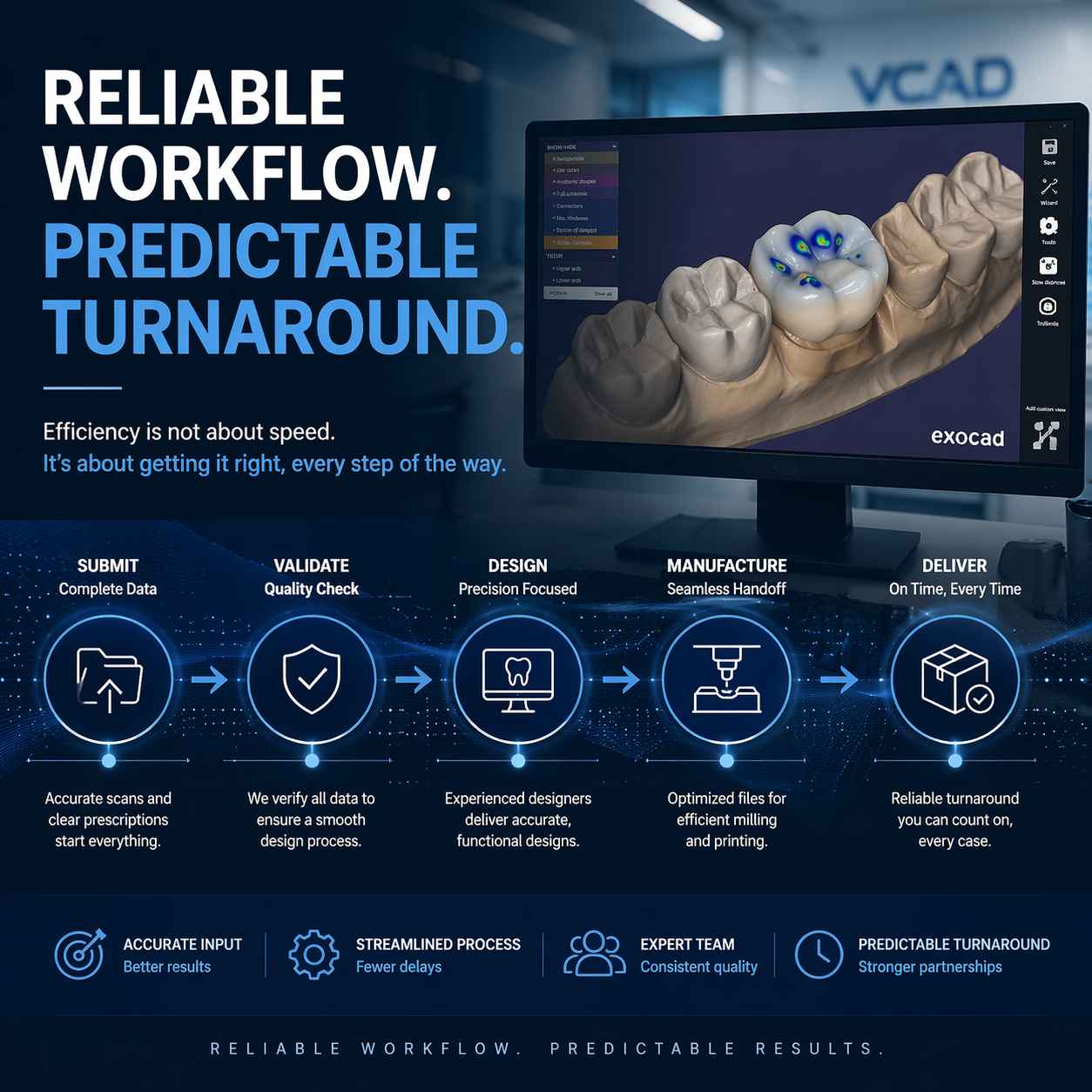
Selecting an outsourcing partner is no longer a peripheral decision in digital dentistry. As workflows become increasingly dependent on CAD design, digital case intake, and integrated production systems, the performance of an external laboratory directly affects clinical timelines, restoration accuracy, and operational stability.
Dental outsourcing lab selection should not be based on isolated factors such as speed or cost. From a laboratory perspective, reliability is defined by how consistently a partner maintains workflow continuity—across intake, design, production, and communication—under varying case conditions.
This article outlines a structured framework for evaluating outsourcing laboratories, focusing on three core dimensions: quality control discipline, communication structure, and consistency in execution.
Reliability as a Workflow Property, Not a Single Capability
A common misconception is that reliability is determined by technical skill alone. In practice, most laboratories can produce acceptable results under controlled conditions. The difference emerges when:
- Case volume increases
- Case complexity varies
- Input quality becomes inconsistent
A reliable partner maintains stable performance under these conditions. This requires not only technical capability but also structured processes that govern how cases are handled at every stage.
In dental outsourcing lab selection, the focus should shift from individual outputs to system behavior.
Intake Quality Control: The First Indicator of Reliability
The intake stage is the earliest point at which workflow stability can be assessed.
What a Reliable Lab Verifies at Intake
A structured intake process includes:
- Validation of required scan sets (preparation, antagonist, bite)
- Assessment of file compatibility across formats (e.g., STL, PLY, XML, DCM)
- Review of prescription completeness and clarity
- Identification of missing or inconsistent data
Cases that do not meet these criteria are not processed immediately. Instead, they are paused until sufficient information is provided.
Why Intake Discipline Matters
Labs that bypass intake validation may appear faster initially but introduce downstream inefficiencies:
- Interrupted design workflows
- Increased communication during processing
- Higher likelihood of remakes
A reliable laboratory enforces intake QC consistently, even if it delays individual cases. This approach stabilizes the overall workflow.
Communication Structure: From Informal Exchange to Defined Protocols
Communication is often underestimated in outsourcing relationships. However, it is one of the primary determinants of workflow efficiency.
Characteristics of Structured Communication
Reliable laboratories define:
- Standardized case submission formats
- Clear channels for file transfer and communication
- Documented case instructions and parameters
- Response protocols for clarification requests
These elements ensure that dental outsourcing lab selection is not dependent on informal or ad hoc communication.
Impact on Timeline Stability
When communication is structured:
- Cases proceed without repeated clarification
- Design teams operate with clear parameters
- Delays caused by misinterpretation are minimized
Conversely, unstructured communication leads to fragmented workflows and unpredictable turnaround times.
Design Consistency: Repeatability Across Cases
Consistency in CAD design is a key indicator of reliability. It reflects how well a laboratory standardizes its internal processes.
Indicators of Design Consistency
- Uniform margin handling across cases
- Consistent occlusal design protocols
- Stable application of thickness and material parameters
- Predictable anatomical outcomes
Consistency reduces variability, which is essential for maintaining efficiency at scale.
Risks of Inconsistent Design
When design approaches vary:
- Adjustments increase at the clinical stage
- Remake rates rise
- Workflow becomes less predictable
In dental outsourcing lab selection, consistency is often more valuable than peak performance on individual cases.
Alignment Between Design and Manufacturing
A reliable outsourcing laboratory does not treat design and production as separate functions. Instead, it ensures that both stages are aligned.
Design for Manufacturability
Design must account for:
- Material-specific constraints
- Minimum thickness requirements
- Production tolerances
If design decisions are not aligned with manufacturing capabilities, issues arise during fabrication.
Integrated Workflow Advantage
When design and production are coordinated:
- Cases transition smoothly between stages
- Adjustments during production are minimized
- Output matches design intent consistently
This integration is a critical factor in evaluating outsourcing partners.
Turnaround Time as a Measure of Process Stability
Turnaround time is often used as a primary selection criterion. However, its significance lies in consistency rather than speed.
What Reliable Turnaround Looks Like
- Defined timelines based on case complexity
- Predictable start points after intake validation
- Minimal variation across similar cases
Turnaround time should reflect a controlled process rather than reactive execution.
Factors Influencing Turnaround
Reliable laboratories structure their timelines based on:
- Case completeness
- Complexity and volume
- Workflow capacity and scheduling
For example, design timelines are typically adjusted based on case size and complexity rather than applied uniformly.
Case Tracking and Workflow Transparency
Transparency in workflow management is another key indicator of reliability.
Features of Transparent Systems
- Real-time case status tracking
- Visibility into design and production stages
- Shipment and delivery updates
These systems allow both laboratory and clinic to monitor progress without relying on manual follow-up.
Benefits for Workflow Control
- Reduced uncertainty in case handling
- Faster identification of issues
- Improved coordination between stages
Transparency supports accountability and enhances overall efficiency.
Handling Variability: A Core Test of Reliability
In real-world workflows, variability is unavoidable. Reliable laboratories are defined by how they manage it.
Sources of Variability
- Differences in scan quality
- Variations in case complexity
- Inconsistent prescription details
Structured Response to Variability
Reliable partners implement:
- Standardized intake criteria
- Flexible but controlled design protocols
- Clear communication for resolving discrepancies
This ensures that variability does not translate into workflow instability.
Scalability and Capacity Management
As case volume increases, the ability to scale becomes critical.
Indicators of Scalable Systems
- Ability to handle fluctuating case volumes
- Consistent performance under increased demand
- Structured allocation of design and production resources
Risks of Limited Scalability
- Bottlenecks during peak periods
- Delays due to capacity constraints
- Reduced consistency in output
In dental outsourcing lab selection, scalability determines whether a partner can support long-term growth.
Quality Control Beyond Final Inspection
Quality control is often associated with final inspection. In reliable workflows, it is distributed across multiple stages.
Multi-Level QC Structure
- Intake QC: Validating input data
- Design QC: Reviewing digital output
- Production QC: Verifying physical restorations
This layered approach reduces cumulative error and improves overall accuracy.
Impact on Workflow Efficiency
- Fewer remakes
- Reduced need for adjustments
- More predictable outcomes
Quality control, when applied consistently, becomes a driver of efficiency rather than a constraint.
Evaluating Risk in Outsourcing Partnerships
Selecting a laboratory also involves assessing operational risk.
Key Risk Factors
- Dependence on informal communication
- Lack of standardized processes
- Inconsistent turnaround performance
- Limited transparency in case handling
Risk Mitigation Through Structure
Reliable laboratories reduce risk by:
- Defining clear workflows
- Enforcing intake and QC protocols
- Maintaining consistent communication
This structured approach supports long-term collaboration.
A Practical Framework for Dental Outsourcing Lab Selection
Based on workflow considerations, a reliable laboratory can be evaluated across three core dimensions:
1. Input Control
- Does the lab enforce intake quality control?
- Are submission requirements clearly defined?
2. Process Stability
- Are design and production workflows standardized?
- Is turnaround time consistent across cases?
3. Output Consistency
- Are results repeatable across similar cases?
- Are remakes and adjustments minimized?
This framework shifts the focus from isolated capabilities to system-level performance.
Conclusion: Reliability Is Built on Process Discipline
Dental outsourcing lab selection is fundamentally a decision about workflow structure. A reliable laboratory is not defined by individual strengths but by its ability to maintain consistent performance across all stages of the process.
From intake validation and communication to design consistency and production alignment, each element contributes to overall reliability. Laboratories that enforce structured workflows, maintain transparency, and manage variability effectively provide a more stable foundation for long-term collaboration.
In digital dental workflows, reliability is not an outcome—it is a property of the system that produces it.