


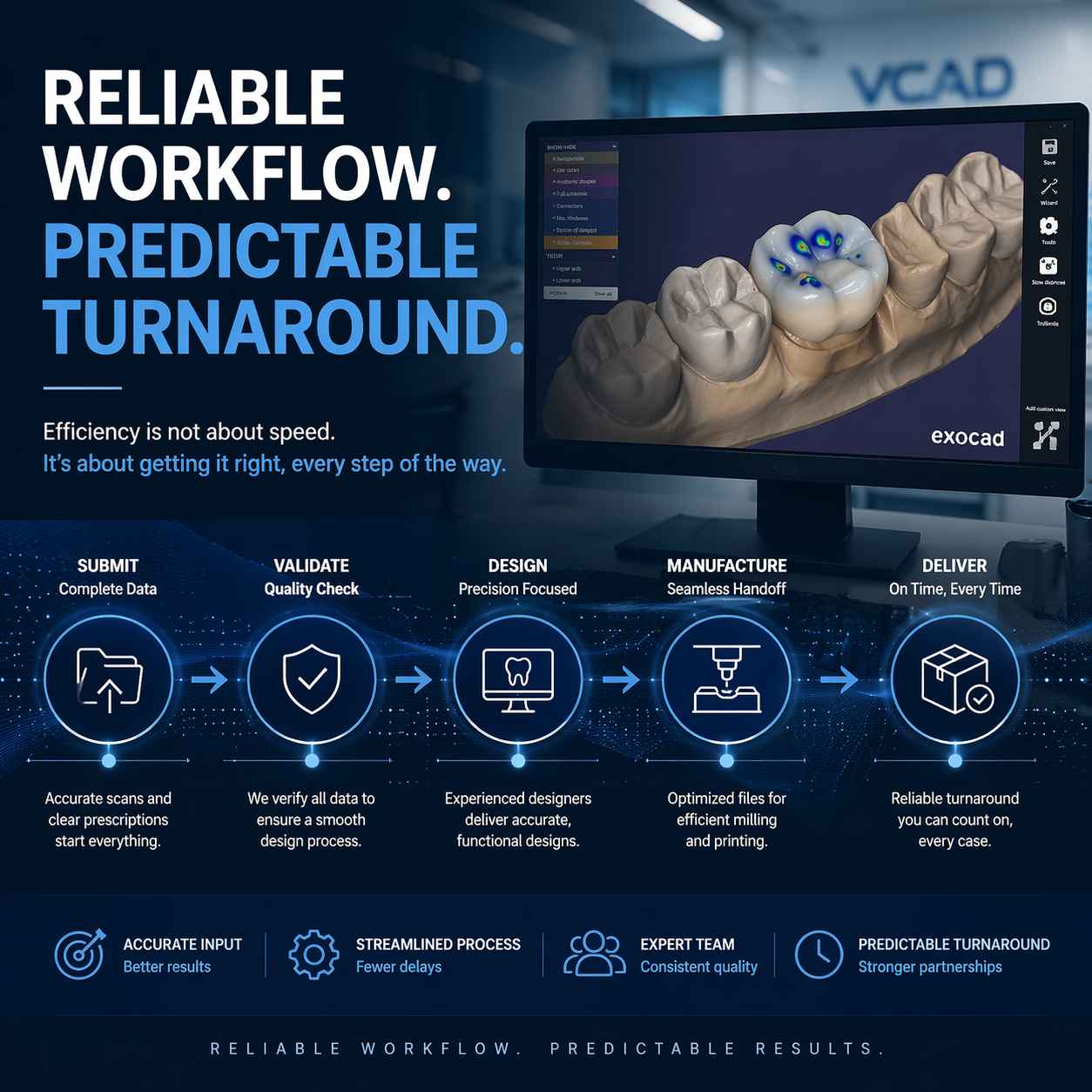
In digital dental workflows, CAD design is often perceived as a standardized service—one that can be evaluated primarily by speed or cost. However, from a laboratory perspective, this assumption does not hold under real production conditions. The variability in dental CAD design quality becomes evident when cases move beyond initial design into manufacturing, fitting, and clinical delivery.
The distinction between low-cost CAD design and lab-grade precision is not defined by software alone. Both may use similar tools. The difference lies in how workflows are structured, how input data is validated, how design decisions are controlled, and how consistently results are delivered across varying case conditions.
This article examines the operational differences between low-cost and lab-grade CAD design, focusing on workflow stability, risk exposure, and long-term efficiency.
Cost as an Output of Process, Not a Primary Variable
Low-cost CAD services are often positioned around reduced pricing or faster turnaround. However, cost is not an isolated variable—it reflects how the workflow is structured.
Characteristics of Cost-Driven Models
- Minimal intake validation
- High throughput with limited case segmentation
- Reduced time allocated per case
- Limited communication or feedback loops
These characteristics allow for lower operational cost per case but introduce variability into the workflow.
Characteristics of Lab-Grade Models
- Structured intake quality control
- Defined design protocols
- Integrated quality assurance
- Consistent communication processes
In this context, dental CAD design quality is not a feature—it is the result of process discipline.
Intake Discipline: The First Point of Divergence
The most immediate difference between low-cost and lab-grade design appears at the intake stage.
Low-Cost Intake Approach
- Cases are accepted with minimal validation
- Missing or unclear data is often handled during design
- Designers may proceed with assumptions to maintain speed
Lab-Grade Intake Approach
- Cases are reviewed for completeness before design begins
- Required scan sets and parameters are verified
- Incomplete cases are paused until clarified
Workflow Impact
When intake is not controlled:
- Design workflows are interrupted
- Errors propagate downstream
- Turnaround time becomes inconsistent
Lab-grade workflows prioritize input quality to stabilize the entire process.
Design Execution: Throughput vs Controlled Precision
Low-Cost Design Characteristics
- Emphasis on speed and volume
- Limited time per case
- Reduced customization based on clinical context
Design decisions may rely on default parameters rather than case-specific considerations.
Lab-Grade Design Characteristics
- Structured application of design protocols
- Consideration of margin integrity, occlusion, and material constraints
- Alignment with manufacturing requirements
This approach ensures that dental CAD design quality is consistent across cases, not dependent on individual interpretation.
Margin Handling and Its Downstream Consequences
Margin definition is one of the most sensitive aspects of CAD design.
In Low-Cost Workflows
- Margins may be approximated when scan data is unclear
- Limited time is spent refining margin lines
- Variability increases across cases
In Lab-Grade Workflows
- Margin clarity is validated at intake
- Designers refine margins based on clear data
- Consistency is maintained across restorations
Impact on Fit and Remakes
Poor margin handling leads to:
- Open or overextended margins
- Increased chairside adjustment
- Higher remake rates
These outcomes directly affect workflow efficiency beyond the design stage.
Occlusal Design: Simplification vs Controlled Adjustment
Occlusion is another area where differences in dental CAD design quality become evident.
Low-Cost Approach
- Simplified occlusal mapping
- Reduced emphasis on contact distribution
- Greater reliance on default articulation settings
Lab-Grade Approach
- Controlled occlusal contact design
- Consideration of load distribution
- Alignment with clinical input and case requirements
Workflow Implications
Inaccurate occlusion leads to:
- Chairside adjustments
- Patient discomfort
- Additional clinical time
Lab-grade design reduces these issues by integrating occlusal considerations into the workflow.
Design-to-Manufacturing Alignment
A critical distinction between low-cost and lab-grade CAD design lies in how well designs translate into production.
Low-Cost Limitations
- Designs may not fully account for material constraints
- Thickness and connector parameters may be inconsistent
- Production adjustments may be required
Lab-Grade Integration
- Design parameters are aligned with manufacturing capabilities
- Material-specific constraints are considered
- Output is consistent with production requirements
This alignment ensures that design intent is preserved through fabrication.
Quality Control: Reactive vs Embedded Systems
Low-Cost QC Approach
- Limited or final-stage inspection
- Issues identified after design completion
- Corrections handled reactively
Lab-Grade QC Approach
- Intake-level validation
- Design-level review
- Pre-production verification
This multi-layered QC structure reduces cumulative error and improves overall dental CAD design quality.
Communication Structure and Case Clarity
Communication is often reduced in low-cost workflows to maintain speed.
Low-Cost Communication
- Minimal clarification during intake
- Limited feedback to clinics
- Reduced documentation of case details
Lab-Grade Communication
- Structured case submission requirements
- Clear documentation of design parameters
- Feedback loops for improving input quality
Workflow Impact
Clear communication reduces:
- Misinterpretation of cases
- Design variability
- Delays caused by clarification
Turnaround Time: Perceived Speed vs Actual Efficiency
Low-cost services often emphasize faster turnaround. However, speed must be evaluated across the full workflow.
Immediate Processing vs Stable Flow
- Low-cost: faster initial processing, higher risk of rework
- Lab-grade: controlled intake, consistent processing timelines
Hidden Delays
Low-cost workflows may introduce:
- Additional communication during design
- Remakes due to inaccuracies
- Production adjustments
These factors extend total case time, even if initial design appears faster.
Consistency Across Case Volume
Scalability is a key consideration in dental CAD design quality.
Low-Cost Scalability
- High volume capacity
- Increased variability under load
- Reduced consistency across cases
Lab-Grade Scalability
- Structured workflows maintain consistency
- Capacity is managed without compromising quality
- Output remains stable across varying volumes
Consistency becomes more critical as case volume increases.
Risk Distribution in Design Choices
Selecting low-cost CAD design introduces specific operational risks.
Short-Term Benefits
- Lower cost per case
- Faster initial turnaround
Long-Term Risks
- Increased remake rates
- Higher chairside adjustment time
- Workflow instability
Lab-grade design reduces these risks by prioritizing process control over short-term efficiency.
When Low-Cost CAD Design May Be Suitable
Low-cost models may be appropriate in specific scenarios:
- Non-critical or temporary restorations
- Cases with low complexity
- Situations where variability can be tolerated
However, even in these cases, workflow impact should be considered.
When Lab-Grade Precision Becomes Critical
Lab-grade dental CAD design quality is essential for:
- Implant restorations
- Multi-unit bridges
- Full-arch cases
- High-volume production environments
In these contexts, consistency and predictability outweigh initial cost considerations.
Evaluating CAD Design Quality Beyond Cost
A practical evaluation framework includes:
Input Handling
- Does the provider validate case data before design?
Design Consistency
- Are results repeatable across cases?
Workflow Integration
- Is design aligned with manufacturing requirements?
Communication Structure
- Are case instructions clearly defined and documented?
This framework shifts the focus from cost to system performance.
Conclusion: Design Quality as a Workflow Decision
The difference between low-cost CAD design and lab-grade precision is not defined by tools or individual skills. It is defined by how the workflow is structured and controlled.
Dental CAD design quality determines not only the accuracy of individual restorations but also the efficiency and stability of the entire production process. While low-cost options may offer short-term advantages, they often introduce variability that affects long-term outcomes.
From a laboratory perspective, selecting a design model is not a pricing decision—it is a workflow decision that influences every stage from intake to final delivery.