


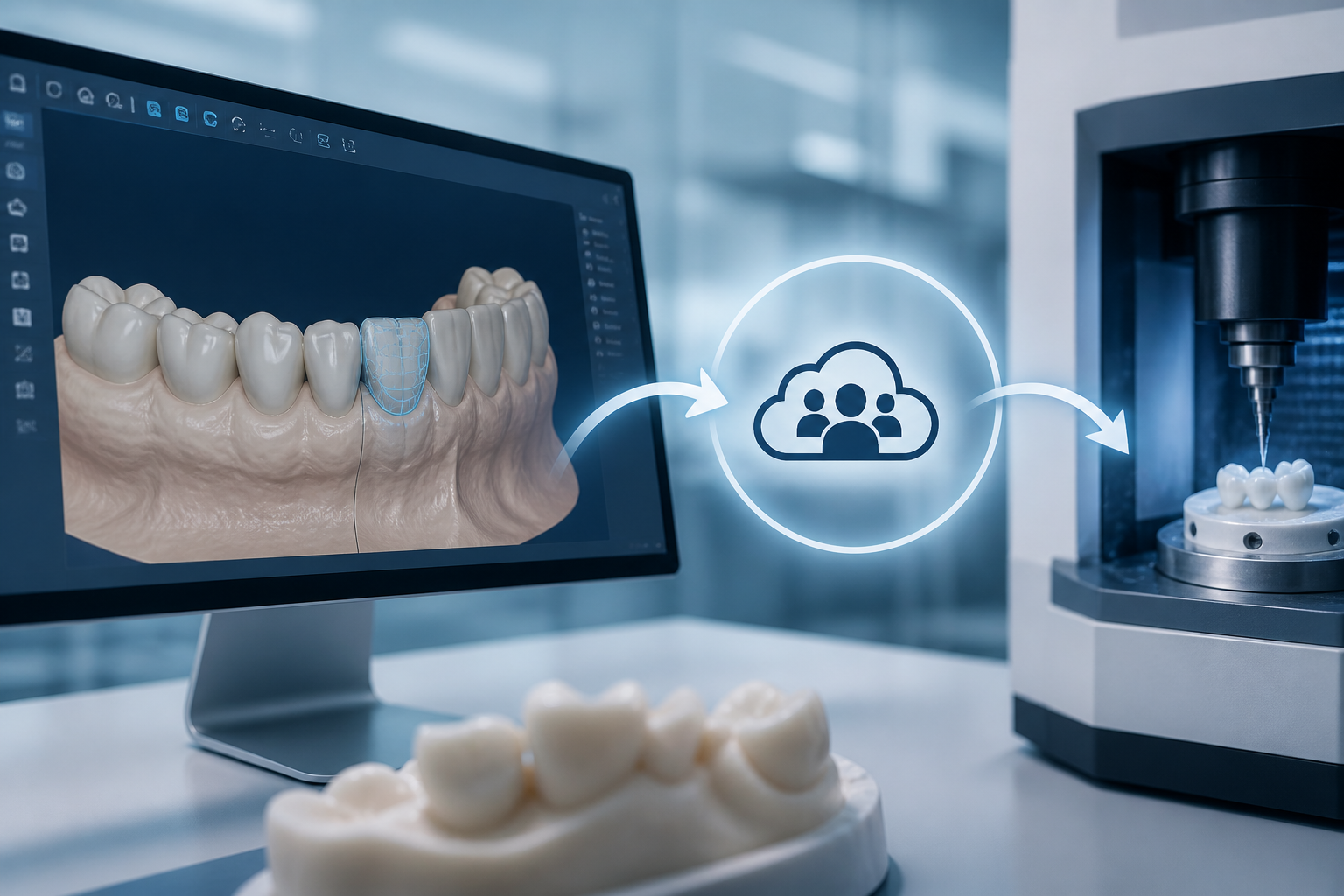
Crown and bridge restorations remain one of the highest-volume categories in dental laboratories. While digital workflows have improved design accuracy and manufacturing precision, production stability is still challenged by fluctuating case volume, variability in input data, and internal capacity limitations.
From an operational perspective, crown and bridge outsourcing is not simply a method of increasing output. It is a strategy for stabilizing workflow, reducing variability, and maintaining consistent production performance under changing conditions.
This article examines how outsourcing contributes to production optimization in crown and bridge workflows, focusing on intake control, design consistency, manufacturing alignment, and throughput stability.
Crown and Bridge Production as a High-Volume Workflow
Unlike complex implant or full-arch cases, crown and bridge restorations are characterized by:
- High daily case volume
- Repetitive workflows with defined parameters
- Sensitivity to small deviations (margin, occlusion, contacts)
Because of these characteristics, even minor inefficiencies can scale rapidly across multiple cases.
Common operational challenges include:
- Design bottlenecks during peak submission periods
- Variability in turnaround time
- Increased adjustment or remake rates
- Inconsistent workload distribution across teams
Optimizing this category requires a system-level approach rather than isolated improvements.
Stabilizing Intake as the First Step in Production Optimization
Production efficiency begins with intake quality.
Intake Variability in Crown and Bridge Cases
Even in high-volume workflows, input data can vary significantly:
- Incomplete scan sets (missing antagonist or bite)
- Inconsistent margin clarity
- Unclear prescription parameters
When these issues are not controlled, they introduce variability into the design stage.
Role of Structured Intake in Outsourcing
In crown and bridge outsourcing, intake is typically standardized:
- Required scan sets are defined and verified
- File formats are checked for compatibility
- Cases with incomplete data are paused until clarified
Impact on Production Stability
By ensuring that only validated cases enter the workflow:
- Design interruptions are minimized
- Production schedules remain predictable
- Variability across cases is reduced
Redistributing Design Workload to Eliminate Bottlenecks
CAD design is often the limiting factor in crown and bridge production.
Internal Design Constraints
- Fixed number of designers
- Limited capacity during peak hours
- Increased pressure to maintain speed
These constraints lead to:
- Queue buildup
- Inconsistent processing times
- Reduced design quality under load
Outsourcing as a Load Balancing Mechanism
With crown and bridge outsourcing:
- Excess case volume is distributed externally
- Internal teams are relieved from overload
- Design queues are reduced
Workflow Result
- Continuous case flow
- Reduced waiting time before design
- Improved consistency in output
Standardization of Design Across High-Volume Cases
Consistency is critical in crown and bridge workflows due to the repetitive nature of cases.
Risks of Inconsistent Design
- Variation in margin placement
- Differences in occlusal contact
- Inconsistent proximal contact strength
These variations lead to increased adjustment and remake rates.
Outsourced Design Protocols
Outsourced workflows typically apply:
- Defined margin handling procedures
- Standardized occlusal parameters
- Consistent internal spacing settings
Impact on Production
- Reduced variability across cases
- Improved fit consistency
- Lower adjustment rates
Standardization supports both efficiency and predictability.
Aligning Design with Manufacturing Requirements
Production efficiency depends on how well design integrates with manufacturing.
Common Misalignment Issues
- Designs that do not account for material constraints
- Inconsistent thickness or connector dimensions
- Lack of consideration for production tolerances
These issues result in:
- Adjustments during manufacturing
- Delays in production
- Increased risk of remakes
Integrated Approach in Outsourcing
In structured crown and bridge outsourcing workflows:
- Design parameters are aligned with manufacturing capabilities
- Material-specific requirements are incorporated into CAD
- Output is optimized for production processes
Resulting Benefits
- Smooth transition from design to fabrication
- Reduced need for production adjustments
- Improved overall efficiency
Managing Turnaround Time Through Workflow Control
Turnaround time in crown and bridge production is influenced by multiple variables.
Internal Variability
- Fluctuating case volume
- Differences in case complexity
- Interruptions due to incomplete data
These factors make turnaround unpredictable.
Structured Turnaround in Outsourcing
Outsourced workflows typically:
- Begin processing after intake validation
- Allocate time based on case size and complexity
- Maintain consistent processing windows
Workflow Impact
- Predictable delivery timelines
- Reduced variability across cases
- Improved coordination with clinical schedules
Reducing Adjustment and Remake Rates
Adjustment and remakes are major constraints on production efficiency.
Common Causes in Crown and Bridge Cases
- Margin inaccuracies
- Occlusal discrepancies
- Proximal contact issues
Role of Outsourcing in Reduction
By enforcing:
- Intake quality control
- Standardized design protocols
- Multi-level quality checks
outsourcing reduces the frequency of these issues.
Impact on Throughput
- Fewer rework cycles
- Reduced material waste
- Faster progression to delivery
Lower remake rates directly improve production capacity.
Supporting Multi-Format Digital Workflows
Modern crown and bridge workflows involve data from multiple scanner systems.
Internal Challenges
- Limited compatibility with different file formats
- Need for manual conversion
- Increased processing time
Outsourced Flexibility
Outsourced partners often support:
- Multiple file formats (STL, PLY, XML, etc.)
- Standardized data processing
- Integration with various digital systems
Workflow Benefit
- Reduced delays due to file issues
- Improved intake efficiency
- Consistent data handling
Balancing Workload Across Production Stages
Crown and bridge production involves multiple stages:
- Intake
- Design
- Manufacturing
- Finishing
Internal Imbalance
When design becomes overloaded:
- Manufacturing capacity may remain underutilized
- Workflow becomes uneven
- Overall productivity decreases
Outsourcing as a Balancing Tool
By offloading design:
- Workload is distributed more evenly
- Manufacturing can operate at full capacity
- Workflow becomes synchronized
This balance is essential for optimizing production.
Handling Peak Demand Without Disruption
Case volume in crown and bridge workflows often fluctuates.
Internal Limitations
- Fixed capacity cannot adapt quickly
- Peak periods create bottlenecks
- Low-volume periods lead to underutilization
Outsourced Flexibility
Outsourcing enables:
- Rapid scaling of design capacity
- Efficient handling of peak demand
- Stable performance across varying volumes
This flexibility supports consistent production output.
Maintaining Workflow Continuity Through Communication
Communication plays a key role in production stability.
Structured Communication in Outsourcing
- Defined submission protocols
- Clear case documentation
- Feedback loops for improving input quality
Impact on Workflow
- Reduced need for clarification
- Fewer interruptions during design
- Improved coordination between stages
Effective communication supports continuous workflow execution.
When Crown and Bridge Outsourcing Delivers Maximum Value
The benefits of crown and bridge outsourcing are most evident in:
- High-volume production environments
- Laboratories experiencing design bottlenecks
- Workflows requiring consistent turnaround
- Operations handling diverse case inputs
In these scenarios, outsourcing functions as a stabilizing component within the production system.
Conclusion: Production Optimization Through Workflow Stability
Optimizing crown and bridge production is not achieved by increasing speed alone. It requires controlling variability, balancing workload, and maintaining consistent processes across all stages.
Crown and bridge outsourcing improves production by:
- Stabilizing intake and design workflows
- Reducing bottlenecks
- Standardizing output
- Supporting scalable operations
By integrating outsourcing into the workflow, laboratories can maintain continuous production flow, improve consistency, and increase throughput without compromising control.
In digital dental production, efficiency is achieved not by accelerating individual steps, but by ensuring that the entire system operates in a stable and predictable manner.