


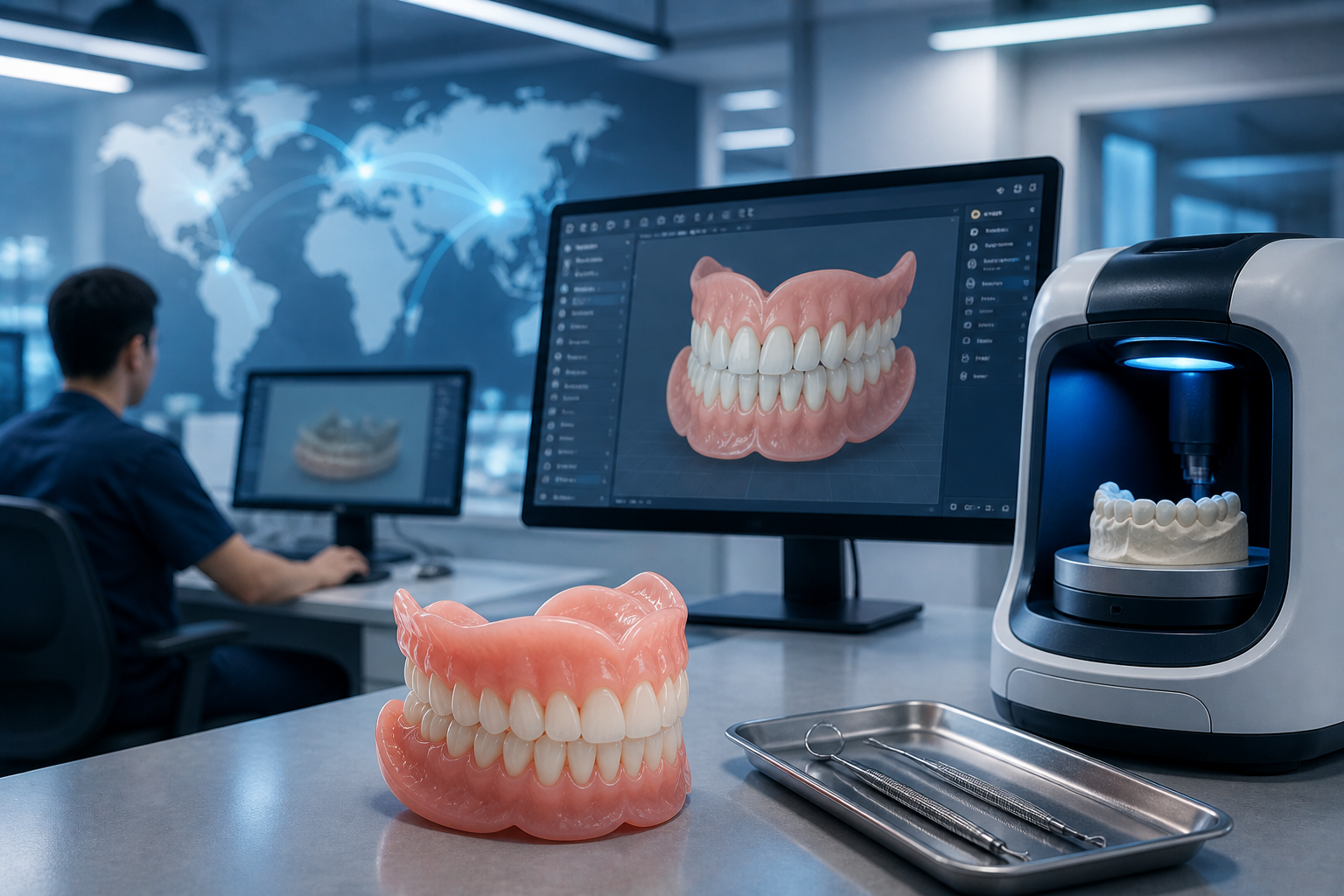
Digital dentistry depends on a simple premise: the design can only be as accurate as the data it is built on. In crown and bridge, implant, and removable workflows alike, intraoral scans serve as the primary input for CAD design. When scan data is incomplete, distorted, or inconsistent, the resulting design must compensate for uncertainty—often leading to variability in fit, occlusion, and overall restoration performance.
Article content
ToggleFrom a laboratory perspective, intraoral scan quality dental CAD is not just a clinical concern. It is a foundational variable that determines how efficiently cases move through the workflow, how predictable outcomes are, and how often adjustments or remakes occur.
This article analyzes how intraoral scan quality affects CAD design accuracy and explains how structured workflows manage scan-related variability.
Scan Quality as the Foundation of Digital Design
In traditional workflows, physical impressions introduce variability through material distortion and handling. Digital workflows eliminate some of these variables but introduce a new dependency: scan data integrity.
In CAD-based production:
- Geometry is defined entirely by scan data
- Margin identification relies on scan clarity
- Occlusion depends on accurate bite capture
- Fit and adaptation are derived from surface accuracy
If the input is compromised, the design cannot fully correct it. Instead, it must interpret incomplete or distorted information.
This is why intraoral scan quality dental CAD directly influences design accuracy and downstream performance.
Geometry Accuracy: The Basis of Fit
The most fundamental aspect of scan quality is geometric accuracy.
Common Geometry Issues
- Surface noise caused by scanning artifacts
- Missing data in deep or reflective areas
- Distortion from stitching errors
- Inconsistent mesh density
Impact on CAD Design
When geometry is inaccurate:
- Internal fit may be uneven
- Contact points may be misaligned
- Seating may be incomplete
Design software operates on the assumption that the mesh represents true anatomy. When this assumption is incorrect, errors propagate through the workflow.
Margin Clarity and Its Role in Design Precision
Margin definition is one of the most critical steps in CAD design.
Scan-Related Margin Challenges
- Blurred or indistinct margin lines
- Incomplete capture of preparation edges
- Artifacts masking margin boundaries
Effect on CAD Design
When margins are unclear:
- Designers must estimate margin location
- Variability increases between cases
- Risk of overextension or underextension rises
Workflow Implications
- Increased chairside adjustment
- Higher likelihood of remakes
- Reduced predictability in fit
Clear margin capture is essential for maintaining intraoral scan quality dental CAD standards.
Bite Registration and Occlusal Accuracy
Occlusion in digital workflows is defined by the relationship between upper and lower scans.
Common Bite-Related Issues
- Incomplete or unstable bite registration
- Misalignment between arches
- Inconsistent articulation data
Impact on CAD Design
- Incorrect occlusal contact points
- High or low contacts in the final restoration
- Need for chairside occlusal adjustment
Design Limitations
Even advanced CAD systems cannot compensate for inaccurate bite data. They can only simulate occlusion based on the provided relationship.
Full-Arch vs Single-Unit Scan Sensitivity
Scan quality requirements vary depending on case type.
Single-Unit Cases
- Smaller scan area
- Lower risk of cumulative distortion
- Easier to maintain accuracy
Full-Arch Cases
- Larger scan area increases stitching complexity
- Higher risk of distortion across the arch
- Greater impact on occlusal and spatial relationships
Workflow Consideration
In full-arch cases, small deviations accumulate, making intraoral scan quality dental CAD even more critical for maintaining accuracy.
Mesh Integrity and Data Stability
Beyond visible geometry, internal mesh structure affects how CAD software processes scan data.
Mesh Integrity Issues
- Holes or gaps in the mesh
- Overlapping polygons
- Irregular triangulation
Impact on CAD Operations
- Difficulty in defining margins
- Errors in Boolean operations
- Instability during design adjustments
Workflow Impact
Poor mesh integrity increases processing time and reduces design reliability.
File Resolution and Its Effect on Detail Capture
Scan resolution determines how much detail is captured in the digital model.
Low-Resolution Scans
- Simplified geometry
- Loss of fine detail
- Reduced margin clarity
High-Resolution Scans
- Detailed surface representation
- Improved accuracy in design
- Larger file sizes requiring more processing power
Balance in Workflow
While higher resolution improves accuracy, it must be balanced with system compatibility and processing efficiency.
File Format and Data Interpretation
Scan quality is also influenced by how data is stored and transferred.
Format Considerations
- STL: geometry only, no color
- PLY: includes color and texture
- Other formats may include metadata
Impact on Design
- Loss of color data may reduce margin visibility
- Conversion between formats may introduce distortion
Structured workflows ensure that file formats are compatible and preserve critical data.
Intake Validation: Filtering Scan Quality Before Design
Given the impact of scan quality, validation at intake is essential.
Intake-Level Checks
- Completeness of scan data
- Clarity of margins
- Stability of bite registration
- Integrity of mesh structure
Cases that do not meet these criteria are paused until corrected.
Workflow Benefits
- Prevents flawed data from entering design
- Reduces mid-process interruptions
- Improves overall efficiency
Design Compensation vs Design Accuracy
When scan quality is suboptimal, designers may attempt to compensate.
Compensation Strategies
- Smoothing irregular surfaces
- Estimating margin boundaries
- Adjusting occlusion based on assumptions
Limitations
- Compensation introduces variability
- Accuracy depends on subjective interpretation
- Results are less predictable
Workflow Perspective
True accuracy comes from high-quality input, not from post-processing adjustments.
Impact on Manufacturing and Final Fit
Scan quality affects not only design but also production outcomes.
Downstream Effects
- Poor fit due to inaccurate geometry
- Occlusal discrepancies requiring adjustment
- Increased remake rates
Manufacturing Constraints
Production processes reproduce the digital design precisely. If the design is based on flawed data, errors are replicated in the final restoration.
Relationship Between Scan Quality and Workflow Efficiency
Low scan quality introduces inefficiencies at multiple stages:
- Increased communication for clarification
- Additional design time for compensation
- Higher adjustment and remake rates
High scan quality supports:
- Continuous workflow
- Reduced need for correction
- Predictable turnaround times
This makes intraoral scan quality dental CAD a key factor in operational efficiency.
Managing Variability Through Structured Workflows
While scan quality varies, workflows can be structured to manage its impact.
Key Strategies
- Standardized intake criteria
- Clear communication of scan requirements
- Feedback loops to improve submission quality
- Consistent QC processes
These measures reduce variability and improve overall outcomes.
Limitations and Practical Considerations
Even with advanced scanning technology, certain limitations remain:
- Difficulty capturing subgingival margins
- Variability in clinical scanning technique
- Environmental factors affecting scan quality
These factors cannot be fully eliminated but can be managed through structured workflows.
Conclusion: Scan Quality as a Determinant of Design Accuracy
Intraoral scan quality dental CAD is a fundamental determinant of design accuracy in digital dental workflows. It influences margin definition, occlusion, fit, and overall restoration performance.
By validating scan data at intake, standardizing design processes, and aligning workflows with input quality, laboratories and clinics can reduce variability, improve efficiency, and achieve more predictable outcomes.
In digital dentistry, accuracy does not begin at the design stage—it begins with the quality of the scan.