


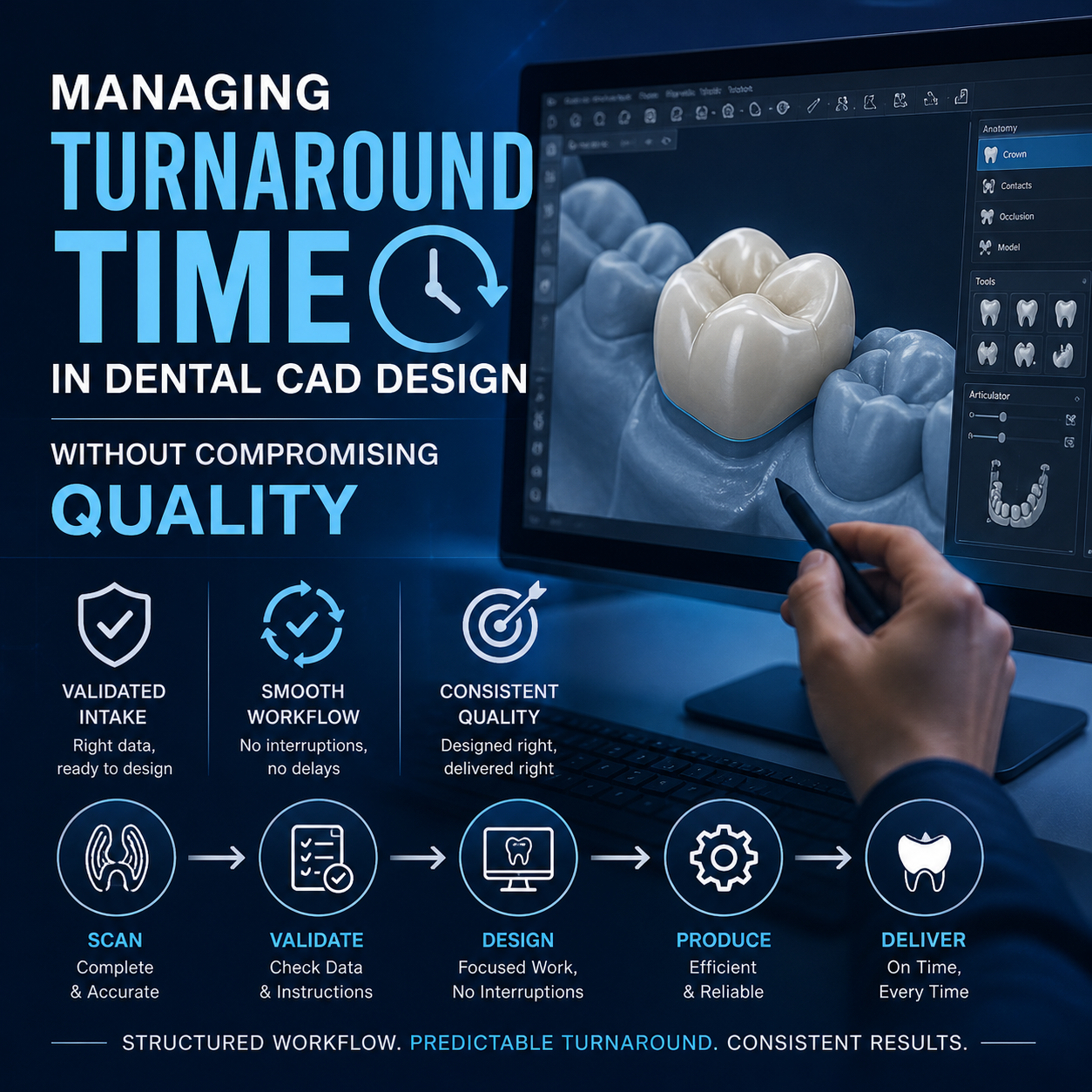
Turnaround time is one of the most closely monitored metrics in digital dental production. However, attempts to shorten timelines often create unintended consequences—design inconsistencies, increased adjustment rates, and workflow instability. From a laboratory perspective, dental CAD turnaround time is not a function of speed alone. It is the outcome of how well the workflow is structured to process cases without interruption or rework.
Managing turnaround time effectively requires balancing throughput and accuracy. This balance is achieved not by accelerating individual steps, but by controlling the conditions under which each step operates.
This article examines how laboratories can manage turnaround time in CAD design while maintaining consistent quality across cases.
Rethinking Turnaround Time as a Workflow Outcome
Turnaround time is often interpreted as the duration between case submission and delivery. In structured workflows, this definition is incomplete.
Actual Start Point of Turnaround
Turnaround begins only when:
- All required scan data is complete
- Files are compatible and validated
- Case instructions are clear
Cases submitted without meeting these conditions do not enter active processing.
Workflow Implication
Dental CAD turnaround time is determined by:
- How quickly cases reach a validated state
- How consistently they move through design
- How often they are interrupted
This shifts the focus from speed to workflow stability.
Intake Validation as the First Control Point
The most effective way to manage turnaround time is to control what enters the workflow.
Role of Intake Quality Control
At intake, laboratories verify:
- Completeness of scan data (prep, antagonist, bite)
- File integrity and compatibility
- Clarity of prescription parameters
Cases that fail validation are paused until corrected.
Impact on Turnaround
- Prevents interruptions during design
- Reduces need for mid-process clarification
- Supports continuous processing
Without intake control, turnaround becomes unpredictable due to repeated interruptions.
Eliminating Mid-Process Interruptions
Interruptions are one of the primary causes of extended turnaround time.
Common Sources of Interruption
- Missing or unclear margin data
- Incomplete bite registration
- Ambiguous design instructions
Workflow Effect
- Designers must stop and request clarification
- Cases are removed from the active queue
- Processing time is extended beyond planned timelines
Prevention Strategy
By ensuring that only validated cases enter design:
- Designers work without interruption
- Case flow remains continuous
- Turnaround time becomes more predictable
Structuring Design Workflows for Consistency
Consistency in design execution is essential for managing dental CAD turnaround time.
Variability in Unstructured Workflows
- Different designers apply different parameters
- Case handling varies based on interpretation
- Output quality fluctuates
Standardized Design Protocols
Structured workflows define:
- Margin handling procedures
- Occlusal contact parameters
- Internal spacing settings
Impact on Turnaround
- Reduced need for design revisions
- Faster progression to production
- Consistent processing times across cases
Standardization minimizes variability, which is a key factor in maintaining stable turnaround.
Managing Case Complexity and Segmentation
Not all cases require the same processing time.
Complexity Factors
- Number of units (single crown vs multi-unit bridge)
- Restoration type (implant vs conventional)
- Occlusal and anatomical considerations
Segmentation Strategy
Cases are categorized based on complexity:
- Simple cases with shorter processing windows
- Complex cases with extended timelines
Workflow Benefit
By aligning processing time with case complexity:
- Overloading of design capacity is avoided
- Turnaround expectations remain realistic
- Workflow remains balanced
Queue Management and Capacity Control
Queue management directly affects how quickly cases move through design.
Internal Queue Challenges
- High submission volume creates backlog
- Designers must prioritize tasks dynamically
- Workflow becomes fragmented
Structured Queue Management
- Only validated cases enter the queue
- Cases are processed in defined sequences
- Capacity is aligned with workload
Impact on Turnaround
Efficient queue management ensures that dental CAD turnaround time reflects actual processing time rather than waiting time.
The Role of File Submission Quality
File submission quality influences how quickly cases can be processed.
Effects of Poor Submission
- Additional time required for file correction
- Increased communication for clarification
- Delays before design can begin
Effects of High-Quality Submission
- Immediate progression to design
- Reduced need for manual intervention
- Stable processing timelines
Ensuring consistent dental CAD file submission quality is essential for managing turnaround.
Communication Efficiency and Its Impact on Timelines
Communication delays are a significant contributor to extended turnaround time.
Common Communication Issues
- Missing case details
- Delayed responses to clarification requests
- Inconsistent communication channels
Structured Communication Approach
- Standardized submission forms
- Defined communication protocols
- Clear response expectations
Workflow Impact
Efficient communication reduces:
- Time spent waiting for information
- Interruptions during design
- Variability in processing time
Balancing Speed and Quality in Design Execution
Attempting to reduce turnaround time by increasing speed often introduces risk.
Speed-Focused Approach
- Reduced time per case
- Increased likelihood of design errors
- Higher adjustment and remake rates
Quality-Focused Approach
- Controlled design processes
- Reduced need for rework
- More predictable outcomes
Workflow Perspective
True efficiency is achieved when cases are completed correctly the first time, reducing the need for additional cycles.
Integrating Quality Control Without Extending Timelines
Quality control is often perceived as adding time to the workflow.
Reactive QC
- Issues identified after design
- Corrections required
- Additional time added
Preventive QC
- Issues identified at intake and design stages
- Errors prevented before production
- Reduced need for rework
Impact on Turnaround
Preventive QC improves overall efficiency by eliminating delays caused by corrections.
Aligning Design with Manufacturing for Faster Completion
Turnaround time includes both design and production.
Design-Manufacturing Misalignment
- Requires adjustments during production
- Delays fabrication
- Extends delivery timelines
Integrated Workflow
- Design parameters aligned with manufacturing constraints
- Smooth transition between stages
- Reduced need for adjustments
This alignment ensures that design completion leads directly to production without delay.
Managing Variability in High-Volume Environments
High-volume workflows introduce additional challenges.
Sources of Variability
- Fluctuating case volume
- Differences in input quality
- Variation in case complexity
Control Mechanisms
- Intake validation
- Standardized design protocols
- Structured queue management
These mechanisms stabilize workflow and support consistent turnaround.
Continuous Monitoring and Process Adjustment
Managing dental CAD turnaround time requires ongoing evaluation.
Key Metrics
- Average processing time per case type
- Frequency of interruptions
- Rate of design revisions
Process Improvement
- Identify bottlenecks
- Adjust workflow structure
- Refine submission and communication protocols
Continuous improvement ensures that turnaround remains stable over time.
Limitations and Practical Considerations
Certain factors affecting turnaround cannot be fully controlled:
- Variability in scan quality
- Delays in communication from external sources
- Differences in case complexity
However, structured workflows mitigate these variables by reducing their impact on overall processing time.
Conclusion: Turnaround Time as a Controlled Workflow Outcome
Dental CAD turnaround time is not determined by how quickly individual cases are processed, but by how consistently the workflow operates as a whole.
By focusing on:
- Intake validation
- Design standardization
- Communication efficiency
- Quality control integration
laboratories can manage turnaround time without compromising design accuracy.
In digital dental workflows, efficiency is achieved not by accelerating isolated steps, but by ensuring that each case progresses through a stable and uninterrupted system.