


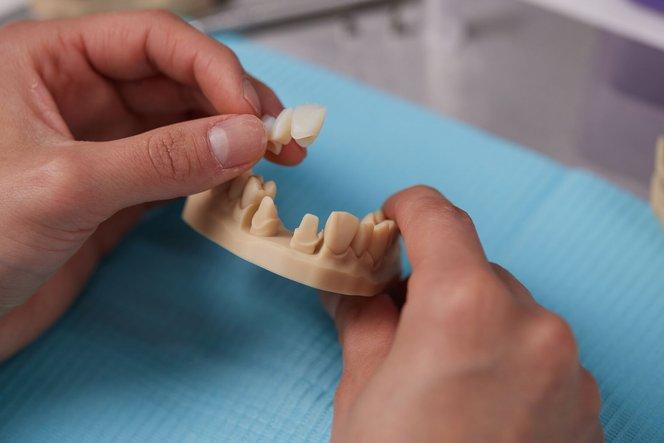
Chairside adjustment is often treated as a routine part of crown delivery. However, from a laboratory and workflow perspective, frequent or extensive adjustment is not incidental—it is an indicator of variability within the digital production chain. Each adjustment reflects a deviation between the designed restoration and the clinical reality it must fit.
Understanding dental crown adjustment issues requires analyzing the entire workflow, from scan data acquisition to CAD design and manufacturing. These issues rarely originate from a single step. Instead, they result from cumulative inconsistencies across multiple stages.
This article examines the primary causes of crown adjustment issues and explains how structured digital workflows reduce variability and improve first-time fit.
Adjustment as a Symptom of Workflow Misalignment
In a controlled workflow, restorations are designed to seat with minimal intervention. When adjustment is required, it indicates that one or more parameters were misaligned.
Types of Adjustment
- Occlusal adjustment (high or low contacts)
- Proximal contact adjustment
- Internal fit adjustment (seating resistance)
- Margin-related discrepancies
Each type corresponds to a specific stage in the workflow where variability may have been introduced.
Scan Data Quality as the Starting Point
All CAD design decisions are based on scan data. If the input is incomplete or inaccurate, design cannot fully compensate.
Common Scan-Related Issues
- Incomplete margin capture
- Noise or distortion in preparation geometry
- Missing or unstable bite registration
- Inconsistent mesh density
Impact on Adjustment
- Poor margin definition leads to seating issues
- Inaccurate geometry affects internal fit
- Incorrect bite data results in occlusal discrepancies
Workflow Insight
High-quality input data is the foundation for reducing dental crown adjustment issues. Without it, variability propagates through the workflow.
Margin Definition and Its Downstream Effects
Margin definition establishes the boundary of the restoration.
Sources of Margin Variability
- Unclear scan data
- Inconsistent interpretation during CAD
- Lack of standardized margin protocols
Impact on Adjustment
- Overextended margins may prevent proper seating
- Underextended margins may lead to open edges
- Uneven margin definition creates inconsistent fit
Workflow Implication
Accurate and consistent margin definition is essential for minimizing adjustment.
Bite Registration and Occlusal Discrepancies
Occlusion is one of the most common areas requiring adjustment.
Causes of Occlusal Issues
- Incomplete bite capture
- Misalignment between upper and lower scans
- Inaccurate articulation in CAD
Resulting Problems
- High contact points
- Uneven occlusal distribution
- Need for chairside adjustment
Workflow Perspective
Occlusal accuracy depends on the integrity of bite data and how it is interpreted during design.
Internal Fit and Seating Resistance
Internal fit determines how smoothly a crown seats onto the preparation.
Causes of Poor Internal Fit
- Incorrect cement gap settings
- Inaccurate margin placement
- Distortion in scan geometry
Adjustment Outcomes
- Tight seating requiring internal adjustment
- Incomplete seating affecting occlusion
- Increased chairside time
Workflow Insight
Internal fit must be calibrated relative to accurate margin definition and scan data.
Proximal Contact Variability
Contact strength between adjacent teeth is another frequent adjustment point.
Causes of Contact Issues
- Inconsistent contact parameter settings
- Variation in scan data accuracy
- Lack of standardization in design
Adjustment Impact
- Open contacts requiring addition
- Tight contacts requiring reduction
- Variability in patient-specific fit
Workflow Consideration
Consistent parameter application is necessary to control contact strength.
Design Variability and Lack of Standardization
Inconsistent design practices contribute significantly to dental crown adjustment issues.
Sources of Design Variability
- Different designers applying different parameters
- Lack of standardized workflows
- Case-by-case interpretation without defined protocols
Impact on Workflow
- Increased variability across cases
- Reduced predictability in fit
- Higher adjustment rates
Solution Approach
Standardized design protocols reduce variability and improve consistency.
Manufacturing Alignment and Its Role in Adjustment
Even accurate designs can result in adjustment if manufacturing is not aligned.
Misalignment Factors
- Material shrinkage not properly compensated
- Inconsistent milling or printing processes
- Differences in material behavior
Resulting Issues
- Dimensional inaccuracies
- Fit discrepancies
- Need for post-production adjustment
Workflow Integration
Design must account for manufacturing constraints to ensure accurate output.
Communication Gaps and Their Impact on Design
Incomplete or unclear communication introduces uncertainty into the workflow.
Common Communication Issues
- Missing material specification
- Unclear design instructions
- Lack of case-specific information
Impact on Adjustment
- Designers rely on default assumptions
- Variability increases
- Adjustments become more frequent
Structured Communication
Defined submission protocols and clear documentation reduce ambiguity and improve design accuracy.
How Digital Workflows Reduce Adjustment Issues
Digital workflows reduce variability by introducing structure and control at each stage.
Intake Quality Control
- Verification of scan completeness
- Validation of file integrity
- Identification of missing data
Design Standardization
- Consistent parameter application
- Defined margin and occlusal protocols
- Structured design processes
Integrated Quality Control
- Multi-stage QC (intake, design, pre-production)
- Prevention of errors before manufacturing
Workflow Outcome
- Reduced variability across cases
- Improved first-time fit
- Lower adjustment rates
Preventive vs Reactive Workflow Models
Adjustment issues are often addressed reactively.
Reactive Approach
- Adjustments performed after delivery
- Issues corrected at chairside
- Increased clinical time
Preventive Approach
- Issues identified and resolved before design
- Structured workflows minimize variability
- Adjustments reduced at delivery
Key Insight
Preventive workflows are more efficient and scalable.
The Role of File Submission Quality
File submission quality directly affects design accuracy.
Submission Issues
- Missing scan components
- Poor file organization
- Incompatible formats
Impact on Workflow
- Delays due to clarification
- Increased design variability
- Higher adjustment rates
Best Practice
Structured dental CAD file submission ensures that cases enter the workflow in a state suitable for accurate design.
Managing Adjustment in High-Volume Workflows
In high-volume environments, small inconsistencies can scale into significant inefficiencies.
Effects of Frequent Adjustment
- Increased cumulative chairside time
- Reduced throughput
- Higher operational complexity
Workflow Control Measures
- Standardized intake and design processes
- Consistent QC integration
- Structured communication
These measures reduce adjustment frequency and support stable workflows.
Limitations and Practical Considerations
Certain factors contributing to adjustment cannot be fully eliminated:
- Variability in clinical preparation
- Challenges in capturing subgingival margins
- Differences in patient anatomy
However, structured workflows reduce their impact by controlling controllable variables.
Conclusion: Reducing Adjustment Through Workflow Alignment
Dental crown adjustment issues are not isolated problems. They are indicators of misalignment within the digital workflow.
By addressing:
- Scan data quality
- Margin definition accuracy
- Occlusal and contact design
- Manufacturing alignment
- Communication clarity
digital workflows can reduce variability and improve first-time fit.
In modern dental production, minimizing adjustment is not achieved through post-delivery correction. It is achieved by structuring the workflow so that each stage supports accurate and consistent outcomes from the beginning.