


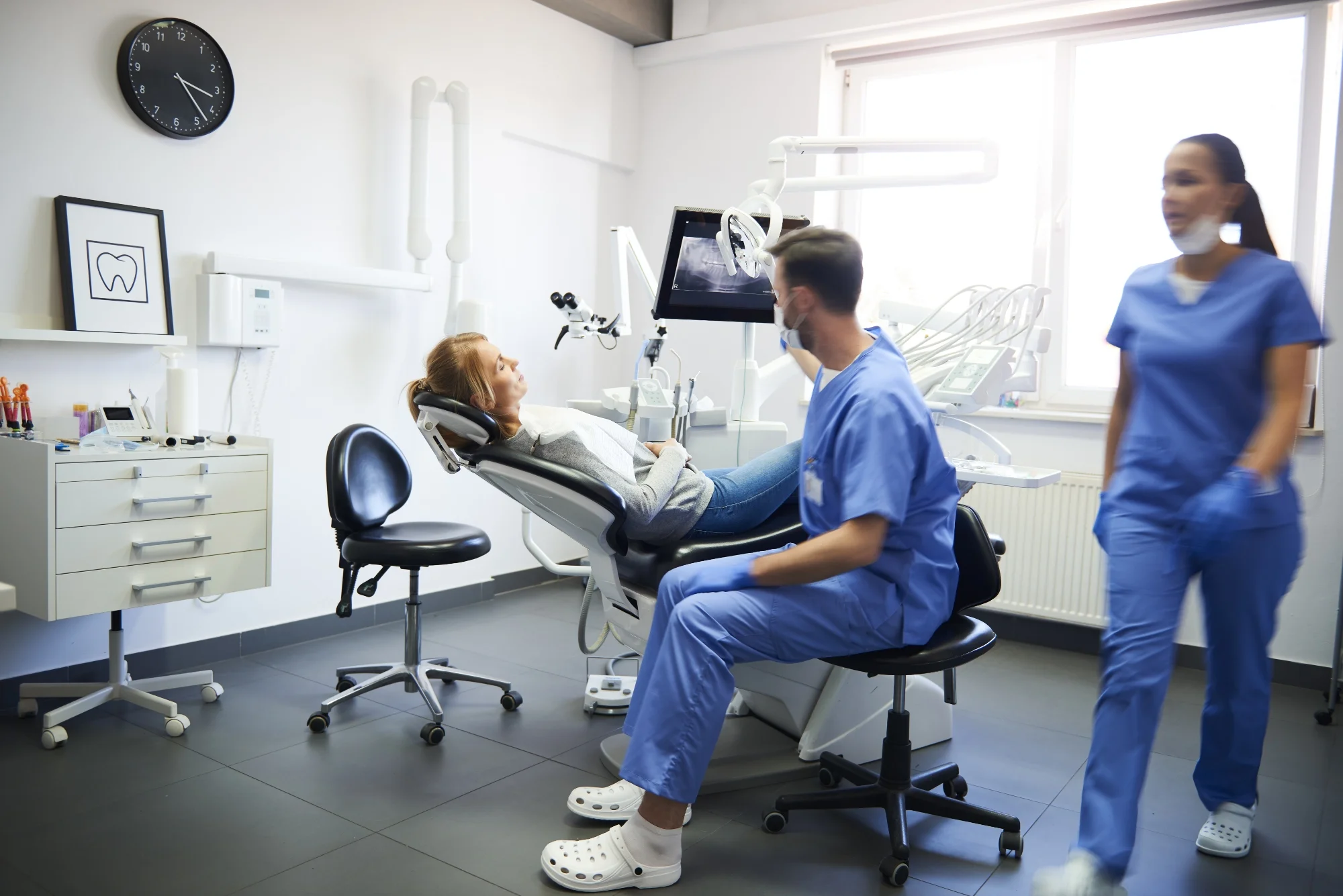
The digital revolution in dentistry is accelerating faster than ever, and nothing is shaping that evolution more profoundly than artificial intelligence (AI). While CAD/CAM, intraoral scanning, and digital workflows have existed for more than a decade, AI is transforming these technologies from “tools” into “partners.” Dentistry is shifting from manual interpretation toward intelligent automation — and dental labs, clinicians, and patients stand to benefit tremendously.
By 2025, AI is no longer a futuristic concept. It is already operating inside design engines, scan validation software, occlusion analyzers, and shade-matching systems. At VCAD Dental Outsourcing Lab, AI is embedded throughout the workflow, improving accuracy, speed, consistency, and predictability.
But what exactly can dentists expect from AI? And how is AI reshaping the future of dental design?
Let’s explore how AI-driven dentistry is redefining precision, reducing remakes, and ensuring every restoration behaves as predictively as it looks.
1. AI in Scan Verification — The First Line of Accuracy
In traditional workflows, technicians manually evaluated scan quality. This process was heavily dependent on individual experience and could be inconsistent between designers. AI has changed that.
AI algorithms can evaluate scan data with microscopic precision — detecting errors that even experienced technicians may overlook.
1.1 How AI analyzes the scan
AI-driven scan validation checks:
- Margin clarity at pixel-level accuracy
- Gingival retraction success using geometry-based algorithms
- Moisture interference, reflecting light irregularities
- Under-scan areas and missing data
- Occlusal alignment using multi-surface correlation
- Structural distortions caused by hand movement or scanner drift
Each part of the scan is graded based on clarity, depth, and integrity.
1.2 Why this matters clinically
AI can detect:
- unclear margins BEFORE design
- bite misalignment BEFORE occlusion problems appear
- tissue overlap BEFORE emergence issues develop
This prevents errors from entering the CAD stage.
1.3 VCAD’s AI-driven scan validation system
VCAD uses:
- automated margin scoring
- real-time bite verification
- noise detection
- surface defect analysis
If problems arise, the clinician receives annotated screenshots with rectification instructions.
The impact:
More accurate restorations, fewer remakes, and a smoother CAD workflow.
2. AI in Occlusion Prediction — Dynamic Function Before Milling
Occlusion has historically been one of dentistry’s most subjective and error-prone areas. Human eyes and articulators cannot fully simulate functional movement with precision.
AI changes this by modeling functional biomechanics directly inside the software.
2.1 How AI predicts occlusion
AI evaluates:
- contact intensity levels
- pressure distribution
- movement pathways (centric, lateral, protrusive)
- potential high spots
- cusp-collision likelihood
- restorative thickness under load
It creates a dynamic simulation of how the restoration will behave in real chewing conditions.
2.2 Occlusal problems AI prevents
- high centric stops
- premature contacts
- lateral interferences
- posterior disclusion failure
- chipping risk
- TMJ-related discomfort
AI highlights high-risk zones in red or orange, guiding technicians toward optimal adjustments.
2.3 VCAD’s functional occlusion AI
VCAD integrates:
- force heatmaps
- dynamic motion simulation
- automatic reduction suggestions
- occlusal thickness alerts
This ensures every restoration functions naturally — not just geometrically.
The impact:
Restorations that require minimal chairside adjustment and remain stable long-term.
3. AI in Morphology Design — Natural Anatomy in Seconds
CAD designers traditionally sculpted cusps, grooves, ridges, and contours manually. This required high artistic skill and was time-consuming.
AI now generates natural anatomy instantly.
3.1 How AI shapes anatomy
AI analyzes:
- age-based wear patterns
- tooth type (incisor, molar, premolar)
- adjacent morphology
- bite classification
- ethnic morphology tendencies
- occlusal philosophy (canine guidance, group function)
It combines these factors to auto-generate morphology that:
- looks natural
- functions correctly
- aligns harmoniously with adjacent teeth
3.2 What AI prevents
- flat occlusal tables
- overly sharp cusps
- unnatural grooves
- asymmetrical surfaces
- low occlusal detail
- esthetic imbalance
3.3 VCAD’s morphology AI system
VCAD uses a morphology library built from tens of thousands of scanned natural teeth.
AI selects and adapts the ideal morphology for each case, then CAD technicians refine it further.
The impact:
Faster design, more consistent anatomy, and natural-looking restorations.
4. AI in Shade Matching — Solving One of Dentistry’s Hardest Problems
Shade communication has always been a clinical weak point. Lighting, angle, skin tone, and camera settings create variation.
AI now standardizes shade interpretation.
4.1 How AI reads shade images
AI evaluates:
- hue, value, chroma
- translucency patterns
- surface reflection
- gingival-to-incisal color gradient
- background color contamination
- light temperature adjustments
Using machine learning, it predicts the closest matching shade in standardized shade libraries.
4.2 What AI prevents
- shade mismatch
- incorrect translucency
- inconsistent brightness
- inaccurate stump shade influence
4.3 VCAD’s shade AI engine
VCAD integrates:
- calibrated light references
- AI-based color correction
- shade homogenization
- translucency depth mapping
This dramatically reduces shade-related remakes — one of the costliest in dentistry.
The impact:
Predictable esthetics and higher patient satisfaction.
5. AI as a Workflow Optimizer — Smart Decisions From Start to Finish
AI is not only improving design — it is optimizing the entire workflow from case intake to final QC.
5.1 AI-powered case routing
VCAD’s system can automatically assign:
- the ideal CAD designer
- the ideal material
- the proper milling strategy
- the correct sintering cycle
It evaluates case complexity and matches it with the most suitable technician and machine.
5.2 AI-driven QC (Quality Control)
AI performs digital QC on:
- margin continuity
- internal fit geometry
- minimum thickness
- occlusal clearance
- contact intensity
If any measurement falls outside the acceptable tolerance, the system alerts the technician.
5.3 Predictive error prevention
Using historical data, AI can predict:
- which cases have high risk of remake
- likely sources of scanning error
- which contact zones will cause insertion problems
- how material thickness will behave under sintering
The future of CAD/CAM is proactive, not reactive.
AI is no longer an optional enhancement — it is becoming the backbone of modern digital dentistry. By 2025, clinics and labs that embrace AI will improve:
- accuracy
- turnaround times
- esthetic outcomes
- patient satisfaction
- operational efficiency
VCAD integrates AI into every stage of production, from scan validation to functional occlusion simulation. This ensures restorations that not only look beautiful on a screen but behave predictably in the mouth.
The future of dental design is not just digital.
It is intelligent.
AI is the bridge between imagination and clinical perfection.