


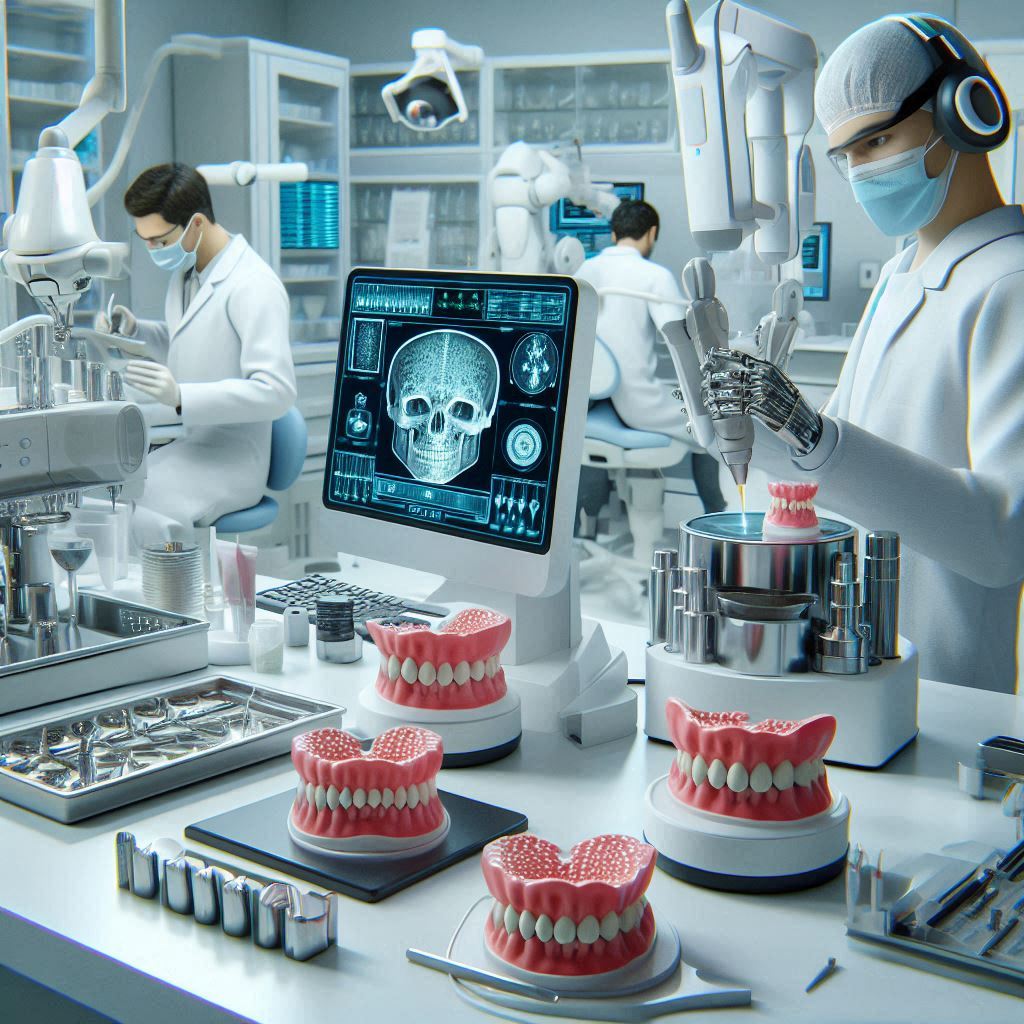
In today’s world of digital dentistry, quality control is no longer just a final checkpoint — it is an intelligent, data-driven system that must operate continuously throughout the entire workflow. As restorative dentistry becomes more digital, more complex, and more high-volume, traditional human-only QC methods simply can’t keep up with modern expectations of accuracy and consistency.
This is where artificial intelligence enters the stage.
At VCAD Dental Outsourcing Lab, AI-enhanced quality control is not an experimental feature — it is a foundational system embedded in every step from data intake to final inspection. Machine learning algorithms analyze patterns, detect inconsistencies, and flag risks that the human eye might miss. Rather than replacing technicians, AI acts as a second brain: fast, unbiased, and constantly learning from thousands of cases.
This article explores how AI reshapes quality control and builds a new standard of consistency for global dental partners.
1. Why Traditional Quality Control Is No Longer Enough
For decades, dental QC was manual: technicians inspected restorations visually, checked margins with loupes, and verified occlusal contacts using articulators. While this craftsmanship is invaluable, it comes with limitations.
1.1. Human fatigue and variability
Even the most skilled technician can experience micro-variations in judgment — especially when handling dozens of cases per day.
- Margin clarity depends on lighting
- Shade interpretation varies by eye perception
- Contact tightness may be inconsistent
- Minute digital inaccuracies may go unnoticed
Human QC works best when supported by intelligent systems.
1.2. Increasing case volume and complexity
Digital dentistry has exploded:
- higher esthetic expectations
- more implant and full-arch cases
- more multi-material workflows
- more rush cases
Manual QC alone cannot scale efficiently.
1.3. Global expectations accelerate the need for consistency
Clinicians around the world expect:
- identical morphology across multiple restorations
- predictable contact strength
- stable functional occlusion
- consistent results regardless of technician
This consistency requires a hybrid model — the precision of AI combined with the intuition of human craftsmanship.
2. How VCAD Uses AI to Build Data-Driven Quality Control
At VCAD, AI is integrated into a complete QC ecosystem called the VCAD Predictive Assurance System (PAS). It analyzes every layer of the digital and physical workflow.
2.1. AI at the Data Intake Stage
AI begins working long before the design starts. The system checks:
- STL integrity
- missing bite scans
- distorted geometries
- insufficient tooth prep
- poor isolation
- unclear margins
- scanner stitching errors
The AI flags issues and generates instant recommendations, reducing intake error by up to 42%.
Example alerts include:
- “Margin visibility below 0.2 mm on disto-lingual area.”
- “Occlusal reduction insufficient for chosen material.”
- “Opposing dentition heavy artifact detected.”
This early warning protects the entire workflow.
2.2. AI during CAD Design
VCAD designers work with AI copilots that analyze:
- cusp height consistency
- occlusal clearance
- connector thickness (for bridges)
- crown thickness uniformity
- emergence profile geometry
- internal fit uniformity
Machine learning models compare each design to a reference library of 100,000+ successful restorations, predicting potential risks.
2.3. AI in Predictive Occlusion Mapping
AI simulates:
- protrusive and lateral movement
- pressure distribution
- premature contacts
- interference zones
This allows technicians to refine contacts before milling. What once required chairside adjustment is now perfected in the digital stage.
2.4. AI for Milling Verification
Before sending to the mill:
- toolpath simulation is checked
- compensation for tool diameter is validated
- overcut risk is predicted
- material shrinkage is calculated
AI ensures the chosen milling block orientation optimizes translucency and strength.
2.5. AI-Enhanced Final QC
After milling, cameras capture 360° images of the restoration. Algorithms analyze:
- surface texture
- margin integrity
- contour symmetry
- shade homogeneity
- glaze quality
Any anomaly is highlighted for human verification.
3. Machine Learning Gives VCAD a Consistency Advantage
VCAD’s AI systems learn continuously — every case, every revision, every feedback note becomes part of the knowledge base.
3.1. Pattern Recognition at Scale
AI identifies patterns in:
- high-remake cases
- preferred morphology of each clinician
- typical reduction levels by region
- recurring shade bias with specific camera types
- scanner-specific distortion tendencies
This allows VCAD to predict and prevent issues even before they arise.
3.2. Clinician-Specific Design Profiles
Each dentist develops unique preferences over time. AI stores:
- contact strength preference
- occlusal morphology style
- esthetic contour tendency
- cement space preference
- specific design instructions
When a new case is uploaded, AI automatically aligns design settings to the clinician’s profile, ensuring consistency across hundreds of cases.
3.3. Predictive Remake Prevention
AI analyzes the restoration and predicts:
“Probability of chairside adjustment: 18%.”
“Probability of proximal tightness: 23%.”
“Probability of occlusal high spot: 31%.”
Technicians can correct risks before the crown is shipped.
3.4. AI-Supported Shade Accuracy
By reading pixel data and cross-checking VCAD’s shade library:
- color temperature
- translucency gradient
- cervical chroma
- light reflection index
AI creates a shade heatmap that enhances the accuracy of staining.
4. How AI Improves Human Performance Rather Than Replaces It
AI’s role at VCAD is collaborative, not competitive.
4.1. AI handles detection; humans handle interpretation
A computer can detect a margin inconsistency, but a human interprets:
- patient anatomy
- clinical context
- long-term behavior
- esthetic balance
4.2. AI removes repetitive tasks
Technicians spend less time:
- checking thickness
- scanning for errors
- searching for inconsistencies
They spend more time on the artistic work that matters.
4.3. Humans provide the emotional intelligence
AI does not understand:
- urgency behind a clinician’s voice
- esthetic preference of a patient
- empathy needed for complex cases
Human coordinators interpret these nuances and communicate them across teams.
4.4. AI + Human = Predictable, high-quality outcomes
This hybrid model produces:
- lower remake rates
- faster turnaround
- consistent quality across volumes
- happier clinicians and patients
5. The Future of AI Quality Control in Dentistry — and VCAD’s Vision
AI in dentistry is just beginning. In the next decade, QC will become even more predictive and automated.
VCAD is already developing:
5.1. Digital Twin Integration
AI links QC data to digital twin simulations:
- stress mapping
- long-term wear prediction
- fracture probability forecasting
Each restoration becomes a small ecosystem of data.
5.2. Autonomous Occlusion Optimization
Systems will auto-adjust contacts using real-world patterns from thousands of patients.
5.3. Vision-Driven QC Robotics
Robotic QC arms will use AI to inspect:
- margin edges
- internal fit
- occlusal grooves
with micron-level precision.
5.4. Fully Predictive Laboratory Scheduling
AI will forecast:
- daily case volume
- technician allocation
- sintering load management
- shipment batching
This eliminates bottlenecks and ensures stability.
5.5. Global Learning Across Labs
With anonymized shared datasets:
- global AI models learn faster
- performance improves for all clinics
- knowledge spreads without revealing personal data
The future of quality control is a fusion of intelligence — machine intelligence and human intelligence working in synchrony.
AI-enhanced quality control is no longer optional in digital dentistry — it is the new gold standard. As case volumes rise and expectations grow, only labs that combine machine precision with human craftsmanship will thrive.
VCAD’s AI-powered QC ecosystem ensures:
- higher accuracy
- greater consistency
- fewer remakes
- faster workflows
- better long-term performance
This is not automation for automation’s sake. This is precision elevated through intelligence — the perfect partnership between algorithms and artistry.
When AI and technicians work together, quality stops being an outcome and becomes a guarantee.