

Category Archives: News

The Changing Landscape of Global Dental Outsourcing – What 2026 Will Look Like


The dental industry is no longer confined by geography. In the past decade, digital transformation and global logistics have turned local laboratories into international collaborators. What was once a physical exchange of models has become a real-time transfer of data, design, and trust.

As 2026 approaches, this transformation is accelerating. The global dental outsourcing market — valued at over USD 3.2 billion in 2024 — is projected to grow at nearly 12% annually, fueled by advances in digital scanning, AI design, and cost-efficient manufacturing networks.

But this growth isn’t just about cheaper production. It’s about a redefinition of partnership, where precision, speed, sustainability, and data transparency become the real competitive currencies.

At VCAD Dental Outsourcing Lab, these shifts aren’t predictions; they’re the lab’s daily reality. Serving clinics across North America, Europe, and Asia, VCAD stands at the intersection of efficiency and innovation — where outsourcing is no longer a service, but a system.

Here’s how the landscape is changing — and what the world of digital dental outsourcing will look like by 2026.

1. From Cost Efficiency to Capability Partnerships


Historically, outsourcing was driven by one factor: cost. Clinics and labs in developed markets delegated labor-intensive production to regions with lower expenses. But as technology democratized access to high-end equipment, the outsourcing equation shifted from cheap labor to smart collaboration.

By 2026, capability outsourcing will define the industry. Clinics will seek partners who can:

  • Integrate seamlessly with their digital workflows.


  • Offer specialized design expertise for complex restorations.


  • Deliver consistent quality verified by data, not promises.


VCAD exemplifies this shift. Its One-Contact Platform allows global clinicians to upload cases, review designs in real time, and communicate directly with assigned technicians — all without friction.

In this new paradigm, outsourcing labs are no longer “external vendors.” They become strategic extensions of clinical practice.

Dentists retain creative control while gaining an entire digital infrastructure: CAD teams, AI analytics, and precision manufacturing — all operating under their brand’s clinical philosophy.

The winners of 2026 will be those who outsource intelligence, not just effort.

2. The Rise of 24-Hour Global Workflows


Time zones used to be obstacles; now they are assets.

As digital outsourcing networks mature, asynchronous production has become the new form of efficiency. A clinician in Los Angeles sends scans at 6 PM; a technician in Ho Chi Minh City begins design immediately; by morning, the restoration is ready for review.

This 24-hour production rhythm creates a perpetual motion of productivity — dentistry that never sleeps.

VCAD was among the first to systematize this advantage. By leveraging its Vietnam-based operations, the lab transforms time differences into turnaround benefits. With 8-hour CAD design and 2-day production cycles, clients effectively gain an extra working day per week without expanding their staff.

By 2026, this model will evolve even further:

  • Cloud-based manufacturing hubs will distribute production dynamically based on capacity and proximity.


  • AI load-balancing systems will assign cases to available designers or machines globally.


  • Predictive scheduling will estimate case delivery before design even begins.


The result: zero idle time, zero missed communication, and a new kind of global rhythm — one where distance disappears in the flow of data.

3. Data Transparency and Trust – The New Differentiator


In a crowded outsourcing market, how can clinics know which lab to trust? The answer, increasingly, will be data transparency.

By 2026, global clients will demand real-time visibility into their outsourced production — not just tracking numbers, but performance metrics: remake rates, QC reports, and sustainability audits.

VCAD’s approach offers a glimpse into that future. Its QC Dashboard allows clients to view:

  • Material batch certifications.


  • Digital tolerance reports (CAD vs CAM deviation).


  • AI-analyzed remake causes and correction rates.


Each case carries a traceable QC passport, ensuring that every restoration can be verified, not just visually approved.

Transparency is more than accountability — it’s differentiation. In the next era of outsourcing, trust will be measurable.

Labs that can show data will dominate those that only make claims. And clinics will choose partners who align with their brand values — accuracy, ethics, and environmental responsibility — not merely pricing.

4. Automation, AI, and the Rebirth of Human Expertise


There’s a myth that automation will replace technicians. In truth, automation will refocus them.

By 2026, AI will handle repetitive CAD tasks — margin detection, occlusion balancing, nesting optimization — freeing technicians to do what machines cannot: interpret nuance, understand esthetics, and empathize with patient needs.

VCAD already implements this synergy. AI detects margin lines and predicts contact points, but human designers refine anatomy, adjust translucency, and validate occlusal logic.

The result is a human-in-the-loop system — automation accelerates, but artisans perfect.

Moreover, the role of technicians is expanding into data interpretation. They’re no longer just designers; they are data analysts, reviewing metrics from hundreds of cases to continuously refine standards.

Outsourcing labs that train their teams for this hybrid role — technical artistry combined with analytical reasoning — will define the next generation of professionals.

The global lab of 2026 will look less like a factory and more like a research hub — a place where human creativity and artificial intelligence collaborate to restore smiles with scientific precision.

5. Sustainability and Ethical Globalization


Outsourcing often raises questions about sustainability and ethics: carbon footprint, material sourcing, and fair labor practices. The future will demand that global efficiency also mean global responsibility.

By 2026, clients will expect labs to publish environmental and social responsibility metrics alongside their technical ones.

VCAD is already taking that lead through:

  • Eco-friendly packaging using biodegradable pulp containers.


  • Recycling of zirconia waste dust and PMMA remnants.


  • Carbon offset partnerships supporting reforestation in Southeast Asia.


  • Energy-efficient milling operations monitored through smart power grids.


Beyond environment, ethical outsourcing means respecting both people and privacy. VCAD adheres to HIPAA and GDPR standards globally, ensuring patient data remains secure even across borders.

Ethical globalization isn’t just moral; it’s strategic. In an age where consumers scrutinize brands for authenticity, clinics that partner with responsible labs gain reputational advantage.

Sustainability, once peripheral, has become the signature of premium outsourcing.

Conclusion


Global dental outsourcing is no longer about distance; it’s about design — of systems, data, and trust.

As 2026 approaches, the most successful labs will not compete on cost, but on collaboration intelligence: the ability to connect seamlessly, predict outcomes, and uphold transparency from scan to smile.

VCAD Dental exemplifies this evolution. It represents the shift from vendor to partner, from manufacturer to collaborator, from efficiency to empathy.

In this changing landscape, the labs that thrive will be those that see outsourcing not as delegation, but as symphony — a global collaboration where every time zone, technician, and algorithm plays in tune with the same rhythm: precision without borders.

Because the future of dentistry isn’t global by geography; it’s global by design.
 

The Rise of Digital Twins in Dentistry – Predicting Outcomes Before Milling Begins


Dentistry has always balanced art and anatomy, but the next decade will add another dimension — simulation. As design and manufacturing become increasingly digital, the industry is entering an era where every restoration can exist twice: once virtually and once physically.

This concept, known as the digital twin, is reshaping how dental labs, clinicians, and patients understand success. Instead of discovering problems after milling, labs can now predict them before production even starts.

At VCAD Dental Outsourcing Lab, digital twins aren’t theoretical. They are woven into daily workflow, guiding decisions, validating designs, and ensuring every restoration behaves as beautifully as it looks.

1. What a Digital Twin Really Is


The term “digital twin” originated in aerospace engineering — a complete virtual replica of a physical asset that mirrors its condition, behavior, and lifecycle. In dentistry, the principle is the same: create a virtual version of the patient’s oral environment and simulate how a restoration will perform under real conditions.

At VCAD, a digital twin isn’t just a 3D model. It’s a living simulation composed of:

  • Anatomical data: intraoral scans, CBCT bone structures, soft-tissue topography. 

  • Material data: mechanical properties of zirconia, lithium disilicate, or resin. 

  • Functional data: occlusal dynamics, muscle force vectors, and bite motion paths. 


This multidimensional model allows technicians to test restorations virtually — applying pressure, light, and even aging scenarios — before a single toolpath is generated.

Digital twins bridge imagination and reality. They replace assumption with analysis, turning “I think it will fit” into “we know it will fit.”

2. How VCAD Builds the Digital Twin


Creating a true digital twin requires integration between disciplines that rarely speak the same language: scanning, CAD/CAM engineering, and biomechanics. VCAD unites them into a coherent digital architecture called the VCAD Simulation Matrix.

1. Data Fusion


The process starts with merging intraoral STL files and CBCT DICOM data. AI-based alignment matches bone landmarks with surface anatomy at a tolerance under 40 µm. This generates a hybrid dataset that includes both soft and hard tissue geometry.

2. Material Profiling


Each chosen material in VCAD’s library carries a profile — density, elastic modulus, fracture resistance, and translucency. These values feed into the simulation to predict stress and deformation.

3. Functional Mapping


Jaw-motion data captured from digital articulators or facial scanners is imported to simulate realistic movement. The twin doesn’t just sit in occlusion; it moves through it.

4. AI Validation Layer


Before milling, algorithms analyze the twin for weak zones, sharp internal corners, or thin connectors that could fail under load. Designers receive corrective suggestions instantly.

By the time a restoration reaches the CAM stage, every geometric decision has already been stress-tested in silico.

3. Predictive Manufacturing – Seeing the Future of Fit


Traditional workflows confirm quality after production; predictive manufacturing flips the sequence. With digital twins, VCAD predicts the outcome before the machine starts.

1. Virtual Fit Testing


The twin simulates cement space, margin adaptation, and proximal contacts at micron accuracy. The system projects how the restoration will seat on the prepared tooth, factoring in adhesive film thickness.

2. Force Simulation


Finite Element Analysis (FEA) visualizes occlusal pressure as a color-coded heatmap. Technicians can redistribute cuspal contacts digitally, avoiding high-stress areas that might lead to chipping or screw loosening.

3. Thermal and Hydrothermal Aging


Software models temperature cycles and moisture exposure equivalent to years of oral use. Weak points appear before they can exist physically.

4. Machine Readiness Check


The twin also verifies whether the chosen milling block and toolset can reproduce the geometry without overcutting. If a risk appears, the CAM planner adjusts toolpaths automatically.

Predictive manufacturing transforms trial-and-error into trial-and-truth — producing restorations that arrive pre-validated rather than merely polished.

4. From Simulation to Clinical Reality – The Collaboration Loop


A digital twin has no value unless it informs the clinician. VCAD turns simulation data into practical insight through its Clinical Feedback Interface.

When a case is complete, clinicians receive:

  • A Fit Report: 3D visuals showing predicted versus actual seating. 

  • Force Distribution Map: a snapshot of functional pressure zones. 

  • Material Stress Summary: recommendations for future cases with similar anatomy. 


During follow-up, dentists can upload post-treatment scans. The system overlays them on the original twin to measure real-world deviation. These differences train VCAD’s AI models, improving prediction accuracy over time.

This creates a virtuous circle: simulation → production → clinical feedback → smarter simulation.

Clinicians gain confidence, technicians gain foresight, and patients gain restorations that simply fit.

The more the network grows, the smarter the twins become — because each case teaches the next how to succeed.

5. The Future – Intelligent Ecosystems, Not Individual Cases


Digital twins are not the end goal; they are the beginning of an intelligent dental ecosystem. As AI and cloud connectivity expand, these virtual replicas will interact across global networks.

Imagine a world where:

  • A clinician’s scan in Toronto automatically compares with thousands of prior twins to suggest optimal design parameters. 

  • Material databases update themselves based on worldwide performance data. 

  • Predictive systems forecast how a crown will age under a patient’s specific bite force and diet profile. 


VCAD is already building this foundation. The lab’s Twin Analytics Hub aggregates anonymized case data, creating a collective intelligence that benefits every partner clinic. Each new case refines the global model, making dentistry less reactive and more anticipatory.

Yet amid this technological leap, VCAD preserves a guiding truth: technology should enhance, not eclipse, human judgment. A twin can simulate muscle motion, but only a clinician can read emotion — the smile, the relief, the trust.

The future of digital dentistry belongs to this partnership: artificial precision guided by authentic perception.

Conclusion


Digital twins mark the transition from measurement to foresight. They allow dental professionals to see the outcome before it exists, merging design, biology, and data into one predictive framework.

For VCAD Dental, the goal isn’t merely faster production; it’s certainty — restorations that function as expected because their performance was already proven in the virtual world.

Every patient deserves that assurance. Every clinician deserves that confidence. And every technician deserves tools that let science and art move in unison.

In a few years, asking whether a lab uses digital twins will sound as outdated as asking if it uses CAD/CAM. The technology will be invisible — woven into every smile, every crown, every quiet moment when precision meets peace of mind.


Data Integrity in Dental Manufacturing – Why Accuracy Begins With Information Management


In modern dentistry, precision doesn’t start with a bur or a milling spindle — it starts with data. Every margin line, every bite alignment, and every shade record is a set of digital instructions that determines what a restoration will become.

A single corrupted scan, mislabeled file, or misread prescription can ripple through production, producing errors invisible until it’s too late. When thousands of cases flow through a global lab network daily, the challenge isn’t designing faster; it’s protecting accuracy at the information level.

At VCAD Dental Outsourcing Lab, data integrity is treated as the first form of craftsmanship. Before machines carve zirconia, the lab engineers the reliability of the digital thread connecting clinician to technician.

Here’s how information management, when handled with scientific discipline, becomes the foundation of precision manufacturing.

1. Why Data Integrity Is the New Quality Control


For decades, quality control meant physical inspection — verifying margins, contacts, and color. In the digital era, that’s no longer enough. Today’s restorations are born as code, and if the code is wrong, the craft can’t save it.

Consider the average digital case:

  • Three STL files (upper, lower, bite) 

  • One Rx form with clinical notes 

  • Multiple shade photos and material requests 

  • Communication threads between clinician & lab 


Each case may generate > 200 data points before a single toolpath is written. If even one entry is mismatched — a swapped jaw orientation or an outdated STL revision — the resulting crown may be flawless geometrically yet wrong biologically.

That’s why VCAD treats data integrity as a preventive form of quality control.

Rather than catching errors at the end, the lab eliminates them at the start through an integrated verification pipeline: automated file validation, metadata cross-checking, and human contextual review.

Accuracy begins not with cutting tools but with clean data flow. Once information travels perfectly, precision naturally follows.

2. The Architecture of VCAD’s Data Management System


Behind every on-time restoration lies an invisible digital infrastructure. VCAD’s Data Integrity Management System (DIMS) ensures that every case entering the portal remains traceable, consistent, and protected throughout its lifecycle.

1. Case Traceability Matrix


Each upload automatically receives a unique Case ID embedded into all derivative files — designs, toolpaths, QC reports, and invoices. No file ever exists without lineage. A clinician can open a case months later and reconstruct its full genealogy: when it was scanned, designed, milled, and approved.

2. Checksum and Version Control


All STL and DICOM files pass through checksum algorithms that detect corruption or silent edits. Version control records every design iteration, allowing instant rollback if inconsistencies appear.

3. Structured Metadata Library


Material type, restoration category, shade code, and clinical priority are stored in structured fields rather than free text. This prevents confusion from non-standard naming (“Zr HT A2” vs “Zirconia A2 High Translucency”).

4. Data Security Layer


Files are encrypted during transfer and storage using ISO 27001-compliant protocols. Role-based access ensures that only authorized technicians can open or edit a case.

The result is a manufacturing environment where data moves like a calibrated instrument — no drift, no noise, no loss.

3. Human Context in a Digital Pipeline


Technology can detect errors, but only humans can interpret context. A file may be technically valid yet clinically ambiguous: an “onlay” that looks suspiciously like a full crown, or a shade note that contradicts the photograph.

At VCAD, every case passes a human context checkpoint before design begins.

A trained case coordinator reviews:

  • Preparation type vs requested material (thin veneer requests flagged for strength check). 

  • Shade images for lighting consistency. 

  • Margin clarity and gingival data in the scan. 


If anything is unclear, the coordinator contacts the clinician for confirmation within minutes — not hours or days.

This combination of automation + human intuition bridges what VCAD calls the “semantic gap”: the difference between what the file says and what the clinician means.

Because data integrity isn’t only about bits and bytes; it’s about preserving intent.

When intent remains intact, the digital workflow becomes a true extension of the clinician’s mind, not just their scanner.

4. Integrating Data Integrity Into Manufacturing Precision


Once a case enters the production line, data integrity shifts from prevention to control. VCAD uses a closed-loop system that links design, CAM, and QC through shared metadata.

1. Design Lock-In


After CAD approval, the system creates a read-only snapshot with all parameters — cement gap, occlusal thickness, margin offset — stored as hash values. Any post-approval edit requires digital sign-off from a supervisor.

2. Machine Calibration via Data Logs


Each milling machine pulls its toolpath directly from the verified CAD repository. Calibration data (tool length, spindle temperature, run-time history) is logged and linked to the Case ID. If a fit issue arises, engineers can trace not only the file but the machine’s state during production.

3. Cross-Platform Data Consistency


Whether a case is designed in 3Shape or Exocad, milled on imes-icore or Roland, the output follows a unified data schema. VCAD’s middleware translates between formats to ensure dimensional coherence.

4. QC Feedback Integration


Inspection data feeds back into the digital file: actual vs planned dimensions, color spectra, and fit records. This creates a living “digital twin” of every restoration — a dataset for continuous improvement.

Through this integration, VCAD turns data integrity into manufacturing memory. The system remembers every measurement so that future cases inherit past accuracy.

5. Beyond Technology – The Ethics of Data Integrity


Precision isn’t only a technical goal; it’s an ethical responsibility. Each digital case represents a human patient — their anatomy, their privacy, their trust.

VCAD treats information security as a moral contract. The lab complies with GDPR and HIPAA standards, ensuring that personal data is used only for manufacturing and never for external analytics without consent.

Training programs reinforce this mindset: technicians learn that a patient’s STL file is not a commodity but a biometric signature. Deleting redundant files after project completion is mandatory, not optional.

Moreover, VCAD’s clients retain data ownership. The lab acts as custodian, not proprietor — a crucial distinction in a world where data often outlives the patient record.

Ethical data integrity extends beyond compliance; it’s about respect. When patients trust digital dentistry with their anatomy, the industry must respond with digital honor.

VCAD’s system ensures that precision and privacy coexist — because one without the other isn’t progress; it’s regression disguised as innovation.

Conclusion


In a field where microns decide success, data is the new material. Steel machines can cut perfectly, but only if they follow perfect instructions.

VCAD’s approach to data integrity proves that accuracy doesn’t begin at the mill; it begins at the moment information is born. Through automated verification, human context, and ethical custodianship, the lab creates not just restorations but a digital ecosystem of trust.

When data flows purely, errors vanish, efficiency accelerates, and craftsmanship finds a new ally in information science.

In the future of digital dentistry, those who master materials will succeed today — but those who master data will define tomorrow.


Material Science in Dentistry: What Labs Need to Know About the Next Generation of Ceramics


Dentistry is quietly undergoing a materials revolution. What used to be an art of porcelain layering and hand mixing is now a discipline of physics, chemistry, and nanotechnology. Each generation of ceramic advances not only beauty but the fundamental science of how restorations interact with light, pressure, and time.

At VCAD Dental Outsourcing Lab, every restoration begins with material intelligence — understanding not only what a ceramic looks like, but how it behaves. From multilayer zirconia to hybrid glass ceramics, the lab’s philosophy is simple: form follows science.

Let’s explore how the next generation of dental ceramics is transforming the relationship between design, manufacturing, and performance — and how VCAD leads that evolution.


1. The Evolution of Dental Ceramics


Ceramics have always defined the aesthetics of dentistry. But in the digital era, they have become equally important for function and predictability.

Early porcelain-fused-to-metal (PFM) systems offered strength but lacked optical depth. Pure feldspathic porcelain delivered translucency but fractured under stress. The last two decades changed everything with zirconia and lithium disilicate, which combine strength, beauty, and digital compatibility.

Now, a new generation has emerged — multilayer, monolithic, and hybrid materials engineered for CAD/CAM workflows.

At VCAD, technicians classify ceramics into four evolutionary stages:

  1. First-generation (PFM): Strength from metal, beauty from porcelain. Labor-intensive and inconsistent.


  2. Second-generation (Pressable ceramics): Lithium disilicate improves translucency but requires manual layering.


  3. Third-generation (Monolithic zirconia): Machine-milled strength but initially too opaque.


  4. Fourth-generation (Multilayer zirconia and hybrid composites): Gradient translucency, balanced flexural strength, fully digital processing.


Each generation solved one problem and revealed another. VCAD’s material R&D focuses on uniting them all — the strength of zirconia, the optical realism of glass, and the manufacturing efficiency of digital design.
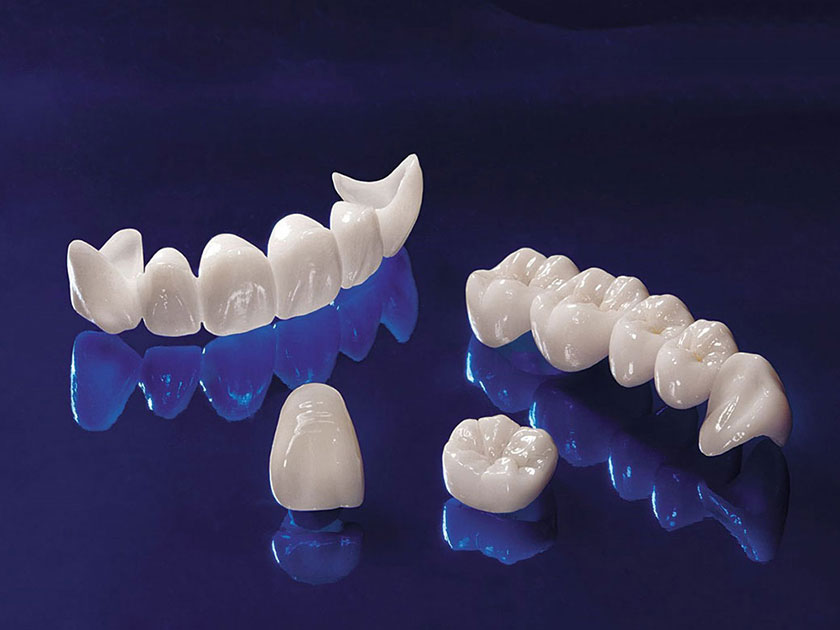
The evolution of materials isn’t about replacement; it’s about convergence.


2. Understanding Material Behavior – The Science Beneath the Surface


To design restorations that last, labs must understand how ceramics behave beyond their catalog values.

1. Microstructure and Strength


Zirconia’s strength (900–1,200 MPa) comes from transformation toughening — crystals expand when stressed, stopping cracks from spreading. But as translucency increases (with 5Y or 6Y yttria content), crystal size grows, and flexural strength drops. VCAD balances these trade-offs by matching materials to indication:

  • Posterior bridges → 3Y-TZP zirconia (high strength).


  • Anterior veneers → 5Y or 6Y zirconia (high translucency).


2. Optical Properties and Light Dynamics


Ceramics interact with light differently depending on their crystalline density and glass content. Translucent ceramics refract light in a way that mimics enamel scattering. VCAD technicians calibrate layer thickness to control brightness gradients — ensuring vitality without excessive translucency that may gray out the tone.

3. Thermal Expansion and Bonding


Each material expands differently under temperature changes. VCAD engineers verify the Coefficient of Thermal Expansion (CTE) compatibility between frameworks and veneering porcelains to prevent delamination.

4. Aging and Hydrothermal Stability


Zirconia can undergo low-temperature degradation when exposed to moisture. Through controlled sintering cycles and surface polishing, VCAD minimizes this transformation, extending long-term stability.

This scientific precision transforms ceramics from artistic guesses into predictable engineering materials.

As one VCAD technician puts it: “We don’t just match shades — we match physics.”

3. Multilayer Zirconia – Engineering Light and Strength


Multilayer zirconia represents one of the greatest achievements in dental material innovation. It combines gradient translucency with color saturation, mimicking natural enamel-to-dentin transition.

At VCAD, multilayer blocks are carefully selected and milled with directional orientation in mind — the top layer reserved for enamel translucency, the middle for chroma, and the base for strength.

1. Optical Gradient Design


By digitally aligning crown orientation with material gradient, designers ensure that incisal edges capture light naturally while cervical areas retain warmth. This avoids the “flat white” appearance typical of early zirconia restorations.

2. Strength Gradient Simulation


Finite element analysis (FEA) within VCAD’s CAD system simulates stress distribution during mastication. The stronger base of the zirconia bears occlusal load, while the translucent layer handles esthetics. This prevents catastrophic failure while maintaining lifelike appearance.

3. Controlled Sintering Profiles


Different layers of zirconia shrink at slightly different rates during sintering. VCAD uses custom sintering schedules, developed through years of calibration, to equalize contraction and prevent internal tension.

4. Surface Texture and Glaze Optimization


Once milled, each restoration undergoes precision polishing. Smooth surfaces reduce plaque retention and increase optical clarity — because a perfectly finished surface reflects light more uniformly, appearing more “alive.”

Through this methodology, VCAD achieves the ideal marriage of physics and perception — restorations that work hard and look effortless.

4. The Rise of Hybrid Ceramics and Composite Materials


The next frontier in dental material science is not pure ceramic — it’s hybridization.

Hybrid ceramics combine ceramic fillers with polymer matrices to mimic the elasticity of dentin while preserving esthetics. Examples include VITA Enamic, Cerasmart, and other nano-resin composites.

VCAD uses hybrid materials strategically for specific indications: long-term temporaries, minimally invasive restorations, and implant provisional frameworks.

Key advantages include:

  • Shock Absorption: The polymer network absorbs occlusal stress, reducing chipping.


  • Milling Efficiency: Hybrids mill faster and with less tool wear.


  • Repairability: They can be easily polished or re-bonded chairside.


However, hybrid materials require disciplined calibration. Their lower modulus means they deform slightly under pressure, demanding precise cement space settings and bonding protocols.

To manage this, VCAD’s AI system adjusts cement gap automatically based on the chosen hybrid material’s modulus of elasticity.

These adaptive workflows ensure consistency even when working with materials that behave unpredictably in less controlled environments.

The message is clear: the future of dental ceramics isn’t rigidity — it’s responsive intelligence.


5. Data-Driven Material Selection – Precision Through Knowledge


Material choice is no longer a matter of habit or brand loyalty; it’s a decision grounded in data.

VCAD’s Material Intelligence Platform tracks every restoration produced: what material was used, where it was placed, how long it lasted, and what clinical feedback it received.

Over time, this creates a living database that reveals performance patterns:

  • Which zirconia brands deliver lowest fracture rates.


  • Which translucency levels best match natural enamel in different ethnic skin tones.


  • Which sintering profiles yield the most consistent fits.


This data feeds directly into VCAD’s Material Recommendation Engine, guiding technicians and partner clinics toward evidence-based choices.

The system turns experience into algorithmic knowledge. Instead of guessing, VCAD predicts.

And because material science evolves constantly, the lab maintains active collaboration with universities and suppliers to test emerging ceramics — from graphene-reinforced composites to bio-active glass hybrids that promote tissue integration.

Ultimately, VCAD views material innovation not as a product race but as an ethical commitment: to deliver restorations that are safer, stronger, and scientifically justified.


Conclusion


Ceramics are no longer inert materials — they are engineered ecosystems where light, structure, and chemistry interact.

At VCAD Dental Outsourcing Lab, understanding these interactions defines the very concept of precision. From multilayer zirconia to hybrid composites, each material is not just selected but studied, calibrated, and continuously improved through data feedback.

This fusion of material science and digital engineering elevates dentistry from craftsmanship to evidence-based artistry.

Because in the end, the patient never asks what brand of zirconia was used — they simply trust that their smile feels natural, functions perfectly, and endures over time.

That trust is built on invisible science. And at VCAD, science is not behind the smile — it is the smile.

Beyond Aesthetics: Functional Occlusion Design in the Digital Era


In dentistry, beauty captures attention, but function sustains satisfaction. A restoration can look flawless under studio lights yet fail in the patient’s mouth if it disregards one fundamental truth — the harmony of occlusion.

As digital dentistry evolves, it’s tempting to focus on color, texture, and translucency while underestimating occlusal dynamics. Yet behind every long-lasting smile lies the invisible architecture of force balance, muscle adaptation, and biomechanical logic.

At VCAD Dental Outsourcing Lab, functional occlusion design isn’t an afterthought; it’s the backbone of precision. Every CAD case, from a single veneer to a full-arch restoration, is shaped not only by esthetics but by physics — the science of how teeth move, meet, and endure.

Let’s explore how the digital era is transforming functional occlusion from guesswork into a data-driven discipline, and how VCAD engineers that transformation every day.

1. Why Function Defines Longevity


Dental restorations live in a battlefield of pressure. Every bite, swallow, and grind applies complex multidirectional forces. The difference between a restoration that lasts 10 years and one that fractures in 10 months often comes down to how well it respects occlusal harmony.

Traditional design relied heavily on technician intuition — the “eye and feel” method. But this approach couldn’t fully predict micro-interferences, eccentric contacts, or muscle-driven stress points. Once digital design arrived, it promised mathematical perfection — yet early CAD systems often oversimplified real occlusion, producing restorations that looked ideal on-screen but required endless chairside adjustments.

VCAD’s philosophy bridges both worlds: digital precision guided by clinical intelligence.

Before any design begins, each scan is analyzed through occlusal mapping software that detects high-pressure zones based on 3D articulation models. These maps visualize where forces concentrate, allowing technicians to adjust cusp angles and contact areas accordingly.

But the process doesn’t end in software. Every adjustment is grounded in clinical logic — maintaining anterior guidance, preserving posterior stability, and ensuring disclusion during lateral movement.

In short, the goal isn’t simply to make a crown that fits — it’s to make one that behaves correctly.

Aesthetic perfection draws admiration; functional perfection earns loyalty.


2. The Science Behind Functional Occlusion


Occlusion design is both mechanical and biological. It’s where dental anatomy meets muscle physiology and material engineering.

  1. Biomechanics of Force Distribution
    Every occlusal contact transfers load through enamel, dentin, bone, and muscle. Imbalanced contacts amplify stress on individual units, causing microcracks or TMJ discomfort. Digital tools at VCAD simulate load paths, ensuring forces disperse symmetrically across the arch.

  2. Dynamic Motion Analysis
    Using virtual articulators integrated with CAD systems, VCAD recreates mandibular movement in all three planes. Instead of designing in static bite, technicians visualize motion — protrusive, lateral, and retrusive. Each movement reveals how cusps should rise, glide, and release.          

  3. Material–Force Compatibility
    Different materials behave differently under load. A zirconia crown tolerates compressive stress but risks chipping under sharp lateral force. Lithium disilicate offers beauty but needs thickness optimization. VCAD calibrates occlusal anatomy based on both material mechanics and functional demand.

  4. AI-Assisted Occlusion Prediction
    Through thousands of analyzed cases, VCAD’s AI algorithms now predict probable interference zones for specific tooth types and prep styles. When a CAD designer models an upper molar, the system flags potential collision points even before simulation.


This fusion of science and data ensures that every restoration embodies both beauty and biomechanical wisdom. Function, once invisible, becomes measurable — and therefore controllable.

3. Digital Tools that Redefine Functional Precision


The revolution of occlusion design lies in how software, scanning, and simulation technologies merge into one intelligent pipeline.

1. Digital Articulation & Real-Time Feedback


VCAD employs advanced articulator modules in 3Shape and Exocad to simulate movement dynamically. Technicians can adjust cusp inclines while observing virtual jaw motion. Any excessive contact automatically highlights in red, indicating high-load regions.

This replaces guesswork with geometry. Adjustments are quantified: “reduce 0.2 mm” instead of “just a bit lower.”

2. Occlusal Clearance Optimization


Before milling, the system verifies minimal clearance between opposing surfaces based on cement thickness and material requirements. This ensures bonding integrity without over-reduction.

3. Integration with Intraoral Scanner Data


Every patient’s bite record differs slightly from the articulator default. VCAD aligns digital bite data directly from intraoral scanners to the CAD design, achieving true patient-specific articulation.


4. Force Heatmaps and Predictive Modelling


An internal VCAD innovation — the “Force Heatmap Dashboard” — overlays visual pressure distribution on digital models. Designers instantly see high-stress points, modify anatomy, and confirm correction before milling.

These digital systems allow VCAD to maintain functional repeatability across thousands of cases monthly. What used to depend on manual artistry now rests on measurable parameters — without losing the human intuition that interprets them.

In dentistry, precision doesn’t mean rigidity; it means predictability.


5. The Clinician–Lab Feedback Loop


Functional occlusion design cannot exist in isolation — it’s a conversation between the mouth and the monitor.

VCAD has built this loop through clinical feedback integration. Every partner clinic contributes performance data:

  • Chairside adjustment time per case. 

  • Patient comfort ratings after insertion. 

  • Follow-up reports on wear or fracture. 


This information feeds back into VCAD’s AI performance model, refining design algorithms and technician training.

When patterns emerge — for instance, a specific occlusal morphology producing slight high contacts in posterior second molars — VCAD updates its global design library to prevent recurrence.

This loop transforms experience into evolution. Each restoration doesn’t just serve one patient; it teaches the system how to serve the next better.

Moreover, VCAD encourages two-way communication:
Clinicians can mark adjustments directly on digital models and upload them back to the portal. The lab team reviews and tags these modifications, ensuring knowledge retention.

The outcome is a constantly learning ecosystem — a lab that improves not by assumption but by accumulation.

Functional excellence, after all, is not built in one design — it’s cultivated through continuous feedback.


6. Function Meets Esthetics – The Philosophy of Balance


It’s easy to imagine esthetics and function as opposing forces — one emotional, one technical. But in reality, they are inseparable. The most beautiful smile collapses without proper function, and the most functional crown feels foreign if it lacks visual harmony.

VCAD’s design philosophy embraces both through the principle of “aesthetic biomechanics.”

Every restoration follows three rules:

  1. Form Follows Function – The anatomy mirrors natural wear patterns, ensuring both comfort and realism. 

  2. Light Follows Contour – Proper cusp curvature enhances reflection, creating natural brightness without over-staining. 

  3. Color Follows Movement – Translucency gradients are adjusted along functional paths, imitating how natural enamel thins toward occlusal edges.


This synthesis allows technicians to design restorations that work like nature and look like art.

The digital era doesn’t replace the human eye — it refines it. Tools amplify intuition; data strengthens creativity.

For VCAD, the ultimate measure of success isn’t the scan, the software, or even the smile. It’s time itself — how long the restoration endures without losing beauty or balance.

Because when function and esthetics move together, time becomes their witness.


In modern dentistry, technology is no longer the main bottleneck — communication is. A restoration can be designed with sub micron precision, yet fail clinically because the message between dentist and lab was lost in translation.

This invisible gap costs time, trust, and money. A misinterpreted shade note, an unclear margin, or an incomplete prescription can turn hours of technical work into waste. For global digital workflows, where clinicians and technicians may be thousands of miles apart, clarity isn’t optional — it’s the foundation of quality.

At VCAD Dental Outsourcing Lab, communication is treated as a process, not an afterthought. The lab has built a Communication Framework that merges digital tools, standardized language, and human understanding into one system of collaboration. Here’s how it works — and why it redefines global dental partnerships.


1. The Root Problem: Lost in Translation


Every dental case begins as an idea — the clinician’s vision of what the patient needs. But by the time that vision reaches the lab, it often gets diluted through incomplete data, inconsistent terminology, or assumptions about design intent.

A common example: the dentist requests “more translucency on the incisal edge,” but the technician interprets it as “lighter shade at the tip.” The result? Two different aesthetics, one unhappy patient.

These misalignments stem from a deeper issue: the two professions speak different dialects of the same language. Clinicians think in terms of biology, occlusion, and patient emotion; technicians think in design geometry, material behavior, and manufacturability.

VCAD recognizes that bridging this gap requires more than polite emails. It requires a shared structure of meaning — a way for both sides to interpret and respond consistently.

That’s why every case begins with a structured digital prescription (VCAD Rx) that translates clinical intent into standardized design parameters:

  • Restoration type & material 

  • Preparation depth & margin line visibility 

  • Occlusal scheme preferences 

  • Esthetic reference photos and shade mapping 


The Rx form isn’t just a checklist — it’s a communication translator. It forces clarity before design begins, reducing the probability of subjective misunderstanding.

When information is clear, collaboration becomes predictable — and predictability breeds trust.

2. The Three-Layer Communication Model


VCAD’s communication system operates on three coordinated layers: Data, Design, and Dialogue.

1. Data Layer – The Foundation


This is where structure lives. Every case uploaded to VCAD passes through data verification software that ensures files, Rx forms, and images match the clinician’s prescription. AI-driven tools flag inconsistencies such as missing bites, incomplete scans, or mismatched material codes.
This foundation prevents the “garbage-in, garbage-out” effect that plagues many labs.


2. Design Layer – The Visualization Bridge


Once data is verified, technicians work within VCAD’s cloud-based 3D environment, which supports live annotations. Clinicians can view the evolving design in real-time, rotate models, and leave comments directly on the geometry.
This visual collaboration eliminates ambiguity — “a bit thinner” becomes “reduce 0.2mm on distal cusp.”


3. Dialogue Layer – The Human Element


Even with perfect data and visualization, empathy matters. Each clinic is assigned a dedicated case coordinator — a bilingual professional trained in both clinical and technical communication. They interpret subtle intentions that machines can’t: tone, urgency, and nuance.
This human layer ensures that messages are not only delivered but understood.

These three layers work like a neural network: the data supplies memory, the design provides structure, and the dialogue adds emotion. Together, they make digital collaboration human again.


3. Turning Asynchronous Workflows into Real-Time Collaboration


Time zones once made global partnerships inefficient. A dentist in California sends feedback at 5 PM, and the lab in Asia responds the next morning — valuable hours lost.

VCAD flips this limitation into an advantage. Its time-zone synchronization protocol ensures that design and feedback cycles flow continuously:

  • North American clinics send cases at day’s end. 

  • VCAD’s technicians, working overnight (Asia time), process and design. 

  • By the next morning, cases await review — effectively a 24-hour workflow loop. 


To enhance this, VCAD built a real-time communication dashboard inside its cloud system. Clinicians can:

  • Leave voice or text notes directly within the design case. 

  • Tag priority levels (“urgent,” “esthetic-sensitive,” “review pending”). 

  • Receive automatic notifications when revisions are uploaded. 


This “design while you sleep” model increases global productivity without additional staff. More importantly, it reduces stress for clinicians who no longer chase updates.

For complex restorations — such as full-arch or implant hybrid cases — the dashboard enables synchronous co-design sessions. Both dentist and technician can manipulate the same 3D model simultaneously, discussing contour or gingival support in real time.

By converting asynchronous workflows into a conversation loop, VCAD transforms the global distance into an operational advantage.

4. Standardizing Aesthetic and Functional Communication


The hardest part of lab communication isn’t shade — it’s perception. “Natural translucency,” “warm tone,” “balanced emergence” — these are artistic terms, not numerical data. And yet, they define success.

VCAD’s solution is standardization through reference systems.

The lab uses calibrated light boxes and photographic protocols aligned with Munsell color principles and digital spectrophotometer readings. Clinicians receive a VCAD Shade Guide Protocol, instructing how to capture consistent lighting and angles using common smartphones.

When the image enters the system, AI-based color calibration adjusts for lighting bias, aligning it with VCAD’s internal reference library of 5,000+ shade samples.

For functional aspects, VCAD employs the Functional Matrix Library, which categorizes morphology patterns based on occlusal schemes and age profiles. Instead of ambiguous phrases like “youthful cusp,” clinicians can select a predefined morphology type (“FM-3, moderate cusp, anterior guidance dominant”).

These standardized systems make communication scientific without losing artistry. They give structure to subjectivity — ensuring that both sides visualize the same outcome.

The result: fewer revisions, faster approvals, and restorations that look exactly as imagined, across cultures and continents.

5. The Cultural Element – Trust Beyond Technology


The final bridge isn’t built from software or systems; it’s built from understanding.

Global collaboration means navigating different languages, expectations, and communication styles. VCAD trains every team member not just in English proficiency but in cultural empathy — understanding how clinicians from different regions express feedback.

For example, a Japanese partner may imply dissatisfaction politely (“perhaps the shade is a little strong”), while an American dentist may give direct, technical critique. Both carry the same intent, but require different listening skills.

This attention to nuance prevents small misunderstandings from becoming large tensions. It’s why VCAD’s coordinators are trained to read tone as carefully as data.

Every message, whether digital or human, goes through the same test: Did we truly understand what was meant?

In the end, technology connects devices; communication connects people.

The VCAD Communication Framework proves that clarity is not the opposite of creativity — it’s the condition that allows creativity to flourish. By aligning clinicians and technicians through data, design, dialogue, and empathy, VCAD turns outsourcing into partnership, and partnership into precision.


1. The Evolution of Chair side Efficiency


Dentistry has entered an age of immediacy — patients expect same-day consultations, instant simulations, and rapid delivery. Yet, speed often collides with complexity: digital workflows remain fragmented, files incomplete, and communication lagging across time zones. The result? Lost hours and frustrated patients.

VCAD Dental Outsourcing Lab redefines this reality. Its Digital Case Planning System turns fragmented steps into a continuous, connected workflow — where clinicians, coordinators, and technicians collaborate in real time. Automated verification screens every uploaded file within minutes, ensuring every case starts from a complete foundation. What once felt like a digital bottleneck now flows as a synchronized rhythm between clinic and lab.


2. Data Validation – From Error Checking to Data Confidence


True efficiency begins the moment a scan is captured. VCAD’s Data Validation System performs the “invisible miracle” — catching micro-errors before they multiply. Every file passes through three automated filters for geometry, margin visibility, and bite alignment.

When irregularities arise, an AI-generated report suggests corrections instantly. Then, a human coordinator reviews all data manually, cross-checking shade, prescription, and materials before design begins. This hybrid model of automation and human precision cuts turnaround time by up to 35% and significantly reduces remakes. For dentists, this means confidence from the first click — not the final fit.


3. Visual Communication – The Power of Real-Time Understanding


Explaining translucency or contour by email is like describing color over the phone. VCAD bridges this communication gap with its Digital Visualization Platform. Clinicians preview designs in interactive 3D, rotate models, leave annotations, and approve in-browser.

This tool also transforms patient consultations: seeing a live 3D preview of their future smile builds trust and accelerates decisions. For clinicians, it minimizes revisions; for patients, it replaces uncertainty with understanding. Communication becomes collaboration — and every case begins with mutual clarity.


4. Global Collaboration – Turning Time Zones into Time Savings


VCAD’s strategic location in Vietnam creates a 24-hour production loop for global clients. A clinic in Los Angeles uploads cases at 5:00 PM — VCAD’s team begins design immediately, and by the next morning, results are ready for review.

This near-overnight workflow effectively grants clinicians an extra working day each week. Combined with VCAD’s 8-hour CAD design and 2-day production guarantee, practices manage up to 30% more cases without extra staff. Time difference becomes a competitive edge, not an obstacle — the dental world’s version of compounding efficiency.


5. Integration and Human Partnership – Efficiency That Scales


Efficiency doesn’t stop at the lab. VCAD integrates with major scanners like 3Shape, Medit, and iTero via open APIs for seamless file transfer, auto-Rx attachment, and two-way case tracking. For clinics with in-house milling, validated CAD files are delivered ready to nest and mill — saving minutes on every case.

Behind the technology stands human intelligence: each client has a dedicated coordinator overseeing every detail. This partnership transforms outsourcing into extension — a digital department that never sleeps.

The result is strategic efficiency: data validated, communication visualized, time zones optimized, and people empowered. Chair side speed no longer depends on working harder — but on working in harmony.

VCAD’s Digital Case Planning turns what used to be a linear process into a living loop — where every scan starts a conversation, and every conversation ends in a smile.


We are proud to be the silent partner behind your practice's success.


📩 support@vcaddental.com

📍 WhatsApp/Viber/Telegram: (+84) 866 664 015


1. Introduction: Why Benchmarking Matters in Dental Outsourcing


The dental industry has become increasingly global. Today, a clinician in New York, Paris, or Singapore can easily collaborate with a dental lab located thousands of miles away. Outsourcing is no longer just about cost savings—it is about accessing world-class technology, improving efficiency, and ensuring predictable outcomes for patients.

Yet with so many choices, from well-established labs in the United States and Europe to highly specialized centers in Japan and emerging hubs in Asia, dentists face an important question: which lab offers the best balance of quality, speed, and value? This is where benchmarking becomes critical. By comparing different labs across regions, clinicians can understand how factors like technology adoption, cost structures, quality control, and turnaround times vary worldwide.

Benchmarking also allows dentists to identify partners that align with their clinical philosophy. For some, cost reduction may be the priority; for others, premium esthetics or global certifications matter more. The ideal outsourcing partner is one that delivers across all dimensions.

VCAD Dental Outsourcing Lab, based in Vietnam, positions itself at this intersection. By adopting international standards while leveraging local efficiency, VCAD competes directly with established global players. The question then becomes: how does VCAD compare when benchmarked against leading labs in the US, Europe, and Japan?


2. Global Labs: The Established Standards


To understand where VCAD stands, it is important to first look at how global labs operate in key regions:

  • United States and Europe
    Labs in these regions are recognized for their strict adherence to quality standards and regulatory frameworks. They typically use the latest CAD/CAM technologies, advanced ceramics, and precise workflows. However, high labor costs and overhead expenses mean that restorations often come at a premium price. Turnaround times may also be slower, especially for complex cases, due to higher case volumes and more rigid processes.

  • Japan
    Japanese labs have earned a reputation for meticulous craftsmanship and extraordinary attention to detail. Their restorations are often considered among the most esthetically precise in the world. However, the Japanese market tends to be more inward-focused, with many labs primarily serving domestic clinics. Costs are also relatively high, and accessibility for international dentists is limited.

  • Emerging markets
    In regions such as Southeast Asia, some labs offer low-cost solutions but lack consistency, international certifications, or reliable logistics. While pricing is attractive, dentists may face higher remake rates or concerns about patient safety if global standards are not met.


These benchmarks highlight the trade-offs: premium quality often comes with higher costs and slower turnaround, while lower-cost options risk compromising consistency. For international clinicians, the challenge is finding a partner that bridges these extremes.


This is where VCAD positions itself uniquely—offering global-level standards with the efficiency and flexibility of an emerging market leader.

3. Where VCAD Stands: Competitive Advantages


When benchmarked against leading dental labs in the US, Europe, and Japan, VCAD Dental Outsourcing Labdemonstrates a unique balance of quality, efficiency, and cost-effectiveness. Unlike many emerging-market labs that compete solely on price, VCAD has positioned itself as a global-standard partner with several distinct advantages.

  1. International certifications (CE, FDA, ISO)
    VCAD uses only materials that meet international regulatory requirements. This aligns the lab with the same safety and quality benchmarks followed by US and European labs. For international clinicians, this provides peace of mind that every restoration is biocompatible, safe, and long-lasting.

  2. Digital-first workflows
    While global labs have adopted CAD/CAM technology, VCAD operates as a fully digital lab. From intraoral scan intake to 3D CAD design, milling, and sintering, every step is digitized for precision. Using platforms like Exocad and 3Shape, VCAD produces restorations with micron-level accuracy, reducing chairside adjustment times for dentists.

  3. Faster turnaround times
    Turnaround time is one of the most significant differentiators. US and European labs often require 2–3 weeks for complex cases, while VCAD delivers in 3–5 working days for single crowns and 7–10 working days for full-arch restorations, including international shipping. This speed allows clinics to improve patient satisfaction and maximize chair utilization.

  4. Cost efficiency without quality compromise
    Operating in Vietnam allows VCAD to optimize labor and operational costs, passing savings on to clinics. Yet, unlike many low-cost labs, VCAD does not sacrifice consistency. Its focus on QC and technician expertise means clinics gain the dual advantage of affordability and predictability.

  5. Transparency and communication
    VCAD distinguishes itself through open collaboration. Dentists are invited to review 3D designs online before production, ensuring every case is approved and aligned with clinical requirements. This reduces the likelihood of remakes and builds trust with international partners.

  6. Specialized technician expertise
    While global labs employ highly trained staff, VCAD has developed teams specialized in areas such as implant frameworks, esthetic anterior crowns, and full-arch zirconia. This specialization ensures that even complex cases are handled by technicians with the right expertise.


Taken together, these advantages show that VCAD is not simply another outsourcing option—it is a lab that competes directly with established players on quality while outperforming them in speed and cost efficiency.

4. The Global Positioning of VCAD


When viewed on the global dental map, VCAD occupies a strategic position that bridges the gap between Western precision and Asian agility. This positioning is especially attractive to clinics seeking to balance international quality with economic sustainability.

A bridge between East and West
US and European labs deliver exceptional quality but at high costs, while many emerging-market labs offer low prices but inconsistent standards. VCAD combines the best of both worlds: certified materials, rigorous QC, and digital workflows—at a cost structure that enables clinics to remain competitive.

Trusted by international clinics
VCAD’s growing client base across North America, Europe, and Asia-Pacific demonstrates its ability to serve diverse markets. International dentists report lower remake rates, reduced chairside adjustments, and consistent delivery schedules. This reliability has helped VCAD establish itself as a long-term outsourcing partner rather than just a low-cost alternative.

Scalability for global demand
Unlike small boutique labs in Japan or Europe that may have limited capacity, VCAD’s infrastructure is designed to scale. With advanced milling centers, experienced teams, and efficient logistics, the lab can handle both single-unit cases and high-volume submissions without compromising quality.

Positioning for the future of global dentistry
As outsourcing becomes the norm in dentistry, VCAD positions itself not as a follower but as a trendsetter in Asia. Its commitment to sustainability (eco-friendly workflows and responsible sourcing), investment in new technologies like 3D printing, and emphasis on clinician collaboration ensure that it stays ahead of global trends.

In benchmarking terms, VCAD competes head-to-head with Western labs on quality, outperforms them on speed, and surpasses them on value. For clinicians worldwide, this combination makes VCAD a strategic partner for the future, capable of supporting growth, patient satisfaction, and clinical excellence.

5. Conclusion: Why VCAD Sets a New Benchmark


Benchmarking global dental labs reveals a clear pattern: while Western labs are synonymous with high quality, they come with high costs and slower turnaround. Japanese labs excel in precision but remain inward-focused, limiting accessibility for international clinics. Emerging-market labs may offer competitive pricing, yet often lack consistency and global certifications.


In this landscape, VCAD Dental Outsourcing Lab establishes itself as a new benchmark—a lab that delivers international standards with the agility of an emerging hub. By combining CE, FDA, and ISO-certified materials with fully digital workflows, VCAD ensures restorations meet the same durability and esthetic expectations as those produced in the US or Europe. Its turnaround times, however, are faster, and its cost structures more sustainable for clinics seeking to scale globally.

What sets VCAD apart is not only efficiency but also transparency and collaboration. Clinicians remain part of the design process through digital previews, while multi-layered QC guarantees consistent outcomes. This approach transforms outsourcing into a strategic partnership rather than a transactional service.

For international dentists and clinics, VCAD offers more than restorations—it offers confidence. Confidence in predictable outcomes, in on-time delivery, and in a partner committed to continuous improvement. In short, VCAD does not just participate in global dental outsourcing; it redefines the standard, proving that high quality, speed, and cost-effectiveness can coexist.

Contact us via:

Phone: (+84) 866 664 015

Email: support@vcaddental.com

Facebook: facebook.com/vcadoutsourcingdentallab


TikTok: tiktok.com/@vcaddentallab0

1. Introduction: Why Remakes Happen and What They Teach Us


In restorative dentistry, remakes are inevitable. Even the most experienced clinicians and the most advanced labs occasionally face cases where restorations do not meet the expected clinical outcome. It could be a crown that does not seat properly, a bridge that fractures under pressure, or an implant restoration that fails to integrate seamlessly. For many, these situations feel like failures. However, for forward-thinking labs, remakes are not simply errors to correct but valuable lessons to refine workflows and strengthen partnerships.

Research and clinical practice both confirm that remakes are among the most common sources of frustration for dentists. They increase chairside time, disrupt patient schedules, and add costs that neither the clinic nor the patient anticipated. Yet the real problem is not the remake itself—it is how the lab responds. Some labs hide mistakes, shift blame, or provide vague explanations. This approach erodes trust and creates long-term doubts about reliability.


At VCAD Dental Outsourcing Lab, remakes are treated differently. Rather than regarding them as failures to conceal, VCAD views them as opportunities for transparency, problem-solving, and continuous improvement. Each case is carefully analyzed, documented, and shared with the dentist to ensure accountability and collaboration. This philosophy not only resolves the immediate clinical issue but also prevents similar problems in the future.

By positioning remakes as part of an ongoing quality-improvement cycle, VCAD demonstrates that trust is built through openness and expertise. For international clinics, this means confidence in a partner that does not shy away from challenges but instead turns them into proof of professionalism.

2. Common Causes Behind Complex Remakes


To understand why remakes happen, it is important to recognize the most common factors that compromise restoration success. These issues may arise from the dentist’s clinic, the lab’s workflow, or a combination of both:

  • Impression or scan errors
    Poor-quality impressions or incomplete intraoral scans can distort the patient’s anatomy. This often leads to crowns or bridges that do not seat properly, requiring costly adjustments or complete remakes.

  • Margin design flaws
    If margins are not clearly defined in the digital design stage, restorations risk poor adaptation, resulting in open contacts, recurrent decay, or patient discomfort.

  • Occlusal inaccuracies
    Even small miscalculations in occlusion or contact points can cause fractures, uneven force distribution, or pain. This is particularly critical in implant-supported restorations, where load distribution must be exact.

  • Material mismatch
    Choosing the wrong material for a given clinical situation can undermine longevity. For example, using a weaker ceramic in high-stress posterior regions often results in early fractures.

  • Manufacturing inconsistencies
    Errors during milling, sintering, or finishing can weaken the restoration. Variations in firing cycles or inadequate surface finishing may compromise both esthetics and strength.


At many labs, these issues may repeat because errors are not properly analyzed or communicated. At VCAD, however, each remake is investigated through a root cause analysis. By identifying whether the problem originated in impression quality, CAD design, material choice, or production execution, the lab ensures that the lesson becomes part of a continuous improvement system.

For dentists, this approach provides reassurance that mistakes are not swept under the rug. Instead, they are studied, explained, and corrected in ways that prevent recurrence. Over time, this level of accountability translates into higher success rates, fewer remakes, and greater patient trust.

3. VCAD’s Approach: Transparency and Root Cause Analysis


The difference between an average lab and a trusted partner lies in how they handle setbacks. At VCAD Dental Outsourcing Lab, every remake is approached not as a problem to cover up but as a case study for improvement. This philosophy is what sets VCAD apart in the competitive landscape of international outsourcing.


Full documentation and reporting
When a remake request arrives, VCAD immediately retrieves all associated documentation: original design files, milling parameters, QC photos, and shade records. This ensures the investigation begins with a comprehensive picture of what went wrong. Instead of vague explanations, dentists receive clear and detailed feedback supported by evidence.

Engaging the clinician in analysis
Unlike labs that simply reprocess the case internally, VCAD encourages direct collaboration with the dentist. Using the original intraoral scans or impressions, technicians walk the clinician through the potential causes—whether it was unclear margin capture, occlusal imbalance, or material stress issues. This process not only identifies the source of failure but also strengthens the professional relationship through shared accountability.

Root cause investigation
The goal is never to assign blame but to identify the exact failure point. For example:

  • If the problem lies in the initial impression, VCAD provides feedback and guidance to prevent recurrence.

  • If the issue arose in CAD design, the lab’s senior technician revises the design parameters and updates internal protocols.

  • If manufacturing inconsistencies are found, equipment calibration or workflow adjustments are implemented.


Transparency as trust-building
Clinics around the world value VCAD because of this open-book approach. Rather than keeping errors hidden, VCAD uses remakes to demonstrate its professionalism, showing dentists that their outsourcing partner is committed to continuous improvement and long-term reliability.

4. From Failure to Predictable Success


Once the root cause has been identified, the remake process at VCAD is designed not only to correct the problem but also to upgrade the case to a higher level of success. This mindset transforms remakes from setbacks into opportunities for clinical excellence.

Enhanced CAD/CAM design protocols
If the issue involved margins or occlusion, VCAD introduces a double-check system where two technicians review the design before approval. Dentists are invited to view the updated design via online platforms, ensuring they are satisfied before the case enters production. This collaborative safeguard dramatically reduces the risk of repeat remakes.

Material optimization
In cases where material selection contributed to failure, VCAD shifts to more durable alternatives. For example, a fractured lithium disilicate crown may be remade using multilayer zirconia to handle posterior bite forces, while still meeting esthetic expectations. This proactive adjustment ensures the remake not only solves the immediate issue but also extends longevity.

Stronger quality control (QC) protocols
Remake cases often undergo heightened scrutiny. In addition to standard checks, VCAD’s QC team inspects internal fit, marginal seal, shade matching, and occlusal contact with extra rigor. High-resolution photos are shared with dentists, giving them visibility into the improved workflow.

Predictable outcomes for clinicians and patients
The greatest benefit of VCAD’s remake philosophy is predictability. Dentists can assure their patients that, even when initial complications arise, the lab will deliver a corrected restoration that meets international standards. For patients, this builds trust—not only in their dentist but also in the overall treatment journey.

Turning remakes into learning models
Every remake is logged into VCAD’s internal knowledge base, where technicians and managers use it as a training tool. Over time, these lessons accumulate into a refined workflow that reduces remake frequency overall. This institutional memory is why VCAD consistently reports lower remake rates compared to average international labs.

Case example
A complex full-arch zirconia case from a European client once required a remake due to occlusal discrepancies. Instead of simply re-milling, VCAD initiated a collaborative session with the dentist, redesigned the occlusion with input, and applied upgraded sintering cycles. The remake not only resolved the problem but produced a restoration with superior aesthetics and durability. The client later reported reduced chairside adjustment time and higher patient satisfaction.


By adopting this methodical, transparent, and improvement-oriented approach, VCAD ensures that every remake strengthens the partnership with clinicians rather than undermining it.

5. Conclusion: Trust Built Through Transparency


In dentistry, remakes are often viewed as setbacks—an inconvenience for clinicians and a frustration for patients. Yet the way a lab approaches these challenges reveals its true professionalism. While some labs downplay errors or leave clinicians without clear answers, VCAD Dental Outsourcing Lab has built its reputation on doing the opposite: embracing remakes as opportunities for growth, transparency, and long-term success.

By applying root cause analysis, VCAD ensures that every issue is studied, documented, and resolved. The lab goes further by actively involving clinicians in the process, sharing digital files, photos, and insights to clarify what went wrong and how it is being corrected. This openness transforms remakes from hidden liabilities into visible demonstrations of accountability.

More importantly, VCAD turns clinical failures into predictable successes. With upgraded CAD/CAM checks, refined material choices, and stricter QC protocols, remakes often result in restorations that outperform the original attempt. Dentists benefit from fewer future complications, while patients receive outcomes that restore confidence in their treatment.

For international clinics, this philosophy provides reassurance that they are not just outsourcing to a lab, but partnering with a team committed to continuous improvement. Trust is not built by avoiding mistakes—it is built by addressing them honestly and ensuring they never recur.

In the end, VCAD proves that transparency is the foundation of reliability. By transforming remakes into case studies for excellence, the lab strengthens its partnerships, reduces long-term remake rates, and delivers on its promise of durable, esthetic, and predictable restorations.

Contact us via:

Phone: (+84) 866 664 015

Email: support@vcaddental.com

Facebook: facebook.com/vcadoutsourcingdentallab


TikTok: tiktok.com/@vcaddentallab0

1. Introduction: The Rise of Global Collaboration in Dentistry


Dentistry has become increasingly global. A clinician in the United States, Europe, or Southeast Asia can now collaborate seamlessly with a dental lab in another country thanks to digital dentistry. This shift has given rise to the outsourcing model, where clinics rely on specialized labs abroad to provide high-quality restorations at competitive turnaround times.

The appeal is clear: outsourcing allows practices to access cutting-edge CAD/CAM technology, reduce overhead costs associated with maintaining an in-house lab, and scale their treatment capacity without hiring additional technicians. However, outsourcing across borders also introduces challenges. Concerns about data security, communication delays, and consistency of quality often discourage clinics from exploring international partners.

This is where VCAD Dental Outsourcing Lab has positioned itself as a trusted partner. By developing a transparent and reliable cross-border case management system, VCAD makes it easy for international clinicians to submit cases, track progress, and receive predictable results. The lab’s workflows are built not only on advanced technology but also on clear communication and strict quality control.


For dentists, this means gaining the advantages of outsourcing without compromising on control. Patients see faster turnaround, esthetic restorations, and functional results, while clinicians can confidently expand their treatment capacity with global support.

2. Step 1: Receiving Digital Submissions from International Dentists


The cross-border workflow begins with digital submission of cases. Instead of relying on physical impressions that must be shipped internationally—a process vulnerable to distortion, damage, and delays—dentists send intraoral scans directly to VCAD’s secure system.

Accepted file formats include STL, PLY, and OBJ, all fully compatible with VCAD’s CAD/CAM platforms. Uploads are encrypted, meeting HIPAA and GDPR standards for patient data protection. This ensures that sensitive information remains safe while traveling across digital borders.

The advantages of this approach are immediate. Digital submissions eliminate courier delays, reduce the carbon footprint associated with shipping, and provide an exact digital replica of the patient’s oral anatomy. Accuracy is preserved from the moment the scan is captured to the moment the design process begins at the lab.

Once a submission is received, VCAD’s intake team reviews the case details and categorizes it—whether it’s a single crown, bridge, implant-supported restoration, or a full-arch case. Each case is then assigned to a technician with specialized expertise in that particular type of restoration. This targeted assignment improves efficiency and ensures that every case is handled by someone with the right skill set.

By making digital submissions fast, secure, and specialized, VCAD turns what could be a logistical challenge into a smooth entry point for international collaboration. Dentists gain confidence knowing that their case begins on a solid, protected foundation—setting the tone for successful outcomes throughout the entire workflow.

3. Collaborative Design and Approval


One of the biggest concerns for clinicians when outsourcing internationally is whether they will lose control over design decisions. At VCAD Dental Outsourcing Lab, the workflow is built around collaborative transparency, ensuring that dentists remain actively involved at every stage of the design process.

Once a digital file is received and reviewed, the case is transferred into CAD platforms such as Exocad or 3Shape. Here, VCAD’s experienced technicians design the proposed restoration, taking into account occlusion, contact points, shade requirements, and the esthetic goals outlined by the clinician. However, unlike traditional labs where the design is finalized without external input, VCAD shares a 3D preview of the design online.


This step allows dentists—and, if desired, their patients—to visualize the restoration before production. Feedback can be given in real time: adjustments to occlusal contact, fine-tuning of margins, or esthetic refinements can all be requested. These modifications are quickly integrated by VCAD technicians, who then resubmit the design for final approval.

The benefits of this approach are twofold. First, it minimizes the risk of remakes by catching potential issues at the digital stage rather than after manufacturing. Second, it empowers clinicians to maintain control even when collaborating across borders. The sense of working “side by side” with a lab in Vietnam, despite being continents away, helps build trust and consistency in international relationships.

This approval-based workflow is especially valuable for complex cases, such as full-arch zirconia or implant-supported bridges, where precision is critical. By ensuring that no restoration moves into production without explicit approval, VCAD guarantees outcomes that match the clinician’s expectations and reduce chairside adjustment times.

4. Precision Manufacturing and Quality Control


Once a design is approved, the case advances to manufacturing, where digital precision is translated into physical reality. At this stage, the quality of equipment, materials, and processes determines whether the restoration will meet international benchmarks for strength, fit, and esthetics.

State-of-the-art milling and sintering
VCAD operates with high-resolution milling units capable of delivering micron-level accuracy. Multilayer zirconia, lithium disilicate (E.max), and biocompatible alloys are milled under strict parameters to ensure durability and a precise fit. Zirconia restorations undergo carefully calibrated sintering cycles lasting up to eight hours, a process that ensures optimal strength while preventing microfractures that could compromise longevity.


Consistency across high case volumes
Handling international cases means working at scale without sacrificing precision. VCAD achieves this through workflow discipline, standardizing milling and sintering parameters while maintaining flexibility for case-specific adjustments. This balance allows the lab to serve multiple countries without variation in quality.

Multi-layered quality control
Manufacturing is followed by rigorous quality checks at multiple stages:

  • Post-milling inspection under magnification to verify internal and marginal fit.

  • Shade verification to confirm consistency with the dentist’s instructions.

  • Final esthetic review after glazing and polishing to ensure lifelike translucency and surface finish.


Cases that fail to meet these standards are reworked in-lab, never shipped to the client. This policy drastically reduces remake rates, saving clinics time and protecting patient trust.

Documentation and transparency
Every completed case is packaged with QC reports and photos documenting the restoration’s accuracy and shade. For international clinicians, this transparency reinforces confidence that what arrives at their clinic has been tested and validated according to global standards.

By combining advanced manufacturing with uncompromising quality control, VCAD transforms international outsourcing into a predictable, low-risk process. Clinics no longer need to worry about unreliable outcomes or inconsistent restorations. Instead, they receive high-quality products that align with CE, FDA, and ISO benchmarks, delivered on time and ready for immediate clinical use.

5. Logistics and On-Time Delivery


For international clinicians, even the best-designed and manufactured restoration becomes meaningless if it does not arrive on time. Delays can disrupt patient schedules, extend treatment plans, and erode trust. Recognizing this, VCAD Dental Outsourcing Lab has made logistics management a core part of its cross-border case system.

Reliable global shipping partners
VCAD collaborates with trusted carriers such as DHL and FedEx to manage international deliveries. These partnerships ensure that restorations are transported quickly and securely, with real-time tracking available for every shipment. Clinicians can monitor the progress of their cases and plan patient appointments with confidence.

Turnaround times designed for global clinics
Speed matters. For single crowns or small bridges, VCAD typically delivers within 3–5 working days, including international shipping. More complex cases, such as implant frameworks or full-arch zirconia, are completed in 7–10 working days. This efficiency rivals local labs in many regions, proving that outsourcing does not mean compromising on speed.

Protective packaging and documentation
Each case is packaged in reinforced boxes designed to withstand long-distance travel. Inside, restorations are secured in custom foam inserts, preventing movement or damage during shipping. Alongside the product, clinicians receive QC documentation and high-resolution photos, ensuring full transparency and confidence before the case is even seated.

Problem-solving and contingency planning
Even with global logistics partners, unforeseen events such as customs delays or flight cancellations can occur. VCAD anticipates these risks by working with multiple carriers and offering proactive communication. If a delay is detected, clinicians are informed immediately and provided with revised delivery estimates, ensuring patients are not left in the dark.

By managing logistics as meticulously as design and production, VCAD bridges the gap between Vietnam and international clinics, making cross-border outsourcing as seamless as working with a local lab.

Conclusion: Why VCAD Is a Trusted Partner for International Dentists


Outsourcing dental cases across borders once seemed daunting. Concerns about data security, inconsistent results, and unreliable shipping often kept clinics from exploring international options. But as dentistry becomes more global and digital, the ability to partner with overseas labs is no longer a luxury—it is a necessity for practices that want to stay competitive.

VCAD Dental Outsourcing Lab demonstrates that international collaboration can be both predictable and rewarding. By combining secure digital submissions, collaborative design approval, precision manufacturing, multi-stage quality control, and reliable logistics, VCAD delivers a seamless workflow for clinicians worldwide.

For dentists, this means reduced costs, fewer remakes, and faster turnaround without compromising quality. For patients, it means restorations that fit, function, and last—delivered on time, every time. And for clinics, it means partnering with a lab that feels like an extension of their own team, regardless of distance.

In a dental world that increasingly crosses borders, VCAD has positioned itself as a trusted global partner—one that ensures every restoration meets the highest international standards while arriving exactly when it is needed.

Contact us via:

Phone: (+84) 866 664 015

Email: support@vcaddental.com

Facebook: facebook.com/vcadoutsourcingdentallab


TikTok: tiktok.com/@vcaddentallab0

REQUEST A TRIAL ORDER

Request Sample Case VCAD