

Category Archives: News

Choosing a Dental Outsourcing partner is not only a purchasing decision. It is a workflow decision that affects case intake, design consistency, turnaround stability, manufacturing predictability, and remake risk across the entire restorative process. For dental labs, clinics, prosthodontists, and oral surgeons, the right partner should do more than accept files and return restorations. The partner should function as a dependable technical extension of the internal workflow.

That distinction matters because outsourcing can either reduce operational pressure or quietly increase it. A partner may appear capable based on service range alone, yet still create friction through inconsistent communication, weak file handling, unclear design standards, or unstable production output. On the other hand, a well-structured outsourcing workflow can improve consistency precisely because it introduces discipline where many internal systems become overloaded or variable.

For this reason, evaluating a Dental Outsourcing partner should not begin with broad claims. It should begin with practical questions. How does the partner review incoming files? How are design decisions controlled? How does the team manage implant-specific requirements? What happens when a case is incomplete? How predictable is the workflow across routine and complex cases? These are the questions that reveal whether the partner supports reliability or merely processes volume.

Reliability begins with workflow discipline, not service breadth


A common mistake is to judge a Dental Outsourcing partner mainly by the number of services listed. A broad menu may sound impressive: crown and bridge, implants, removable dentures, night guards, surgical guides, CAD design support, and other digital solutions. But service breadth alone does not prove operational reliability. A partner can offer many categories and still perform inconsistently if the underlying workflow lacks structure.

A more useful starting point is workflow discipline. A reliable partner should show clear case intake rules, defined review steps, organized communication channels, and technical standards that remain stable from one case to the next. This does not mean every case is treated identically. It means the process is coherent enough that the submitting team knows how cases will be handled and what information is required at each stage.

From one perspective, labs want flexibility. From another, they need predictability even more. The strongest Dental Outsourcing relationships usually combine both: flexibility in case handling, but structure in process. Without that structure, flexibility turns into improvisation, and improvisation is a poor foundation for consistency.

File intake quality is one of the first signs of a serious partner


A reliable outsourcing partner does not treat every submitted case as immediately ready for production. The partner should first determine whether the file package is complete and usable. This is one of the clearest operational indicators of quality because weak intake review often leads to later delays, redesign, or remakes.

In a strong Dental Outsourcing workflow, the intake process should verify scan completeness, restoration type, bite relationships, relevant case notes, and any category-specific requirements such as implant system details or design references. If important information is missing, the partner should identify the issue early rather than designing around assumption.

This matters because a partner who begins work without validating the input may appear fast at first while actually creating hidden instability. A case that moves into CAD with incomplete data can return later with far greater disruption. By contrast, a partner who reviews before designing may appear slightly stricter at intake, but often delivers a more dependable workflow overall.

In practical terms, good intake review is a quality signal. It shows that the partner is protecting the case before value is added, not only inspecting it after risk has already entered the system.

Communication quality matters as much as technical capability


Even highly skilled production teams become unreliable when communication is vague, delayed, or inconsistent. This is especially true in Dental Outsourcing, where the external team does not share the same room, case history, or informal discussions as the sending lab or clinic. If the workflow depends on unspoken assumptions, problems tend to surface later and at higher cost.

A dependable partner should communicate clearly at three stages: before design starts, during clarification if needed, and when the case moves into completion or release. That communication should be precise rather than overly broad. The point is not to generate more messages. The point is to reduce ambiguity.

For example, if scan quality is weak, the partner should specify what is missing. If an implant case lacks component clarity, the partner should identify that directly. If a complex case needs more review time, that should be visible early rather than discovered when the expected delivery point has already passed.

There are two different kinds of outsourcing communication. One is reactive and vague, usually appearing only when something has already gone wrong. The other is structured and early, helping the case stay stable before problems grow. A reliable Dental Outsourcing partner should operate in the second mode.

Strong CAD design standards are a core part of reliability


A partner may have capable technicians and advanced software, but reliability still depends on whether design decisions are applied consistently. Similar cases should not receive dramatically different occlusal logic, contact behavior, margin handling, connector planning, or emergence design simply because they were processed on different days or by different designers.

This is why a trustworthy Dental Outsourcing partner should demonstrate stable CAD standards. Crown and bridge cases should reflect repeatable logic in fit, contact, and occlusion. Bridge cases should be designed with consistent attention to connector behavior and insertion logic. Implant restorations should follow disciplined control around component compatibility, access positioning, and restorative space.

The real issue here is not artistic variation. It is technical repeatability. Labs do not gain reliability from stylistic fluctuation. They gain it from design consistency that supports predictable manufacturing and adjustment behavior.

From one angle, CAD design is a creative technical task. From another, it is also a system task. The best partner understands both. The team must be able to adapt to case-specific demands without abandoning core design discipline.

Manufacturing awareness separates true lab partners from pure file processors


One of the most important differences between a useful partner and a weak one is manufacturing awareness. A file processor may produce a visually acceptable design. A real laboratory partner produces a design that is appropriate for how the case will actually be fabricated.

This matters because Dental Outsourcing does not end at the screen. Restorations move into milling, printing, sintering, finishing, assembly, and final inspection. If the design stage ignores manufacturing behavior, the case may look correct digitally while still performing poorly in production. Thickness management, connector structure, access positioning, internal fit logic, and post-processing feasibility all influence whether the restoration remains stable beyond the CAD phase.

A reliable partner therefore designs with production in mind. That is especially critical in implant work, long-span bridges, removable cases, and any workflow where small digital decisions can create large downstream consequences. The more complex the case, the more important this manufacturing awareness becomes.

A practical test is simple: does the partner seem to understand not just how to generate the file, but how that file will behave as a manufactured restoration? If the answer is unclear, the partnership may be technically shallow.

Implant workflow control is a major reliability checkpoint


If there is one area where reliability is easiest to expose, it is implant prosthetics. Implant cases demand stricter control because they involve more than anatomy and occlusion. They depend on library verification, scan body interpretation, retention method, restorative space, component compatibility, and interface precision. A partner who handles implant cases casually is not likely to be reliable elsewhere either.

For Dental Outsourcing, implant workflow control should include early verification of implant-related information before design begins. The partner should not rely on assumption-based library matching or vague component interpretation. Instead, the team should confirm the pathway that the restoration is meant to follow and communicate clearly when essential data is missing.

This does not mean only implant-focused partners are reliable. It means implant workflows reveal how disciplined the overall system really is. A partner that handles implant cases with technical caution, clear review, and consistent logic is more likely to treat other categories with similar seriousness.

In a strange little way, implant cases are honesty machines. They reveal whether the workflow is genuinely controlled or merely looks polished from the outside.

Turnaround reliability is more important than isolated speed


Many teams initially evaluate a Dental Outsourcing partner by asking how fast a case can be completed. That is understandable, but incomplete. Speed matters, yet isolated fast delivery is less useful than stable turnaround behavior across many cases. A partner that returns some files quickly and others unpredictably may create more scheduling difficulty than one whose timelines are slightly more conservative but much more consistent.

A reliable partner should show realistic turnaround behavior tied to case type, case completeness, and workflow conditions. Routine cases may move quickly when the submission is clean. More complex cases may require additional review. That is normal. What matters is whether the partner handles these differences transparently and predictably.

The right benchmark is not only “How fast can they go?” but also “How stable is their process under normal pressure?” Labs and clinics need operational rhythm, not theatrical urgency. In daily dental production, dependable timing is usually more valuable than occasional bursts of apparent speed.

Quality control should be visible throughout the process


A strong Dental Outsourcing partner should not rely on one final inspection point to catch everything. Quality control works best when it appears at multiple stages: intake review, design validation, pre-manufacturing assessment, and final verification. This layered structure is one of the clearest indicators that the partner is serious about reducing avoidable errors.

At intake, QC confirms whether the case is usable. During design, QC checks fit logic, contact behavior, occlusal stability, and category-specific requirements. Before fabrication, QC helps ensure that the design matches the intended production method. After fabrication, QC confirms that the output remains aligned with the approved digital direction.

This matters because many case failures are not caused by one dramatic mistake. They develop through several smaller assumptions that pass unchecked. A layered QC model interrupts that chain earlier. For labs seeking reliability, this is far more important than generic claims about being “quality-focused.”

A partner with real quality discipline usually makes the workflow quieter. Fewer surprises. Fewer clarification loops. Fewer unstable handoffs. In technical environments, boring can be beautiful.

Case compatibility and software handling should reduce friction, not create it


Digital workflows only remain reliable when files move cleanly between systems. That means the outsourcing partner should be comfortable handling the digital environments the submitting lab or clinic actually uses. File compatibility is not just about whether an STL or PLY can be opened. It also concerns how the full case package is interpreted, whether linked data is preserved properly, and whether the workflow avoids unnecessary manual reconstruction.

A dependable Dental Outsourcing partner should make file handling easier, not more fragile. If every submission requires repeated troubleshooting, version checks, or format reinterpretation, the workflow becomes unstable even if the technical team is skilled. The partner should have a clear process for accepted formats, linked case data, and category-specific digital requirements.

This point becomes even more important in complex restorative and implant workflows, where file completeness influences much more than geometry alone. Reliable partners do not treat compatibility as an afterthought. They treat it as part of case readiness.

Consistency across routine cases is often the best proof of trustworthiness


One seductive trap in vendor evaluation is to focus too heavily on exceptional cases. Complex cases matter, of course, but routine case handling is often the better reliability test. A partner may perform well once under special attention and still fail to maintain consistency across daily crown and bridge volume.

For Dental Outsourcing, true trust is built when routine cases behave predictably over time. Fit logic remains stable. Contacts follow known patterns. Communication remains consistent. The team does not reinvent the wheel on every single-unit crown. This is what allows the sending lab or clinic to plan confidently and reduce the mental load of constant oversight.

In other words, a reliable outsourcing partner should not require dramatic management to produce normal results. If the workflow only works when every case is watched closely, the system is not truly dependable.

What a lab should really be looking for


When evaluating a Dental Outsourcing partner, the most useful question is not whether the partner looks advanced. It is whether the partner reduces operational uncertainty. That includes strong intake review, clear communication, repeatable design standards, manufacturing-aware execution, disciplined implant handling, stable turnaround, layered quality control, and practical file compatibility.

These elements are not separate luxuries. Together, they define whether the outsourcing relationship strengthens the workflow or merely relocates its problems. A partner becomes reliable when the submitting team can trust the process, not just the sales description of the process.

Conclusion


A reliable Dental Outsourcing partner should function as a controlled technical extension of the lab or clinic workflow. The right partner does more than accept cases and return restorations. It supports predictability through disciplined intake, clear communication, consistent CAD design, manufacturing-aware thinking, implant-specific control, realistic turnaround behavior, and visible quality checkpoints throughout the process.

For dental labs, clinics, prosthodontists, and oral surgeons, this means the best outsourcing relationship is not necessarily the one with the broadest service list or the boldest speed claims. It is the one that reduces risk, supports consistency, and makes the restorative workflow easier to trust over time.

That is what reliability looks like in practice. Not noise, not bravado, not vague promises—just a workflow that behaves the way a professional laboratory partner should.
 
In a digital restorative workflow, remakes are rarely caused by one dramatic failure. More often, they result from a chain of small inconsistencies: incomplete file submission, unclear case instructions, unstable design parameters, manufacturing variation, or weak communication between clinical and laboratory teams. For dental labs, clinics, prosthodontists, and oral surgeons, this is where Dental Outsourcing becomes more than a capacity solution. It becomes a quality-control strategy.

A well-structured outsourcing workflow can help reduce remakes because it introduces repeatable systems into areas where inconsistency often enters the case. That includes file intake review, CAD design standardization, implant library control, manufacturing alignment, and communication checkpoints before production moves too far downstream. When these processes are managed carefully, the result is not only faster support. It is more predictable restorative output.

This matters because consistency is one of the strongest indicators of laboratory reliability. A dental partner is not judged only by whether a case can be completed. It is judged by whether similar cases are handled with similar logic, similar technical discipline, and similar production behavior over time. That is where Dental Outsourcing can provide real operational value.

Remakes are usually workflow problems before they become product problems


A remake often appears at the final stage of the case, when a restoration does not fit, contacts are unstable, occlusion is off, implant components do not align as expected, or the prosthesis cannot move into production as planned. But the real cause usually began much earlier. In many workflows, remakes start with poor intake, weak case classification, inconsistent design interpretation, or a mismatch between digital intent and manufacturing reality.

This is the first reason Dental Outsourcing can improve consistency. A specialized outsourcing partner typically works through defined submission rules, structured design protocols, and standardized production steps. That does not make errors impossible. It does make the workflow less dependent on improvisation. And improvisation, while sometimes heroic, is not a stable quality system.

From one angle, outsourcing might appear to increase risk because another team is involved. From another angle, it reduces risk because the external workflow is designed to be repeatable at scale. The second outcome becomes more likely when the outsourcing partner operates with strong intake standards, case review discipline, and production consistency rather than acting as a simple overflow vendor.

Standardized intake reduces remake risk at the earliest stage


The first place remakes can be prevented is case intake. If a case enters the workflow with incomplete scans, unclear prescriptions, unstable bite records, or missing implant references, the chance of downstream correction rises immediately. This is where a structured Dental Outsourcing process can help. External teams that depend on repeatable submission quality are often more disciplined about checking whether the case is actually ready before design begins.

For crown and bridge work, this means confirming preparation clarity, antagonist data, bite relationship, and restoration type before the design stage starts. For implant cases, it means verifying scan body accuracy, implant system identification, retention pathway, and case intent. For removable or guide-related work, the intake process should confirm that the digital package supports the design requirements of that category.

Some labs view this kind of intake control as a slowdown. In reality, it often prevents larger delays later. A case paused briefly for clarification at intake is usually less expensive than a case that proceeds into design and then returns through revision or remake. Strong Dental Outsourcing workflows understand this well: they protect quality before modeling begins, not after trouble appears.

Consistent CAD design reduces variation between similar cases


One of the quiet causes of remake risk is inconsistent design decision-making. Two cases with similar anatomy and restorative intent should not behave completely differently just because they were designed by different people under different assumptions. When design logic varies too much, manufacturing variation and seating inconsistency tend to increase as well.

A strong Dental Outsourcing model helps reduce this by applying more repeatable CAD standards. Margin interpretation, occlusal design, proximal contact strategy, connector planning, emergence control, and internal spacing can all be managed with greater consistency when the design process follows stable technical parameters. That is especially valuable for labs handling high volume across multiple clinicians, where internal design outcomes may otherwise drift over time.

This point matters for both routine and complex work. Routine cases benefit because predictable design reduces day-to-day variability. Complex cases benefit because structured review helps prevent design choices from becoming too dependent on individual habit. In other words, outsourcing does not improve consistency merely by adding capacity. It improves consistency when it introduces disciplined design behavior into the workflow.

Manufacturing-aware design is one of the best defenses against remakes


Digital restorations do not fail only because the CAD file was inaccurate in a visual sense. They also fail when the design does not respect how the case will actually be produced. A crown may look acceptable on screen but create milling difficulty, weak support zones, or finishing complications. An implant restoration may appear aligned digitally while carrying risks around interface behavior, access position, or emergence. A bridge may be designed attractively but with connector logic that is weak for the intended material and span.

This is where Dental Outsourcing can improve quality if the external partner is not just a design service, but a laboratory workflow partner. A manufacturing-aware outsourcing team designs with production behavior in mind. It understands that restorations are not just digital objects. They are produced objects that must survive milling, printing, finishing, assembly, and final inspection.

From one perspective, a remake is a delivery problem. From another, more accurate perspective, it is often a design-to-manufacturing translation problem. Outsourcing helps when it strengthens that translation rather than separating the two worlds.

Implant workflows benefit especially from structured outsourcing systems


If there is one category where remake prevention depends heavily on workflow precision, it is implant prosthetics. Implant restorations carry more variables than standard fixed work: scan body accuracy, implant library selection, component compatibility, access planning, restorative space, emergence profile, and interface stability. A small intake or design inconsistency can lead to a large downstream issue.

This is why Dental Outsourcing can be particularly effective in implant workflows when it is built around verification and standardization. A mature outsourcing partner should review implant-specific information before design starts, confirm the correct digital pathway, and apply restoration logic that matches both the component system and the manufacturing plan. This reduces the chance that a restoration moves forward on the basis of a mistaken assumption.

Implant remakes are especially costly because they usually consume more design effort, more manufacturing resources, and more communication time than routine fixed cases. For that reason, any process that improves implant consistency has disproportionate operational value. Outsourcing helps not because implant cases are easy, but because they benefit so much from structured technical control.

Better communication reduces assumption-based remakes


Not all remakes come from bad files or weak design. Some come from ambiguous communication. The restoration type may be clear, but the contact preference may not be. The implant system may be identified, but the intended retention method may remain uncertain. A bridge may be prescribed, but pontic behavior or occlusal expectations may be left unsaid. When the design team fills in these gaps by assumption, the result may be technically reasonable and still wrong for the case.

A good Dental Outsourcing workflow reduces this risk by making communication more structured. Intake questions are raised earlier. Missing information is identified earlier. Case notes are translated into more actionable design instructions. This decreases the number of design choices that rely on inference rather than confirmation.

There are two kinds of workflow calm. One is the calm of a system with clarity. The other is the calm before the remake. Outsourcing improves consistency only when it creates the first kind.

Repeated process discipline creates more reliable production outcomes


Consistency is not built from one careful case. It is built from repeated habits across many cases. This is one of the strongest operational advantages of Dental Outsourcing. External laboratory teams that handle digital cases at scale often depend on repeatable systems simply to stay functional. That discipline can benefit the submitting lab as well.

When cases are reviewed through the same intake logic, designed through the same technical standards, and released through the same quality checkpoints, the output becomes easier to predict. That does not mean every case is identical. It means similar case categories are treated with similar technical discipline. Over time, that reduces variability in seating behavior, occlusal adjustment needs, manufacturing flow, and remake frequency.

For labs and clinics, this repeatability matters because it supports trust. Trust in laboratory work is not built by one excellent case. It is built by knowing what kind of case quality to expect across the next fifty.

Outsourcing can improve internal consistency, not just external support


One of the more interesting effects of Dental Outsourcing is that it often improves the internal workflow of the sending lab or clinic as well. Once a team begins working with a structured outsourcing partner, it tends to become more disciplined in case submission, prescription completeness, file naming, and communication timing. In other words, outsourcing can impose useful order on the upstream side of the workflow.

This matters because some remake risks originate inside the submitting process rather than inside production. Poor scan preparation, weak file packaging, incomplete implant references, and vague notes all increase variability before the external team even begins. When outsourcing forces these habits to become cleaner, consistency improves on both sides of the relationship.

So there are really two mechanisms at work. One is direct: the external partner provides more standardized design and production handling. The other is indirect: the submitting team becomes more systematic because the outsourcing relationship requires it. Both mechanisms can help reduce remakes.

Quality control works better when it is distributed across the workflow


A weak quality system checks the restoration only at the end. A stronger one applies review at multiple stages. This is another reason Dental Outsourcing can improve consistency. Mature outsourcing workflows often distribute quality control across intake, design review, pre-manufacturing validation, and final inspection rather than relying on one last checkpoint.

At intake, QC checks whether the case is complete enough to begin. During design, QC evaluates margins, occlusion, contacts, interfaces, and restorative logic. Before fabrication, QC confirms that the design aligns with the intended material and production route. After production, QC verifies that the result matches the approved digital direction as closely as the case allows.

This layered approach matters because most remakes are not born in one spectacular moment. They emerge through a sequence of small unchallenged assumptions. Distributed quality control interrupts that sequence. And that is exactly how remake reduction becomes real rather than theoretical.

What labs should expect from an outsourcing partner if consistency is the goal


If the goal is fewer remakes and more consistent restorative output, the right outsourcing partner should offer more than technical execution. The workflow should include structured intake standards, disciplined communication, strong file compatibility handling, consistent CAD parameters, manufacturing-aware design, and clear quality checkpoints before production release.

Labs should not judge Dental Outsourcing only by how quickly a file is returned. They should also ask whether the external workflow reduces clarification loops, improves the stability of routine design decisions, and supports repeatable production outcomes across similar cases. These are better indicators of consistency than isolated speed claims.

From a practical standpoint, the best outsourcing relationship is the one that makes the overall workflow quieter. Fewer surprises, fewer avoidable revisions, fewer unstable outputs, fewer remakes. In a dental lab, quiet is often a sign that the system is actually working.

Conclusion


Dental Outsourcing helps reduce remakes and improve consistency when it functions as a structured technical extension of the laboratory workflow rather than as a simple external labor source. Its value lies in standardized intake, clearer communication, more repeatable CAD design, manufacturing-aware planning, implant-specific control, and layered quality review across the case lifecycle.

For dental labs, clinics, prosthodontists, and oral surgeons, the practical advantage is not only increased capacity. It is better process stability. When the workflow becomes more standardized, similar cases are handled more consistently, technical uncertainty is reduced earlier, and the probability of preventable remakes begins to fall.

That is the real quality benefit of outsourcing. Not that it removes complexity, but that it manages complexity with more discipline.
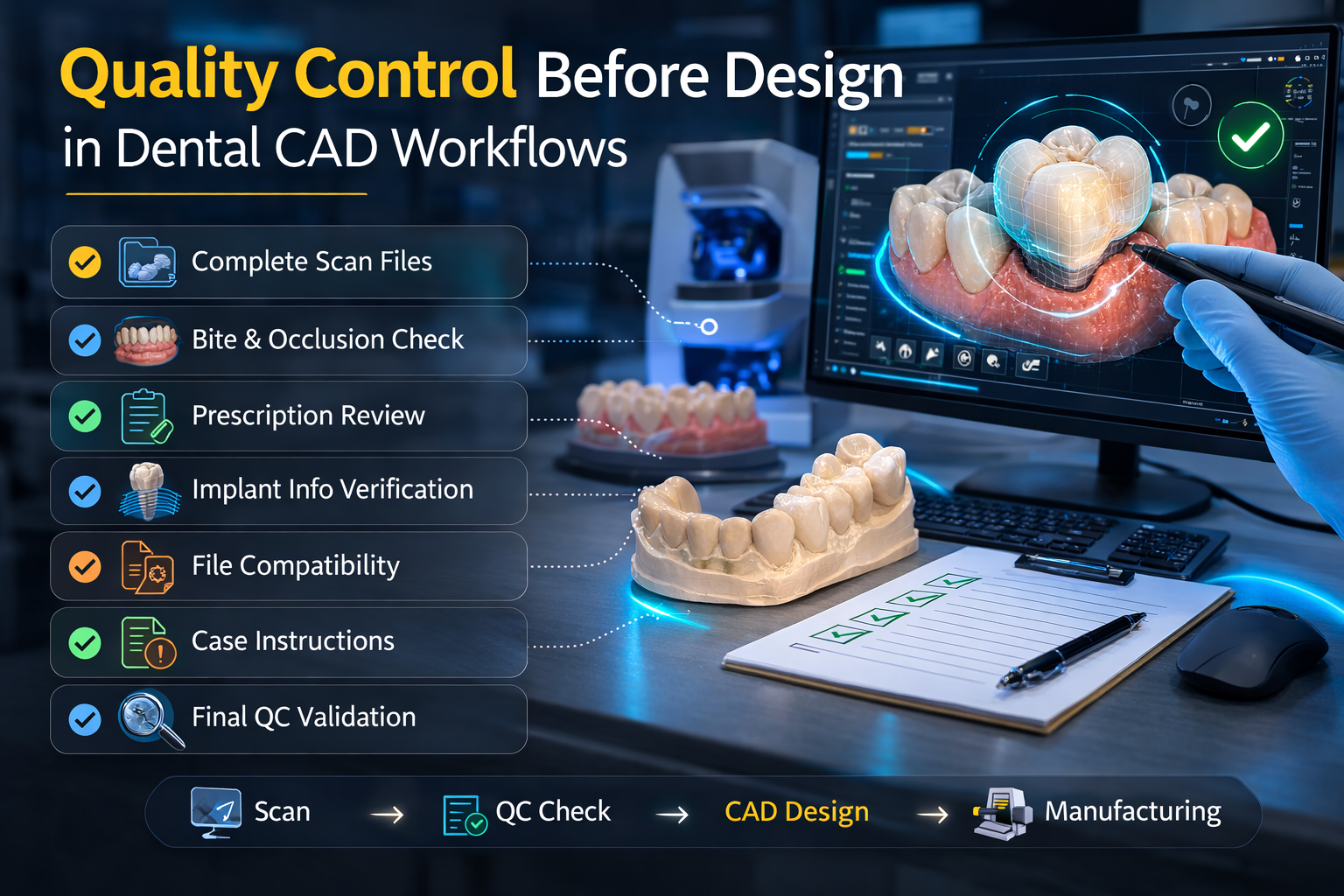
In digital dentistry, design speed often gets more attention than intake discipline. Yet in a professional production environment, the stability of a case is usually determined before the first restoration contour is drawn. This is where Quality Control becomes essential. In dental CAD workflows, pre-design quality control is not an optional checkpoint added for caution. It is a technical stage that determines whether the submitted case is ready for design, whether the digital inputs are trustworthy, and whether the workflow can move forward without avoidable correction.

For dental labs, dental clinics, prosthodontists, and oral surgeons, the practical value of pre-design Quality Control is straightforward. It reduces design interruption, protects manufacturing consistency, improves communication accuracy, and lowers the risk of remakes caused by weak case input. A design team can only work as predictably as the case information allows. If scan quality is poor, if instructions are incomplete, or if implant details are unclear, design becomes a guessing exercise instead of a controlled technical process.

That is why quality-focused CAD workflows begin with validation, not with modeling. The objective is not to delay the case. The objective is to prevent unstable cases from moving deeper into the workflow where errors become more expensive to fix.

Design problems often start before design begins


A common misconception in digital production is that design errors are mostly created during the design stage itself. In reality, many design problems originate earlier. They begin when a case is submitted with incomplete scans, unstable bite records, unclear restoration instructions, or incompatible digital files. By the time these issues become visible in the design stage, the workflow has already lost efficiency.

This is exactly why pre-design Quality Control matters. It allows the lab to evaluate whether the case is complete enough to support accurate CAD work before time is invested in designing contacts, occlusion, anatomy, or interfaces. If the case is weak at the input level, even a highly experienced designer will be working under unnecessary uncertainty.

From one angle, it may seem faster to begin designing immediately and solve problems along the way. From another, more operationally honest angle, that approach usually creates rework. A case that passes through design with unresolved intake problems often returns later through clarification, revision, or manufacturing interruption. In a real lab workflow, those loops cost more than an early intake review.

Pre-design quality control protects the workflow from false speed


Fast turnaround only has value when the case moves forward correctly. A design returned quickly is not truly efficient if it later needs revision because the bite was unreliable, the prep margin was unreadable, or the restoration type was not clearly stated. This is where pre-design Quality Control plays a surprisingly important role in speed. It slows the wrong kind of movement so the right kind of movement can happen later.

There are two ways to think about workflow speed. One focuses on how early the case enters design. The other focuses on how smoothly the case moves from submission to production with minimal interruption. The second is the more meaningful measure. A lab that designs weak cases immediately may appear fast at first, but often loses time in redesign, clarification, and downstream correction.

Pre-design review filters out this false speed. It checks whether the case should proceed now, whether it needs clarification, or whether it requires stronger file support before design begins. That discipline helps the workflow behave more predictably, especially in outsourcing environments where the design team cannot casually fill in missing details by walking across the room and asking a colleague.

Scan quality is the first foundation of reliable CAD work


The most basic function of pre-design Quality Control is to verify whether the scan data is suitable for design. This includes evaluating the preparation scan, antagonist scan, bite scan, and any additional records relevant to the case type. The goal is not merely to confirm that files were uploaded. The goal is to confirm that the files support technical interpretation.

For fixed restorative work, that means readable margins, clear preparation boundaries, reliable occlusal relationships, and enough adjacent anatomy to evaluate contacts and emergence. For implant cases, it means adequate scan body capture, stable soft tissue representation where relevant, and compatibility with the intended digital pathway. For removable prosthetics, guides, or appliances, the QC standard must reflect the specific design logic of those cases.

This is an important distinction. File presence is not the same as file usability. A scan can exist and still be poor enough to disrupt design. In many labs, delayed cases are not caused by missing files at all. They are caused by files that technically arrived but did not provide enough clarity to support accurate CAD work. That is precisely the kind of issue pre-design Quality Control is meant to catch.

Prescription clarity matters as much as scan accuracy


A technically strong scan still does not create a stable workflow if the prescription is vague. Before design begins, the lab needs to know what is being requested. A crown, bridge, veneer, coping, screw-retained implant crown, custom abutment, surgical guide, or night guard each follows a different design logic. If the restoration type is unclear, the design team may stop the case or proceed on assumption. Neither option is ideal.

This is why pre-design Quality Control should verify prescription completeness alongside scan quality. The lab should confirm the restoration category, units involved, relevant material direction when known, and any special instructions that materially affect design. Implant cases require even tighter control because implant system identification, retention pathway, and component references may determine whether the design is valid at all.

From a practical standpoint, this prescription review reduces one of the most common sources of avoidable delay: interpretive back-and-forth after the case has already entered production. A case with clear digital files but unclear restorative intent is not actually ready. It is simply waiting to become a problem later.

File compatibility review prevents invisible workflow loss


In digital dentistry, many inefficiencies are not dramatic enough to look like obvious errors. They appear as small interruptions: a case imports incorrectly, a bite relationship does not align, a linked file is missing, or an implant case arrives without the information needed for library validation. These issues often begin at intake, which makes them ideal targets for pre-design Quality Control.

A strong QC process checks whether the file package is complete and compatible with the intended CAD environment. That may include STL, PLY, XML, DICOM-related files, or platform-linked digital records depending on the case type. The point is not to treat compatibility as an IT problem. It is to determine whether the case can enter design without manual reconstruction or unsafe interpretation.

This matters especially in outsourced CAD workflows. When a case is transferred from one lab or clinic to another, small compatibility issues can quietly consume time before the first technical design step even begins. Pre-design review helps surface those problems early so they can be resolved before they distort turnaround expectations.

Implant cases show why early quality control is not optional


If any category proves the value of pre-design Quality Control, it is implant work. Implant restorations are less forgiving than routine fixed cases because the design depends on more than surface geometry. The workflow may require scan body accuracy, implant system confirmation, correct library selection, restorative pathway clarity, and a stable understanding of emergence, access, and component relationships.

Without intake QC, implant cases can move into design with hidden structural weakness. A designer may begin building the restoration before realizing that the implant reference is incomplete or that the digital records do not support the intended component pathway. By that point, the workflow is already spending effort on unstable ground.

This is why implant QC before design should be specific, not generic. The lab should verify that the implant information is not only present, but usable and consistent with the requested restoration type. In implant CAD workflows, small intake mistakes do not stay small. They tend to travel downstream and become much more expensive.

Pre-design quality control improves communication, not just accuracy


Many people think of Quality Control as purely technical, but in dental CAD workflows it also improves communication. A structured intake review forces the case information to become clearer before active design starts. Missing details are identified earlier. Questions are asked earlier. Expectations are aligned earlier. This reduces the number of vague mid-process conversations that often slow digital workflows.

For outsourced labs, this is particularly valuable. Clear intake QC provides a common language between the sending team and the receiving design team. Instead of discovering problems during design review or production release, both sides address them at the point where correction is fastest and least disruptive.

There are two communication styles in dental workflows. One waits for problems to surface naturally and then reacts. The other uses pre-design Quality Control to expose likely issues before they cause technical delay. The second style is usually quieter, less dramatic, and much more efficient.

Manufacturing consistency depends on what is approved before design


A common mistake is to think of pre-design QC as something only relevant to designers. In reality, it directly affects manufacturing consistency. If the case enters CAD with weak information, the resulting design may include compromises that later create difficulty in milling, printing, finishing, or seating. A crown designed on a questionable bite may require occlusal correction. A bridge designed from unclear instructions may need anatomical revision. An implant restoration built on incomplete references may fail much later, after more time and cost have been invested.

Pre-design Quality Control helps prevent this by asking an early question that protects the entire workflow: is the case ready to become a production file? That question matters because once a case is designed and released, it starts accumulating technical commitment. Manufacturing resources, technician attention, and turnaround planning all begin to align around that design.

If the intake was weak, the rest of the workflow becomes fragile. If the intake was strong, the case has a better chance of moving predictably from design to fabrication. In that sense, quality control before design is not just about reviewing the case. It is about protecting the integrity of everything that follows.

Pre-design review helps labs reduce remake risk without overpromising


In any production system, remake reduction is a major quality objective. But remake risk is rarely controlled by one final inspection step alone. It is managed through multiple upstream decisions, and one of the most influential is whether the case was validated before design. Weak inputs create weak outputs. That principle is brutally simple and annoyingly true.

Pre-design Quality Control reduces remake risk by blocking cases that depend too heavily on assumption. It does not eliminate all errors, and no honest lab should pretend otherwise. But it does reduce the likelihood that a preventable intake issue becomes a costly downstream failure.

From one perspective, this is caution. From another, it is production maturity. Mature CAD workflows do not wait for a case to fail before questioning whether it was ready. They ask that question early, while correction is still relatively cheap and straightforward.

What a practical pre-design quality control process should include


A strong pre-design QC stage should be structured enough to be repeatable, but flexible enough to reflect different case types. At a practical level, that means reviewing scan completeness, scan readability, occlusal reliability, prescription clarity, case identification, file compatibility, and any category-specific information such as implant system details or guide-planning requirements.

For routine cases, the review may be fast because the workflow is standardized. For complex cases, it may require deeper evaluation before design begins. The objective is not to make every case slower. The objective is to make every case more technically honest at entry.

This is also where labs can gain operational leverage. When QC is performed consistently before design, internal capacity is used more effectively. Designers spend less time chasing missing information. Manufacturing teams receive more stable files. Communication becomes more specific. Turnaround becomes easier to predict because the intake stage has already filtered much of the hidden instability out of the system.

Why quality-focused labs review first and design second


Labs that prioritize reliability understand a simple but powerful truth: design amplifies whatever it is given. If the input is clear, design becomes a strong technical tool. If the input is weak, design can become a polished version of uncertainty. That is why pre-design Quality Control is so important in modern CAD workflows. It determines whether the design stage will operate as controlled engineering or as educated guesswork.

For dental professionals sending cases to an external lab, this is also a trust issue. A lab that reviews before it designs is showing that it values predictability over appearance of speed. That approach may feel stricter at intake, but it often produces a smoother workflow overall because problems are surfaced before they multiply.

Conclusion


Pre-design Quality Control matters in dental CAD workflows because it determines whether the case entering design is complete, usable, and technically stable enough to support predictable production. It protects the workflow from false speed, reduces communication noise, improves file reliability, supports manufacturing consistency, and lowers the risk of avoidable redesign or remake.

For dental labs, clinics, prosthodontists, and oral surgeons, the practical lesson is clear. Quality in digital dentistry does not begin when the restoration is finished, and it does not even begin when design starts. It begins earlier, when the case is reviewed critically enough to decide whether design should start at all.

That is what strong quality systems do. They do not just inspect outcomes. They protect the workflow before the outcome is created.

 
In a modern digital workflow, file compatibility is not a minor technical detail. It is one of the main conditions that determines whether a case moves efficiently from scan intake to Dental Design, manufacturing, and final delivery. A restoration may be clinically straightforward, but if the file package is incomplete, mismatched, or poorly structured, the case can stall before meaningful design work begins.

For dental labs, clinics, prosthodontists, and oral surgeons, this is why digital file compatibility should be treated as a workflow issue rather than an IT issue. The format of the incoming data affects scan readability, articulation accuracy, implant library use, case communication, software interoperability, and production predictability. It also affects turnaround. A design team can work quickly only when the files support reliable interpretation inside the actual CAD environment being used.

The practical reality is that most digital cases do not arrive in one universal format. They arrive as a mix of open and closed files, mesh data and prescription data, scan exports and platform-linked records. STL, PLY, XML, DCM, and other formats each play different roles in the chain. Understanding that role is essential if a lab wants Dental Design to begin without unnecessary delay.

File compatibility is really about workflow compatibility


When people talk about digital compatibility, they often reduce the issue to a simple question: can the software open the file? That question matters, but it is not enough. A case can open successfully and still be incomplete for production. A file may import into the CAD system while losing occlusal relationships, color information, implant references, or prescription-linked metadata. That is where workflow problems begin.

In Dental Design, compatibility should be understood at three levels. First, the file must be readable. Second, the file must preserve the information needed for the intended restoration. Third, the file must fit into the manufacturing and communication pathway without creating manual rework. A file that satisfies only the first condition is not truly compatible in a practical sense.

From one perspective, compatibility sounds like a software topic. From another, more useful perspective, it is a case continuity topic. The design team needs to know whether the digital record arriving at intake still contains enough usable meaning to support the restoration that will eventually be fabricated. That is the real test.

Why open and closed file systems affect dental design differently


Digital dentistry operates across both open and closed workflows. Open workflows usually allow file export into broadly usable formats such as STL or PLY. Closed workflows may preserve more integrated information inside proprietary ecosystems, but they can also limit how freely the case moves between scanners, design platforms, and external labs.

This distinction matters because Dental Design is often outsourced, shared, or transferred across different digital environments. An open workflow tends to support easier external collaboration, especially for standard crown and bridge design. A closed workflow may protect data structure inside one ecosystem, but if the receiving lab cannot access the same environment, file transfer becomes more complicated.

Neither model is automatically better in all situations. Open systems support flexibility, but they may require more careful file organization to preserve meaning. Closed systems may carry structured relationships more elegantly, but they can create friction when a case needs to leave the original platform. The important point is that compatibility is not only about format. It is also about whether the file can travel where the case actually needs to go.

STL remains the most common base format, but it is not complete for every case


STL is still the most familiar file format in digital restorative workflows. It is widely used because it is simple, lightweight, and broadly accepted across CAD and CAM systems. For many routine fixed cases, STL provides enough geometric information to support Dental Design efficiently. Crown and bridge workflows often depend on it because the format is easy to export and easy to import across platforms.

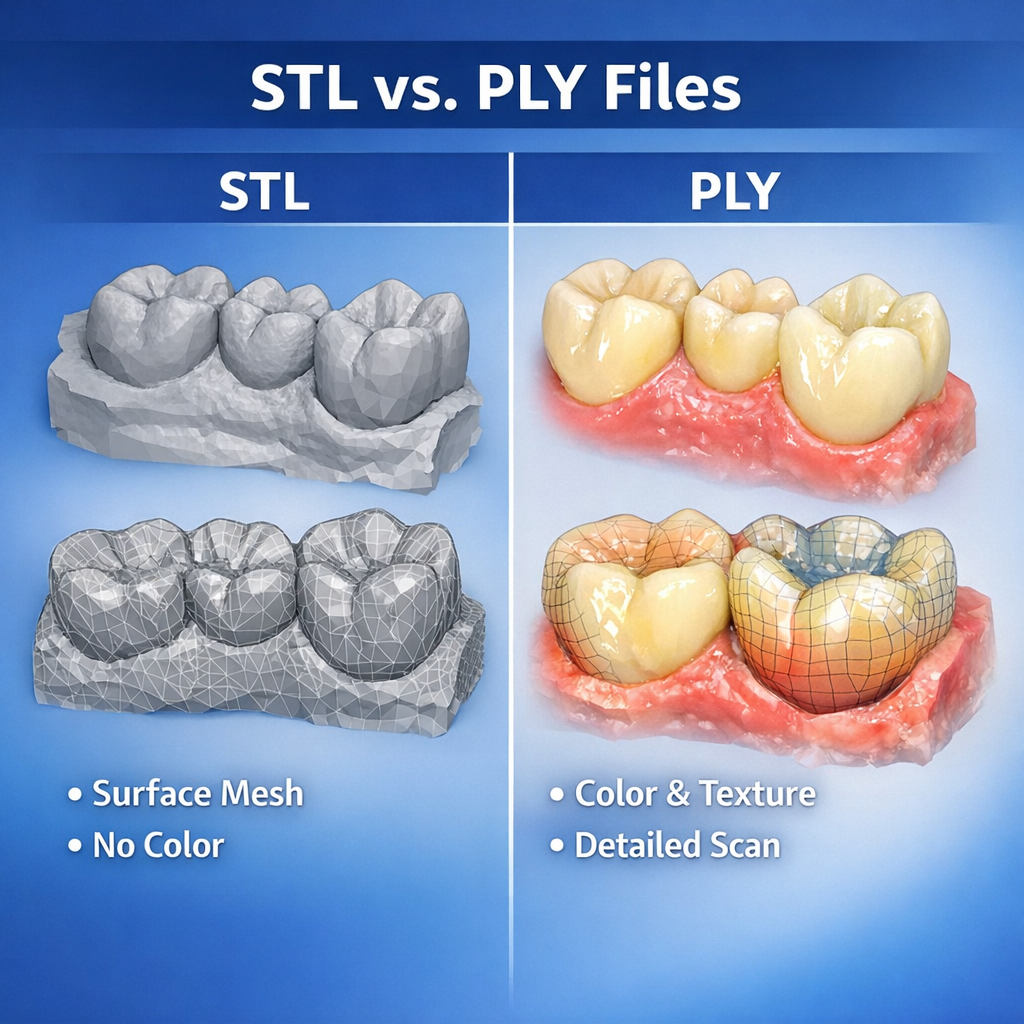
That said, STL only carries surface mesh geometry. It does not include color texture, implant system logic, shade information, or richer metadata. For straightforward posterior crowns, that limitation may not matter much. For more complex cases, it can matter a great deal. If the design team needs more than raw surface shape, STL alone may be insufficient.

This is where many workflows become subtly unstable. A lab may think, “We sent the scan.” Technically true. But if the file lacks the contextual information needed for the intended restoration, the Dental Design stage may still require clarification. STL is extremely useful, but it is not magical. It is a mesh, not a complete digital case language.

PLY adds surface richness that can matter in practical design review


PLY is often discussed alongside STL because both can carry 3D mesh data. The important difference is that PLY can also include color information. In some workflows, that extra visual data helps the design team interpret preparation boundaries, soft tissue detail, scan body capture, and other visual cues that may be less obvious in a plain mesh environment.

For Dental Design, PLY can be particularly helpful when texture improves the readability of the scan. A margin line may still require clinical preparation quality and clear scanning technique, but color data can make the case easier to assess during intake and review. This can support faster case validation, especially in situations where mesh-only data feels visually ambiguous.

That does not mean PLY is always necessary. Many excellent restorative workflows operate perfectly well with STL-based geometry. But when a scanner platform exports both STL and PLY, or when the receiving lab can benefit from texture-enhanced review, PLY can add practical value. In digital dentistry, sometimes the difference between “technically usable” and “cleanly readable” is larger than people expect.

XML matters because geometry alone is not enough


XML files are not usually the visible stars of digital dentistry, but they are extremely important in certain workflows. An XML file often carries structured case data rather than 3D geometry. Depending on the platform, it may include articulation relationships, prescription details, restoration intent, tooth designation, scan alignment logic, or case-specific metadata linked to the main scan files.

For Dental Design, XML becomes valuable because it helps preserve the case context around the mesh. A scan without structured prescription data can force the design team to reconstruct details manually. A scan paired with XML may enter the CAD environment with much more of the original workflow logic intact.

This is especially relevant when cases are exported from intraoral scanning systems or digital platforms that rely on linked file packages rather than one standalone model. If the lab receives only the visible mesh file and not the supporting XML or linked data, the case may lose information that affects efficiency. The result is not always catastrophic. It is often just annoying, slow, and surprisingly avoidable. Which, in production terms, is its own species of catastrophe.

DCM and DICOM-based data serve different purposes from standard model files


DCM generally refers to files associated with DICOM imaging data. In dentistry, DICOM data is essential in workflows involving CBCT scans, surgical planning, implant placement guidance, anatomical evaluation, and certain advanced digital integrations. These files do not function the same way as STL or PLY model files. Instead, they provide volumetric imaging information rather than simple surface geometry.

In Dental Design, DCM or DICOM data becomes especially relevant when the case extends beyond conventional restorative design into surgical guide planning, implant positioning analysis, or workflows that combine intraoral scans with radiographic anatomy. A design team working on such cases may need both the surface scan data and the imaging dataset to plan accurately.

This distinction is important because some teams assume all digital dental files are interchangeable as long as they are “3D.” They are not. STL supports model geometry. DICOM supports volumetric anatomy. XML may support structured workflow data. Each plays a different role. Sending only one when the case requires all three is a classic way to slow a complex workflow before design even starts.

Compatibility problems often come from missing file packages, not bad software


When a case fails to move smoothly into Dental Design, the software often gets blamed first. Sometimes that blame is deserved. More often, the real problem is incomplete packaging. A lab may receive an STL without the articulation reference, a PLY without the expected case notes, or an implant scan without the supporting component information. The software can only work with what it receives.

This is why file compatibility should always be discussed as a package issue, not just a format issue. A crown case may need the prep scan, antagonist, and bite. An implant case may also need scan body data, implant identification, and the correct linked records. A guide case may require surface scans plus DICOM data. When one part is missing, the file format itself is not the whole problem.

There are two ways to think about compatibility. One is narrow: does this file extension work? The other is operational: does this file package allow the case to proceed without reconstruction or assumption? The second question is the one that actually matters in daily lab work.

Implant workflows are where compatibility discipline becomes non-negotiable


Routine fixed restorations can sometimes tolerate mild workflow inconsistency. Implant cases are less forgiving. In implant-related Dental Design, file compatibility affects not only shape interpretation but also library matching, scan body positioning, restoration pathway, and manufacturing logic. A case may appear visually fine while still being structurally incomplete if the implant-specific references are not preserved.

This is why implant workflows often demand stricter intake rules. The receiving lab needs to know which files belong to the case, which system the case depends on, and whether the export pathway preserves the necessary relationships. A generic mesh alone may not be enough. If the implant context is lost, the case can become slower, riskier, or both.

For practical case management, implant compatibility should never be left to assumption. If the file package depends on a specific scanner ecosystem, platform, or linked dataset, that should be clear before the case is transferred. In implant design, ambiguity is a tiny crack that later turns into a very expensive canyon.

Software version and platform behavior affect compatibility more than many teams admit


Even when the file format itself is correct, compatibility can still be affected by software version, export settings, or platform-specific behavior. Two teams may both say they support STL, yet still encounter differences in scaling assumptions, bite import logic, or model orientation behavior. XML-linked workflows can be even more sensitive to version mismatch. DICOM integration may vary depending on the planning environment.

For Dental Design, this means compatibility should be validated in real workflow conditions, not only in theory. It is not enough to know that a format is “supported.” The lab also needs to know whether it behaves predictably inside the intended CAD environment. A case that imports with errors, loses alignment, or requires repeated manual correction is not practically compatible, even if the software technically opens it.

This is one reason mature labs build standardized intake rules around tested workflows rather than around broad assumptions. General compatibility lists are useful. Proven working pathways are better.

Strong file compatibility reduces turnaround because it reduces interpretation


The direct operational benefit of strong compatibility is speed. When the file package is complete, correctly structured, and aligned with the receiving lab’s workflow, Dental Design can start earlier and move with fewer interruptions. Intake review becomes faster. Communication becomes more specific. Quality control becomes easier because the case data is more coherent from the beginning.

By contrast, weak compatibility introduces invisible delay. The lab may need to request missing files, rebuild relationships manually, verify implant context, or interpret unclear exports. None of these tasks looks dramatic on a production chart, but together they erode turnaround, consistency, and design stability.

This is why digital compatibility should be seen as part of case quality. It is not a background convenience. It is one of the structural conditions that determine whether a digital case is actually ready for design.

What labs should provide to support file compatibility from the start


For a smooth Dental Design workflow, labs should send a complete file package rather than isolated files. That includes the primary scan geometry, bite data, antagonist data, linked XML or metadata files when relevant, implant-specific references where applicable, and DICOM data for cases involving radiographic planning. The case should also be clearly identified, and the restoration intent should be stated in a way that matches the digital package.

Just as important, the sending team should know the receiving lab’s accepted formats and tested workflow conditions before urgent cases appear. Compatibility planning is much easier before the goblins of last-minute confusion arrive with clipboards and chaos.

Conclusion


Digital file compatibility in Dental Design is not just a matter of whether a lab accepts STL, PLY, XML, DCM, or other formats. It is a matter of whether the full digital package preserves the information needed for case review, design execution, manufacturing planning, and predictable communication. Each format serves a different role. STL supports broad mesh exchange. PLY can add valuable visual detail. XML often preserves structured case logic. DCM and DICOM data support imaging-based workflows beyond surface models.

For dental labs, clinics, prosthodontists, and oral surgeons, the practical lesson is clear: a compatible file is not simply a file that opens. It is a file package that carries the case forward without forcing the design team to reconstruct missing meaning. In a digital production system, that difference is where workflow stability begins.
In a digital workflow, CAD Design does not begin when the file is opened. It begins when the case is submitted. If the submission lacks critical information, the design process slows down before any restoration geometry is created. For dental labs, clinics, prosthodontists, and oral surgeons working with an outsourcing partner, the quality of case preparation directly affects turnaround, design accuracy, manufacturing predictability, and remake risk.

This is why the question is not only whether a lab has sent the files. The more important question is whether the lab has provided enough structured information for CAD Design to start without delay or assumption. A strong design team can work quickly, but it should not be expected to interpret unclear restorative intent, guess missing implant details, or design around incomplete digital records. Those gaps usually lead to extra communication, design revisions, or downstream manufacturing problems.

Before CAD Design starts, the submitting lab should provide a technically usable package: complete scans, clear restoration instructions, correct case identification, relevant material direction, and any design notes that materially affect the result. When those inputs are organized well, the workflow becomes faster and more predictable. When they are weak, the entire process becomes fragile, no matter how experienced the design team may be.

CAD design starts with case identification, not with contouring


One of the most underestimated parts of digital case preparation is basic identification. Before a design team can review margins, contacts, or occlusion, it has to know exactly what the case is, which units are involved, and what type of restoration is being requested. If files are mislabeled, mixed between arches, or unclear about the unit numbers, the design process becomes slower before any technical work begins.

For CAD Design, proper case identification should include the patient or case ID used by the submitting lab, the arch, the unit or units involved, and the restoration category. A single posterior crown, a multi-unit bridge, an implant-supported crown, and a surgical guide do not enter the workflow the same way. The design team needs to know what kind of task they are reviewing before they determine what additional information is required.

This may sound administrative, but it is not merely clerical. Clear identification is the first layer of workflow control. A technically sound scan can still lose time if the design team has to decode what belongs to which case. In dental outsourcing, ambiguity at the beginning has a habit of multiplying later.

The core scan set must be complete and usable


Before CAD Design starts, the most basic requirement is a complete scan set appropriate to the restoration type. For standard crown and bridge work, this usually includes the preparation scan, antagonist scan, and bite scan. If any of these elements are missing or unreliable, design may pause because occlusal and positional decisions cannot be made safely.

Completeness alone is not enough. The scans must also be usable. Preparation margins should be readable, adjacent structures should be captured clearly enough to evaluate contacts and emergence, and the bite should reflect a stable relationship. In a digital workflow, a file can be present but still be unsuitable for design because the margin is blurred, the bite is distorted, or the scan contains stitching errors.

This is where many labs unintentionally slow the CAD Design stage. They assume that file transfer equals case readiness. It does not. The design team needs input that supports interpretation, not just upload confirmation. A simple posterior case with strong scans often moves faster than a nominally routine case with questionable bite data or indistinct preparation boundaries. In other words, scan quality is not a bonus. It is part of the minimum requirement.

The restoration type must be stated clearly from the beginning


A design team should not have to infer whether the case is a monolithic crown, cutback crown, bridge, coping, veneer, inlay, onlay, implant restoration, removable framework, or another prosthetic category. Before CAD Design starts, the restoration type should be explicitly stated because it determines the design logic, the review process, and the manufacturing pathway.

This becomes especially important when one digital case could support more than one restorative option. For example, a posterior tooth preparation may be restorable as a crown or onlay depending on the clinical plan. An implant site may require a screw-retained crown, a custom abutment with cement-retained crown, or another component-based solution. If the intended restoration is not defined, the design team is forced to stop or interpret. Neither choice supports efficient workflow.

There is a useful tension here. Some submitting teams want flexibility and therefore keep instructions broad. Some design teams want specificity and therefore prefer tightly defined prescriptions. In practice, CAD Design works best when the prescription is specific about what matters and silent about what does not. The design team should have room to execute professionally, but it should not be asked to decide the restorative category on its own.

Material direction influences design decisions earlier than many labs expect


Even though CAD Design is a digital stage, it should not be separated from material reality. The intended material affects thickness management, connector planning, morphology, internal spacing, and manufacturing feasibility. For that reason, the submitting lab should provide material direction before design begins whenever that information is already established.

For a routine crown, the material may seem secondary at first glance. Yet zirconia, lithium disilicate, PMMA, hybrid ceramic, or metal-supported pathways do not behave identically in design or production. In bridge work, material selection becomes even more relevant because connector safety and span behavior must be considered. In implant restorations, the selected restorative material may influence crown geometry, emergence contour, and post-processing expectations.

From one angle, a skilled design team can work with standard defaults and adjust later. From another angle, later adjustment is exactly what slows a digital workflow. When material direction is known early, the CAD Design stage can align more closely with manufacturing needs from the start. That reduces redesign and improves consistency.

Implant cases require component-specific information before design begins


Implant work is where incomplete information causes some of the most expensive delays. Before CAD Design starts on an implant case, the submitting lab should provide the implant system, platform details where relevant, scan body information, restoration type, and intended retention pathway. Without these details, the design team cannot verify the correct library, assess the interface properly, or plan the restorative geometry with confidence.

An implant case is not just a crown on a digital model. It is a component-dependent restoration built around a precise connection. If the implant library is unclear, if the scan body is misidentified, or if the retention method is not defined, the design team may produce a file that appears acceptable but is technically wrong. That is the sort of mistake that behaves politely at first and then causes chaos later.

For implant-related CAD Design, the best submission is the one that eliminates guesswork around hardware. The design team should know whether the case involves a custom abutment, screw-retained crown, hybrid pathway, or another defined solution. It should also know which implant system and components the restoration must match. In implant workflows, details that seem small at submission become structural once design begins.

Occlusal and contact expectations should be communicated when they are nonstandard


Routine cases can often be designed according to standard lab parameters for occlusion and proximal contact. But when a case involves nonstandard expectations, the submitting lab should state them clearly before CAD Design begins. This includes heavy or light contact preference, occlusal scheme considerations, limited clearance concerns, special pontic requirements, or site-specific functional priorities.

The reason is simple: not every restoration should be designed according to the same internal default. A bridge may require careful connector and contact management. An anterior case may need conservative contouring to protect space and esthetics. A night guard or splint case may depend on occlusal logic that is central to function. If these expectations are communicated only after the first design is returned, the workflow becomes slower and less stable.

This is one of the subtle differences between average and strong case submission. Average submission provides the files. Strong submission provides the files plus the exceptions. A design team does not need a long essay on every routine case. It does need early notice when the case departs from normal design assumptions.

Design limitations and clinical constraints should be visible before CAD work begins


Before CAD Design starts, the submitting lab should identify any known limitation that affects the restoration. This may include reduced occlusal space, questionable preparation geometry, difficult insertion path, short clinical crown, adjacent implant proximity, or esthetic constraints in a visible zone. These limitations matter because they shape what the design team can do safely.

A design file created without awareness of these constraints may look idealized rather than realistic. For example, a crown may be given anatomy that cannot be supported within the available clearance. A bridge may be designed without sufficient attention to path of insertion. An implant crown may be contoured beautifully on screen while ignoring access compromises. In each case, the problem is not design skill. It is incomplete design context.

There are two philosophies here. One assumes the design team should discover all limitations from the scan alone. The other assumes the submitting team should flag what it already knows. The second philosophy is more efficient. Good CAD Design is not weakened by better information. It is strengthened by it.

Photographs and visual references matter when they change the design outcome


Not every case requires photos, but some do. When facial context, shade behavior, provisional reference, emergence profile, or anterior anatomy expectations materially influence the result, those visual references should be provided before CAD Design starts. This is especially relevant in anterior esthetic cases, implant soft tissue-sensitive zones, and situations where the final design should reflect an existing restorative reference.

A design team can build morphology from the scan alone in many routine cases. But in cases where visual integration matters, the absence of photos may lead to avoidable interpretation. That does not mean the design will fail technically. It means it may not align as closely with the restorative objective as it could have.

For labs working with an outsourcing partner, this is an important distinction. The goal of CAD Design is not only to generate a file that can be milled. The goal is to generate a file that supports the intended restorative result with minimal revision. When photos influence that result, they belong in the submission package.

Turnaround expectations and priority status should be stated honestly


Before CAD Design starts, the lab should communicate whether the case follows standard scheduling or carries a genuine priority requirement. This should be done clearly and early, not halfway through the process. A design team organizes work based on queue logic, case complexity, and available capacity. If priority information appears late, the workflow may already be structured around a different timeline.

That said, marking every case urgent is not a strategy. It is a fast route to organizational nonsense. Priority status should be reserved for cases that genuinely require faster handling, and the information should be provided at intake along with the rest of the case data.

This matters because delivery speed is part of workflow planning. A design team can support faster CAD Design more effectively when it knows the timeline in advance and when the case is actually ready to move. A rushed case with incomplete input is still incomplete. Urgency does not magically repair missing information.

Quality control begins with the information package


Before design starts, the submitting lab should perform its own internal review of the case package. This means checking that the correct files are attached, the restoration type is stated correctly, implant details are included when necessary, and special instructions are visible. That internal review is the first layer of quality control.

A receiving design team will usually perform its own intake review as well. Together, these two checkpoints create a more stable CAD Design process. Problems are caught earlier, communication becomes more precise, and the number of redesign loops tends to decrease. This is one of the quiet truths of digital outsourcing: good quality control at submission often saves more time than aggressive speed after submission.

A well-prepared case does not guarantee that every design will be simple. But it does make the workflow more honest. The design team can spend time solving restorative problems rather than chasing missing information.

Conclusion


Before CAD Design starts, labs should provide more than just digital files. They should provide a complete technical package that allows the design team to understand the case without delay or assumption. That package should include clear case identification, a complete and usable scan set, explicit restoration type, material direction when known, implant component details where relevant, nonstandard design expectations, known clinical limitations, visual references when they affect the outcome, and honest turnaround priorities.

For dental labs, clinics, prosthodontists, and oral surgeons, the practical benefit is straightforward. Better information at submission leads to smoother design flow, fewer clarification cycles, and more predictable manufacturing preparation. In a digital workflow, CAD Design speed is not driven only by how fast a designer works. It is driven by how well the case is prepared before the first design step begins.

That is what strong case submission does. It turns the design stage from a guessing exercise into a controlled technical process.
In a digital production environment, delays rarely begin at milling, printing, or final finishing. They usually begin earlier, when a case is submitted with incomplete files, unclear instructions, inconsistent naming, or unresolved technical assumptions. For dental labs, clinics, prosthodontists, and oral surgeons, sending cases to an Outsourcing Dental lab efficiently is not simply an administrative task. It is a workflow discipline that directly affects turnaround, design accuracy, manufacturing predictability, and remake risk.

A well-organized outsourcing relationship does not depend on speed alone. It depends on whether the submitted case can move from intake to review, from review to design, and from design to fabrication without unnecessary interruption. That means the sending team must understand what the receiving lab actually needs to begin work correctly. It also means the outsourcing lab must operate with clear intake standards, file compatibility, communication logic, and quality control checkpoints.

When those conditions are in place, outsourcing supports efficiency. When they are not, delays begin before the first technical step. The practical question, then, is not only how to send a case, but how to send it in a way that protects workflow continuity from the start.

Delays usually come from missing clarity, not from distance


A common assumption is that sending work to an external lab becomes slower mainly because the lab is outside the building, outside the city, or outside the country. In reality, physical distance is often less important than workflow clarity. A case can move quickly across time zones if the file package is complete and the instructions are technically usable. On the other hand, a case can stall immediately if the lab receives incomplete scans, missing bite data, unclear restorative intent, or unresolved implant details.

This is why an Outsourcing Dental workflow should be treated as an extension of internal production, not as a casual transfer of files. The sending team should assume that the receiving lab cannot safely guess what was not submitted. If the restorative pathway is unclear, the case will pause. If the file naming is inconsistent, the case may require manual sorting. If the implant system is not confirmed, the design team cannot proceed reliably. None of these delays are caused by outsourcing itself. They are caused by poor submission structure.

From one angle, that may sound obvious. From another, it is exactly where many labs quietly lose time. The workflow gremlin is usually hiding in intake, not in manufacturing.

Start with a complete and structured digital file set


The fastest way to slow down an outsourced case is to submit only part of what the lab needs and expect the rest to be inferred later. A clean submission should include all core files required for the specific restoration type. For standard fixed cases, that typically means the preparation scan, antagonist scan, and bite scan. For more advanced or esthetic cases, photographs or additional design references may also be needed. For implant cases, scan body data, implant system identification, and restorative intent should be established before submission.

This matters because an Outsourcing Dental lab can only move as fast as the file package allows. If the receiving team has to request antagonist data, verify which arch is final, or determine whether the bite relationship is trustworthy, the workflow already begins with interruption. A complete file set does not guarantee perfect speed, but an incomplete one almost guarantees avoidable delay.

Structure is just as important as completeness. Files should be organized clearly, with consistent naming that makes the patient case, arch, unit, and restoration type easy to identify. A technically strong case can still lose time if the lab has to decipher which file belongs to which situation.

File quality matters as much as file presence


Submitting the correct number of files is not enough if the files themselves are weak. A scan can be present and still be unusable. Margins may be indistinct. Bite relationships may be unstable. Scan body capture may be incomplete. Soft tissue displacement may be insufficient for proper interpretation. In digital outsourcing, these issues matter because they determine whether the lab can design or fabricate confidently.

An Outsourcing Dental lab should not be expected to push a case forward just because files technically arrived. The relevant question is whether the files support correct execution. For crown and bridge cases, readable preparations and reliable occlusal records are essential. For implant cases, the scan body must be captured accurately enough to support library alignment. For removable or guide-related work, the underlying digital references must reflect the intended design pathway.

There are two ways to think about file quality. One is minimal compliance: did the files upload successfully? The other is production readiness: can the lab use them without interpretive risk? Only the second view protects turnaround.

Prescription details should remove guesswork, not add narrative


One of the most common sources of outsourced delay is the vague prescription. A lab may receive the scan but still lack the technical information required to proceed confidently. The restoration type may be unclear. The design intent may not be stated. Material direction may be missing. Implant component preferences may not be identified. In these situations, the lab must pause and clarify.

A useful prescription for an Outsourcing Dental lab should be brief but precise. It should state what is being requested, which units are involved, and any important technical notes that influence design or fabrication. For fixed work, this may include restoration type, pontic expectations, occlusal considerations, or contact preferences. For implant cases, it may include implant system, retention method, component pathway, or restorative priorities. For appliances or surgical guides, the functional purpose and design limits should be clear.

The goal is not to write a long essay. The goal is to prevent assumption-based production. The more the receiving lab needs to interpret unstated intent, the slower and less stable the case becomes.

Match the case to the lab’s workflow before you send it


Not every case belongs in the same outsourcing pathway. Some cases are highly suitable for external support because they are routine, complete, and easy to classify. Others require additional discussion before submission because they involve unusual restorative conditions, higher esthetic sensitivity, or mixed technical requirements. Sending everything through the same channel without triage can create unnecessary back-and-forth.

A strong Outsourcing Dental process begins with internal case sorting. Straightforward crown and bridge work may move directly once the file set is complete. Implant restorations, complex bridges, full-arch cases, removable prosthetics, or guide cases may require additional review before release. This does not mean they should not be outsourced. It means they should be prepared more carefully.

From one perspective, this adds one more step before sending. From another, it removes several corrective steps later. The second perspective usually wins in the real world, where every preventable clarification consumes time across both teams.

Confirm software and file compatibility before the case becomes urgent


Software compatibility problems are one of the quiet saboteurs of outsourced workflows. A case may be technically ready but still lose time because of version mismatch, unsupported file behavior, incompatible implant libraries, or incomplete export settings. This becomes especially painful when the case is already urgent and the team discovers too late that the digital pathway is not clean.

That is why an Outsourcing Dental relationship should define file compatibility rules early. The sending team should know which formats are accepted, how implant-related files should be provided, and whether any platform-specific conditions apply. The receiving lab should be clear about its supported workflow conditions rather than improvising compatibility on every case.

This point is easy to underestimate because software issues often look small at first. But in digital dentistry, a small compatibility problem can delay the entire design stage before the first margin is even reviewed. The workflow does not care that the file “looked fine on our side.”

Communicate special priorities at submission, not halfway through design


A case that becomes urgent after submission is harder to manage than one identified correctly from the beginning. The same is true for special design expectations. If a case has an unusual delivery priority, a specific restorative concern, or a nonstandard instruction, that should be stated at intake rather than after the lab has already organized the workflow around a different assumption.

In an Outsourcing Dental system, timing depends heavily on queue logic. The receiving lab sorts cases based on type, complexity, and urgency. If the sending team waits until mid-process to mention that the case is needed earlier than normal, the schedule may already be committed. Likewise, if a crucial restorative note arrives after design begins, the lab may need to revise work that could have been handled correctly from the start.

This does not mean every case should be marked urgent. That path leads to chaos with remarkable efficiency. It means true priorities and true technical exceptions should be visible at submission so the case can be processed correctly the first time.

Good outsourcing communication is proactive, not reactive


Many delays are extended not by the original problem but by slow clarification once the problem appears. A missing bite, unclear implant platform, or questionable margin may only require a short response, but if that response takes hours or a full day, the case stalls. In outsourcing, communication speed becomes part of turnaround.

For this reason, both sides of an Outsourcing Dental workflow should establish a clear communication rhythm. The receiving lab should flag missing information early and specifically. The sending team should respond with complete clarification rather than fragmented follow-up messages. Fast communication is not about sending more messages. It is about reducing the number of interpretive cycles.

A clean outsourcing workflow behaves almost like a shared department: cases come in, issues are identified quickly, responses are precise, and the case moves again. A messy workflow behaves like a relay race where everyone misplaced the baton.

Quality control starts before the case is sent


Some teams think quality control belongs only to the receiving lab. That is too narrow. The sending side also has a QC role. Before a case is transmitted, the team should verify that the file set is complete, the prescription is accurate, the case is named correctly, and all critical technical references are included. This internal check can eliminate a surprising number of avoidable delays.

An Outsourcing Dental lab will usually perform its own intake quality control as well. That second layer matters because it catches unreadable scans, missing files, or mismatched instructions before design or fabrication begins. When both sides apply QC at their own stage, the workflow becomes far more stable. Cases move forward with less interruption because the obvious problems are caught earlier.

This double-check structure is not redundant. It is efficient. Dental workflows are full of enough complexity already; they do not need preventable intake errors joining the party.

Build repeatable submission habits, not one-off corrections


The most efficient outsourcing relationships are not built on constant rescue. They are built on repeatable habits. The sending team uses the same naming logic, the same file structure, the same prescription discipline, and the same internal review process from one case to the next. Over time, that consistency reduces delays because the receiving lab knows what to expect and how to process the case quickly.

This is one of the strongest operational advantages of a mature Outsourcing Dental workflow. Once standards are repeated consistently, case handling becomes faster without becoming careless. The relationship moves from reactive correction toward controlled throughput.

Labs and clinics sometimes search for speed by pushing harder on individual urgent cases. In most workflows, the bigger gain comes from making routine submissions cleaner. Process discipline is not flashy, but it is brutally effective.

Conclusion


Sending cases to an Outsourcing Dental lab without delays depends less on the act of transfer and more on the quality of preparation behind it. Complete file sets, production-ready scans, precise prescriptions, correct case triage, software compatibility, early priority communication, and internal quality control all shape whether a case moves smoothly or stalls at intake.

For dental labs, clinics, prosthodontists, and oral surgeons, the practical lesson is simple: outsourcing works best when the case arrives ready to be understood. A strong external lab can extend capacity, improve workflow flexibility, and support consistent production, but it cannot eliminate delay caused by unclear submission habits.

The most efficient case is not the one sent fastest. It is the one sent correctly the first time.

 
In digital dental production, Turnaround Time is often discussed as if it were a fixed promise. In practice, it is a moving operational metric shaped by case type, file quality, communication speed, design requirements, manufacturing method, and quality control. For dental labs, clinics, prosthodontists, and oral surgeons, the most useful way to evaluate turnaround is not by asking for one universal number. It is by understanding why some cases move quickly and why others require more controlled review.

A routine posterior crown and a multi-unit implant restoration do not follow the same workflow, even when both are submitted digitally. They differ in design sensitivity, manufacturing demands, and risk of downstream adjustment. That difference is exactly why Turnaround Time must be explained in relation to case complexity rather than treated as a blanket expectation.

From a lab perspective, faster workflows are not created by compressing every case into the same timeline. They are created by classifying cases correctly, organizing intake properly, and matching production pace to technical difficulty. That is the real logic behind stable dental turnaround.

Why turnaround time is not one number across all dental cases


Many labs are asked the same simple question: how long will this case take? It sounds reasonable, but it hides a mess of workflow variables. A dental case does not move from scan to delivery in one uninterrupted motion. It passes through intake review, design preparation, CAD work when applicable, manufacturing, finishing, inspection, and communication checkpoints. Some cases glide through those stages. Others stumble over the first one.

This is why Turnaround Time cannot be understood only as a shipping-style deadline. It reflects the amount of technical uncertainty in the case. A simple monolithic posterior crown with complete scans and clear margins may move efficiently because the number of decisions is limited. A complex case may require file clarification, component verification, occlusal planning, esthetic control, or multiple design checks before production can even begin.

From one angle, this can frustrate clients who want fast answers. From another angle, it is exactly what protects manufacturing consistency. A lab that gives identical turnaround expectations for all cases is usually ignoring the technical truth hiding inside the workflow.

What makes a case “simple” in a dental lab workflow


A simple case is not defined only by the number of units. It is defined by predictability. In most digital workflows, a simple case has clean input data, clear restorative intent, and limited need for interpretive design judgment. A single posterior crown is the classic example, but only if the preparation scan is readable, the bite is stable, and the restoration does not involve unusual reduction, questionable insertion path, or unclear occlusal conditions.

Simple cases usually support shorter Turnaround Time because fewer variables need to be resolved before production. Margin interpretation is more straightforward. Anatomical demands are lower. Manufacturing choices are often standardized. Communication loops are minimal. In a well-organized lab, these cases can move quickly because the workflow around them is already stable.

That said, labs should be careful with the word “simple.” A single-unit case with distorted scan data, incomplete bite registration, or unclear preparation boundaries stops being simple almost immediately. In other words, case simplicity is not just about restorative category. It is about the quality of the starting conditions.

What pushes a case into the complex category


A complex case is any case where technical control depends on more than routine execution. This includes implant restorations, long-span bridges, esthetic anterior work, removable prosthetics, surgical guides, night guards with specific occlusal objectives, and cases involving mixed restorative elements. Complexity may come from anatomy, materials, component systems, design limitations, or simply from incomplete information.

For these cases, Turnaround Time expands because the lab has to manage more decisions before manufacturing can proceed confidently. An implant case, for example, may require scan body validation, implant library matching, screw access review, and emergence profile planning. A multi-unit bridge may need closer evaluation of connector strength, insertion logic, and pontic contour. An anterior esthetic case may require tighter control over symmetry, surface anatomy, and restorative volume.

Complex cases also carry more risk if rushed poorly. A lab can move them fast in theory, but if speed bypasses necessary review, the result may be design revision, production delay, remake, or chairside adjustment later. That is why longer Turnaround Time for complex work is not inefficiency by default. Often, it is responsible process management.

File submission quality affects turnaround more than many clients expect


A surprisingly large share of dental workflow delay begins before design or fabrication. It begins at file submission. If the digital impression is incomplete, the bite is unstable, the preparation is poorly captured, or the prescription is missing key details, the case cannot proceed cleanly. The lab must pause, request clarification, or make a technical judgment that may later need correction.

This is one of the most important truths behind Turnaround Time: it is heavily influenced by the quality of case intake. A routine case submitted well may move faster than a nominally simple case submitted badly. For labs, this means turnaround improvement often depends less on working faster and more on reducing friction at intake.

Good submissions usually include complete scan sets, readable preparation boundaries, reliable occlusal records, clear restoration type, and relevant case notes. Implant cases additionally require component accuracy and software/library clarity. When those elements are present, the lab can move with confidence. When they are weak, the workflow starts with hesitation. And hesitation, in dental production, is a very expensive little goblin.

Turnaround time in CAD design is not the same as turnaround time for finished restorations


Another common source of confusion is the assumption that Turnaround Time refers to one single milestone. In digital dentistry, that is rarely true. Design turnaround and final restoration turnaround are related, but they are not identical. A case may receive a CAD file quickly while still requiring fabrication, finishing, quality control, and final coordination. Likewise, a design delay may compress or disrupt the entire downstream production schedule.

For labs and clinics, this distinction matters. When discussing turnaround, it is important to clarify whether the expectation concerns design delivery, production readiness, or final shipped restoration. These are different operational stages with different variables. A fast design is valuable, but only if the file is accurate enough to move smoothly into manufacturing. A fast final restoration is valuable, but only if the design and fabrication stages are both stable.

This is why experienced labs usually frame Turnaround Time in stages rather than as one dramatic promise. That approach may sound less glamorous, but it is much closer to reality and much more useful for planning.

Why simple cases benefit most from standardized workflows


Standardization is one of the main reasons simple cases can be delivered faster. When a lab has clear intake rules, stable CAD parameters, known material workflows, and defined QC checkpoints, routine cases move with less friction. The fewer unique decisions required, the more efficiently the case can move through the system.

For simple work, shorter Turnaround Time is often the result of repetition done well. The lab already knows the design logic, manufacturing sequence, and finishing pattern. That familiarity reduces delay because the workflow is built for predictable execution. Internal communication is lighter, and the risk of redesign is lower.

This does not mean standardization eliminates skill. It means skill is embedded into the process. A well-run lab makes routine cases look easy because the workflow is disciplined enough to absorb them efficiently. That is not luck. It is operational engineering in a white coat.

Why complex cases need controlled variation, not just more time


It is tempting to think that complex cases simply need “more time.” That is partly true, but it misses the deeper point. Complex cases do not only need more hours. They need a different kind of workflow. They need more review depth, more communication, more conditional decision-making, and sometimes different design or manufacturing pathways altogether.

A long-span bridge, for example, may need more than extended design time. It may require structural discussion around connector dimensions and material limitations. An implant restoration may require library verification and restorative space analysis before design begins. A removable prosthetic case may involve different production checkpoints compared to fixed work. In each example, Turnaround Time expands not just because the case is slower, but because it demands controlled variation in process.

This matters because labs that treat all complexity as mere delay often create bottlenecks. Labs that separate complex workflows intelligently usually perform better. The issue is not speed alone. It is whether the workflow knows what kind of case it is dealing with.

Communication speed shapes real turnaround time


A lab can be technically efficient and still lose hours or days if communication is vague. When a case arrives with missing information, unclear restorative intent, or unresolved component questions, the speed of clarification becomes part of the real Turnaround Time. This is especially visible in outsourced design and production workflows, where assumptions cannot be resolved casually across the room.

For simple cases, communication requirements may be minimal. For complex cases, they become central. The lab may need confirmation about implant systems, retention choices, occlusal priorities, esthetic expectations, or production limitations. When these details are clarified early, the case moves more cleanly. When they are delayed, the whole schedule stretches.

From one point of view, communication is a soft skill layered on top of technical work. From a more accurate lab point of view, communication is part of technical work. A workflow without clear communication is not fast. It is merely moving until it hits a wall.

Quality control can extend a timeline but protect the total workflow


Labs sometimes feel pressure to reduce visible Turnaround Time by minimizing review steps. That can work for a moment, right up until the case creates trouble later. Quality control may appear to slow a case in the short term, but in many situations it protects the total workflow from larger downstream disruption.

For simple cases, QC may be brief but still important: confirming margins, occlusal contacts, and design stability before production. For complex cases, QC usually needs to be deeper. Implant interfaces, connector safety, anatomical feasibility, restorative clearance, or appliance function may all require more careful validation. This review adds time, but it also reduces the risk of revision or remake.

The most useful way to judge Turnaround Time is therefore not to ask how quickly a case left one stage. It is to ask how smoothly it moved through all stages with minimal interruption. That is the difference between superficial speed and usable speed.

What labs and clinics should realistically expect


For routine cases with strong digital input and clear instructions, labs should expect relatively short Turnaround Time because the workflow is more predictable and easier to standardize. These are the cases that benefit most from optimized CAD design, repeatable manufacturing systems, and consistent production scheduling.

For complex cases, expectations should shift. Labs and clinics should expect more review, more technical checkpoints, and occasionally more communication before production begins. That is not a sign of weak service. Often, it is a sign that the workflow is protecting restorative accuracy and manufacturing consistency.

The real benchmark is not whether every case moves equally fast. It is whether each case moves at the right speed for its level of difficulty. A good lab does not rush all cases the same way. It manages them according to technical reality.

Conclusion


Turnaround Time in a dental lab is best understood as a reflection of case predictability, workflow discipline, and technical complexity. Simple cases move faster because they require fewer interpretive decisions, support more standardized processes, and carry lower production risk when the submission quality is strong. Complex cases take longer because they demand more review, more communication, and more manufacturing-aware planning.

For dental professionals, the most useful expectation is not a single universal timeline. It is a structured understanding of why routine cases and complex cases behave differently in the lab. When intake is clean, communication is precise, and workflows are matched to case type, turnaround becomes more reliable and easier to plan.

That is what dental labs should aim for: not a one-size-fits-all promise, but a Turnaround Time model grounded in technical reality, operational clarity, and consistent case execution.
In digital dentistry, speed is often discussed as if it were a simple metric. A lab submits a case, a design file comes back, and turnaround is measured in hours. In practice, the timeline for CAD Design delivery is more complex than that. A fast file is only useful if it is technically sound, manufacturable, and aligned with the restorative objective. For dental labs, clinics, prosthodontists, and oral surgeons, the real question is not only how quickly a design can be delivered, but what conditions make that speed realistic and sustainable.

A modern outsourcing workflow can shorten design timelines significantly, but it does so through process control rather than magic. File quality, case type, software compatibility, communication discipline, and quality control all influence delivery time. When those elements are stable, CAD Design can move quickly. When they are weak, even a simple case may slow down before design truly begins.

This is why labs should evaluate turnaround expectations in context. Delivery speed is not an isolated promise. It is the result of how well the digital workflow is structured from intake to release.

Fast CAD design begins before the case enters design


One of the most common misunderstandings in dental production is the belief that turnaround starts when the design team opens the file. In reality, the timing begins earlier, at case intake. Before a case can move into active CAD Design, the lab or outsourcing partner must confirm that the file set is complete, readable, and technically usable.

For a standard crown and bridge case, this usually means a clear preparation scan, a usable antagonist scan, and a stable bite relationship. For implant work, it also means accurate implant system identification, readable scan body data, and clarity around the intended restorative pathway. For removable cases or more advanced prosthetic work, the submission may require additional design references, photographs, or instructions to support correct execution.

From one angle, this intake step may look like delay. From another angle, it is the reason rapid design is possible at all. A case that enters the design queue with missing information does not move faster because someone started early. It usually moves slower because the team must stop, clarify, and restart. Clean intake is the first condition of fast CAD Design delivery.

Simple cases move faster, but only when they are actually simple


Labs often ask how quickly a design can be returned, but that question only makes sense when the case category is clear. A single posterior crown with strong scan quality and complete instructions is not equivalent to a multi-unit bridge, an esthetic anterior case, or an implant-supported restoration. All may fall under digital design, but they do not move through the same timeline.

Routine posterior crowns and standard short-span cases generally allow the fastest CAD Design turnaround because the design variables are more controlled. Margin interpretation is often clearer, occlusal risk is lower, and restorative complexity is limited. By contrast, anterior esthetic cases may require more contour sensitivity, longer visual review, and closer communication. Implant cases add another layer of technical review involving component libraries, emergence profile, screw access logic, and restorative space. Full-arch or removable cases demand still more evaluation.

This is where labs sometimes get tripped by their own expectations. They hear a fast turnaround benchmark for one category and apply it mentally to all categories. The workflow does not care about optimism. It cares about complexity.

What labs should expect from standard turnaround windows


In a well-organized outsourcing environment, a straightforward CAD Design case can often be delivered within the same working day if the file set is complete and the case does not require clarification. That is a realistic expectation for routine crown and bridge design under stable workflow conditions. More complex cases may require longer review windows, even when the design team is highly experienced.

Labs should therefore expect turnaround windows to vary based on the technical demands of the case, not just the queue size. A strong design partner will usually separate cases into practical categories: standard units, more complex multi-unit restorations, implant-related cases, and high-complexity designs involving removable or surgical components. This is not an attempt to complicate scheduling. It is a sign that the workflow is being managed with technical realism.

There are two reasonable ways to think about turnaround. The first is file-return speed: how soon the first design is delivered. The second is production-ready speed: how soon the design can move forward without major correction. The second is the more useful standard. A design returned quickly but sent back for revision is not truly fast. It is merely early.

File quality is the biggest hidden variable in delivery speed


If one factor most consistently affects CAD Design turnaround, it is file quality. Labs sometimes focus on staffing levels or time zone coverage, but poor digital input causes more delay than either. Unclear margins, unstable bite data, incomplete arch capture, distorted scan relationships, or missing case instructions can all interrupt the workflow before real design work begins.

This matters because many delays are not visible on the schedule. A case may technically be “in process,” but the design team may actually be waiting for clarification, verifying anatomy, or checking whether the bite can be trusted. Those hours count, even if they are not described as design time.

A disciplined lab improves delivery speed by standardizing submission quality. That includes scanner consistency, case naming logic, prescription completeness, implant identification where applicable, and clear notes on material direction or design priorities. Outsourcing partners can support this process, but they cannot rescue every weak submission without time loss. The cleaner the incoming data, the faster the CAD Design workflow becomes.

Communication speed affects design speed more than many labs realize


In outsourced workflows, communication is not secondary to speed. It is part of speed. When a design team encounters ambiguous instructions, incomplete implant information, or unclear restorative priorities, the time required to resolve those issues becomes part of the delivery timeline. A one-line clarification delayed by several hours may hold back the entire case.

This is especially relevant in cases where restorative intent is not fully obvious from the scan alone. A bridge may need specific pontic behavior. An anterior case may require conservative contouring. An implant case may depend on a chosen retention path or component preference. If those instructions are not established early, the CAD Design team must either pause or proceed on assumption. Neither option is ideal.

From a process perspective, faster workflows come from fewer interpretive gaps. The best communication is not verbose. It is precise. Labs that submit clear design expectations, complete prescriptions, and organized files usually receive faster and more stable design output. The workflow becomes smoother because fewer decisions are floating in uncertainty like tiny technical ghosts.

Software compatibility influences turnaround more than many teams admit


Another major factor in delivery speed is software compatibility. CAD Design may seem platform-independent when people speak in general terms, but real workflows are shaped by file formats, CAD versions, library availability, and scanner ecosystem behavior. Time is lost whenever a case requires extra conversion, manual repair, version adjustment, or platform-specific interpretation.

For labs, this means turnaround expectations should always be linked to the actual digital pathway. A design team working comfortably within the submitted file environment will move faster than one forced to troubleshoot compatibility before design begins. This is particularly important for implant cases, where library matching and scan body interpretation depend heavily on platform accuracy.

There are two useful operational models here. One emphasizes broad compatibility so more files can be accepted. The other emphasizes standardized intake rules so less variation enters the system. The strongest workflows usually combine both. The design partner can handle multiple file conditions, but the lab still submits under clear technical rules to avoid unnecessary friction.

Quality control can slow the wrong workflow or protect the right one


When labs ask how fast CAD Design can be delivered, they sometimes speak as if quality control and speed are natural enemies. That is not quite right. Poorly managed quality control can certainly slow a workflow. But well-structured QC is often what protects delivery speed from collapsing later.

A design that skips review may return quickly, yet trigger delays in manufacturing, internal adjustment, or remake. A design that includes margin verification, bite validation, connector review, access analysis, and fit logic may take slightly longer upfront but reduce downstream disruption. For labs, the second outcome is usually more valuable.

This is one of those irritatingly practical truths in dental production: the fastest overall workflow is not always the one with the fastest visible first step. Quality control at the design stage supports real speed by reducing correction loops. When labs evaluate turnaround, they should ask not only how quickly the file came back, but how smoothly it moved into production afterward.

Urgent delivery is possible, but not every case is an urgent-delivery case


Most experienced labs will eventually need urgent CAD Design support. A doctor may need a same-day adjustment pathway. A remake may compress the schedule. A high-priority patient appointment may force the case to move faster than usual. In such situations, accelerated design is possible, but only under certain conditions.

Urgent delivery works best for cases that are already complete, technically clear, and relatively controlled in scope. If a case is urgent but incomplete, the urgency does not solve the underlying problem. It simply concentrates the pressure. This is why strong outsourcing workflows distinguish between true rush-ready cases and cases that are merely rushed in expectation.

Labs should also recognize the tradeoff here. A workflow built entirely around emergency speed becomes unstable over time. The best systems preserve room for urgent handling while keeping standard case flow disciplined. Otherwise, everything becomes “priority,” and priority loses meaning.

What a lab should realistically expect from a design partner


A capable design partner should provide more than an optimistic turnaround promise. Labs should expect structured case intake, fast recognition of incomplete files, stable delivery for routine cases, longer but reasonable timelines for complex work, and communication that surfaces technical issues early. Those are the practical foundations of dependable CAD Design delivery.

The partner should also understand that speed is only valuable when it aligns with manufacturing reality. Crown and bridge cases should be designed with occlusion, contacts, thickness, and production logic in mind. Implant designs should reflect component accuracy and restorative feasibility. Removable and guide-related cases should be reviewed according to their specific constraints. Delivery time should be linked to technical validity, not detached from it.

From one perspective, what labs need is speed. From another, more accurate perspective, what they need is controlled responsiveness. That is a less glamorous phrase, but a much better workflow.

How labs can improve their own turnaround expectations


Not all delivery speed depends on the external partner. Labs influence CAD Design timelines directly through their own internal processes. Standardizing file submission rules, improving scanner consistency, clarifying prescriptions, confirming implant details before submission, and organizing priority levels properly can all reduce turnaround time without changing the design provider.

This is worth emphasizing because some labs treat delay as something that happens to them externally. Often, delay is co-produced. The design partner may carry part of it, but the submitting workflow carries the rest. A lab that improves its intake discipline usually sees faster delivery even with the same outsourcing relationship.

That is the unglamorous machinery behind rapid digital dentistry. Better process beats louder expectation almost every time.

Conclusion


So how fast can a dental CAD Design be delivered? In a strong workflow, routine cases can often move within the same working day, while more complex restorations require longer review based on case type, file quality, software conditions, and communication needs. But the more useful answer is this: design speed is only reliable when the workflow supporting it is disciplined.

Labs should expect fast turnaround for clean, standard cases. They should also expect longer timelines for technically demanding cases, especially when implant variables, esthetic sensitivity, or incomplete input increase review requirements. Most importantly, they should measure speed by production readiness rather than by file-return time alone.

In the end, fast CAD Design delivery is not just about how quickly a designer works. It is about how well the entire workflow reduces friction before design starts, during design execution, and after design release. That is what labs should expect from a mature digital partner: not theatrical promises of instant delivery, but a process that turns speed into something technically usable.
In a high-volume digital workflow, crown and bridge production rarely slows down because of one major technical failure. More often, efficiency is reduced by repeated small delays: incomplete file intake, design queue congestion, unclear prescriptions, inconsistent occlusal decisions, or avoidable redesign before manufacturing. For many laboratories, this is where the decision to Outsource Crown and bridge design becomes operationally relevant.

Outsourcing crown and bridge design is not simply a matter of shifting CAD work to an external team. In a well-structured workflow, it is a method of improving case movement from scan submission to fabrication release. The objective is not just faster file delivery. The objective is better internal efficiency: fewer bottlenecks, more consistent design output, clearer case triage, and stronger alignment between design and production.

For dental labs working across multiple restoration types, crown and bridge design often represents the largest share of daily CAD volume. That makes it one of the most practical areas to outsource when internal teams need support without compromising technical control.

Why crown and bridge design becomes a bottleneck before production does


Many labs initially assume that manufacturing capacity is the main pressure point in crown and bridge workflows. In reality, design is often the earlier bottleneck. Milling, printing, sintering, and finishing can only begin once a design file is complete, approved, and technically suitable for production. If internal designers are overloaded, even straightforward posterior crowns may sit in queue longer than necessary.

This is one of the clearest reasons labs choose to Outsource Crown and bridge design. A dedicated external design team can absorb overflow volume, reduce idle time between file receipt and design start, and keep simpler cases moving while internal teams focus on more complex work. That is especially useful for labs balancing routine single units, multi-unit bridges, implant-related cases, and cosmetic anterior restorations within the same daily schedule.

There are two ways to look at this. One view is that outsourcing is a response to labor shortage. The other is that outsourcing is a workflow tool used to protect throughput even when staffing is stable. The second view is usually more accurate for modern digital labs. Efficiency problems do not only appear when a team is understaffed. They appear whenever design demand is more variable than internal capacity.

The quality of file intake determines whether outsourcing improves efficiency


To Outsource Crown design successfully, a lab must first control case intake. External design support only helps when submitted files are complete, readable, and structured well enough to move quickly into CAD review. If incoming files are inconsistent, outsourcing can simply relocate the bottleneck rather than remove it.

For crown and bridge cases, the design team typically needs a clear preparation scan, antagonist scan, and bite registration. The prescription should identify restoration type, margin expectations when relevant, material direction if already determined, and any case-specific notes involving contact preference, occlusal scheme, pontic design, or anatomical limitations. When these details are vague, the design team must pause for clarification, and the supposed speed advantage begins to evaporate.

From a workflow perspective, intake review is not a clerical step. It is the first technical checkpoint. Labs that see the strongest results when they Outsource Crown and bridge design are usually the ones that standardize file submission rules internally before they send anything out. A clean intake process shortens design time because fewer assumptions are required later.

Outsourcing works best when case types are triaged intelligently


Not every case should be treated the same way. A strong outsourcing model separates routine crown and bridge design from cases that demand higher internal oversight or more detailed communication. Single posterior crowns with clean margins, stable occlusion, and standard anatomy often move efficiently through outsourced CAD design. By contrast, anterior esthetic cases, long-span bridges, limited reduction cases, or restorations with unclear insertion logic may require closer review before being released externally.

This is where efficiency becomes a little more subtle. Some labs try to Outsource Crown design as broadly as possible, assuming maximum external volume creates maximum internal relief. That can work in some production environments, but it is not always the smartest approach. In practice, case selection matters more than outsourcing volume alone.

A more disciplined model uses outsourcing to remove predictable routine load from the internal queue. That gives in-house teams more time for cases where nuance, communication, or esthetic sensitivity require tighter direct control. From one angle, this is a division of labor. From another, it is workflow triage disguised as common sense.

Crown and bridge design should reflect manufacturing reality from the start


A recurring problem in poorly managed outsourcing is the separation between digital design and physical production. A restoration may appear acceptable on screen but still perform poorly in manufacturing. Connector thickness may be too weak for the chosen material. Anatomy may create excessive finishing burden. Cement space may not align with the lab’s fit protocol. Contacts may be designed aggressively enough to generate adjustment time at seating.

That is why labs do not benefit from outsourcing to a purely software-driven service with limited awareness of production behavior. When a lab chooses to Outsource Crown and bridge design, the external team should understand how design decisions affect milling stability, layering preparation, finishing efficiency, occlusal correction, and overall remake risk.

This matters especially for multi-unit bridge work. Pontic form, connector geometry, emergence contour, and insertion path should not be treated as isolated digital features. They are manufacturing decisions as much as design decisions. If outsourcing improves file speed but weakens production consistency, the lab has not gained efficiency. It has only moved the mess to a different room.

Turnaround time should be measured by production readiness, not just design delivery


One of the most misleading ways to judge outsourced CAD support is to ask how quickly a design file comes back. Speed does matter, of course. But in crown and bridge workflows, the more important question is whether the returned design is ready to move smoothly into fabrication with minimal correction.

A lab that chooses to Outsource Crown design should evaluate turnaround in layers. How fast does the external team review the case? How quickly do they identify incomplete files? How often do they return technically stable first designs? How much internal adjustment is still required before manufacturing begins? These questions give a much clearer picture of workflow value than a simple headline turnaround number.

There are two competing instincts in production management. One prioritizes immediate movement. The other prioritizes controlled movement. The first looks faster on paper. The second is usually what actually improves efficiency in the lab. A design returned in a few hours but sent back twice for revision is often slower in practice than a slightly later file that moves directly into production.

Communication discipline is one of the hidden drivers of design efficiency


When labs Outsource Crown and bridge design, communication becomes more important, not less. Internal teams can often resolve ambiguity informally because designers, technicians, and case managers are sitting within the same workflow environment. External design teams do not have access to those informal corrections unless the lab communicates them explicitly.

For this reason, outsourced workflows should define what the design team needs to know before they begin. That may include preferred occlusal intensity, contact pressure style, pontic expectations, reduction concerns, material constraints, or special design notes related to the case. In more advanced anterior work, the lab may also need to provide guidance on symmetry, facial contour, or conservative contour management based on the restorative plan.

A common mistake is to assume that experienced designers will infer all of this automatically. Experienced designers can infer some things. They cannot safely infer everything. The more the lab relies on assumption, the less predictable the workflow becomes. Efficient outsourcing is not built on silent interpretation. It is built on repeatable communication standards.

Quality control is what protects outsourced design from becoming rework


No lab improves efficiency by increasing design speed if that speed leads to more remakes, more seating adjustments, or more manufacturing interruptions. This is why quality control is central to any decision to Outsource Crown and bridge design.

Quality control in this context should begin before design starts. The case should be checked for scan clarity, bite reliability, and completeness of instructions. During design, there should be review of margin interpretation, occlusal logic, proximal contact strength, connector safety, and anatomical feasibility. Before production, the lab should confirm that the design aligns with the material pathway and internal manufacturing standards.

This layered QC approach is more useful than a single final inspection because many crown and bridge errors begin as small assumptions. Margins that are barely readable, bites that are technically present but unstable, or connector designs that look acceptable until material choice is considered—these are the sorts of gremlins that chew through lab efficiency one nibble at a time.

Labs that outsource effectively do not eliminate control. They reposition it. Instead of spending all internal energy on raw design production, they can invest more selectively in review, triage, and manufacturing oversight.

Outsourcing supports consistency across fluctuating case volume


One of the strongest practical reasons to Outsource Crown and bridge design is volume variability. Many labs do not experience steady, predictable design demand. They experience peaks. A Monday scan surge, a doctor submitting several bridge cases at once, or a cluster of urgent remakes can overload the design queue even when the team is generally well organized.

Outsourcing gives the lab a way to stabilize that fluctuation without permanently expanding internal staffing for peak demand that may not remain constant. This is not just a staffing benefit. It is a consistency benefit. The lab can preserve internal turnaround expectations more reliably when additional design capacity is available during high-volume periods.

From an operational perspective, this helps protect downstream departments as well. Manufacturing, finishing, and delivery become easier to schedule when the design stage behaves more predictably. That is one of the quiet strengths of outsourcing. When it works well, the improvement is not dramatic. It is systemic.

What a lab should expect from an outsourced crown and bridge design partner


If a lab plans to Outsource Crown design, the external partner should function as an extension of the lab’s technical workflow, not as an isolated file processor. That means more than basic CAD ability. The partner should be able to work within common file formats, follow clear submission standards, understand production limitations, and communicate quickly when case information is incomplete.

The external team should also show consistency in routine design decisions. Crown morphology, contact management, occlusal balance, connector planning, and insertion logic should not vary unpredictably from one case to the next. Labs do not gain efficiency from design variety. They gain efficiency from controlled repeatability.

A useful partner also helps reduce internal friction. Fewer clarification cycles, fewer design corrections before fabrication, and fewer mismatches between CAD intent and production reality are the real markers of value. The outsourcing relationship is working when the lab’s workflow becomes smoother, not merely more outsourced.

Conclusion


To Outsource Crown and bridge design effectively is to improve lab efficiency at one of the most influential stages of the restorative workflow. Crown and bridge cases represent a large share of digital lab volume, and when design queues become congested, every downstream stage begins to slow. External CAD support can relieve that pressure, but only if it is integrated with disciplined intake, smart case triage, manufacturing-aware design, structured communication, and layered quality control.

For modern dental labs, the real advantage of outsourcing is not that someone else draws the crown. The advantage is that the lab can protect internal capacity, keep routine cases moving, and reduce workflow friction across design and production. When done properly, outsourced crown and bridge design does not reduce technical control. It makes that control easier to apply where it matters most.
In implant prosthetics, the quality of the final result is rarely determined by a single design decision. It is shaped by a chain of technical choices: how the implant position is interpreted, how the restorative space is evaluated, how the abutment is designed, how the crown is supported, and how the case is prepared for manufacturing. For dental labs, prosthodontists, oral surgeons, and digitally active clinics, the value of a specialized design service lies in how reliably those decisions are made before production begins.

That is why Implant Crown design services should not be viewed as isolated CAD tasks. In a modern workflow, custom abutment design and implant crown design are closely linked stages within one restorative process. If they are handled separately without coordination, the result may look acceptable on screen while creating problems in fit, emergence, screw access, occlusion, or manufacturing consistency. If they are developed together, the workflow becomes more stable and the restoration is more likely to move cleanly from file submission to fabrication.

Why custom abutment design cannot be separated from implant crown design


A custom abutment is not simply a connector between implant and crown. In many cases, it defines the restorative foundation. Margin position, emergence contour, axial alignment, soft tissue support, and available crown thickness are all influenced by the abutment design. Once these variables are set poorly, the Implant Crown design becomes constrained from the start.

This is the main reason dental professionals benefit from integrated design services rather than fragmented case handling. A crown designed without abutment awareness may require compensation in contour, occlusal anatomy, or internal relief. An abutment designed without crown planning may create esthetic compromise, excess cement risk, or unstable restorative proportions. Neither outcome supports a controlled implant workflow.

From one perspective, these are two design components. From a more accurate laboratory perspective, they are one prosthetic system. The abutment and crown should be developed in relation to each other, not in sequence without technical dialogue.

The design service begins long before the first CAD step


In implant cases, efficient design starts with case intake, not with software tools. Before any custom abutment or Implant Crown file is created, the submission needs to be reviewed for completeness and usability. This includes the scan quality, bite relationship, implant identification, scan body data, restorative site clarity, and the intended retention pathway.

A digital implant case may arrive quickly, but that does not mean it is ready for design. If the scan body is not captured clearly, if the bite is unstable, or if the implant system is not identified accurately, the case enters the workflow with technical uncertainty. That uncertainty does not disappear during design. It usually becomes more expensive later.

For this reason, professional design services for dental professionals should include an intake review process that identifies missing information early. This is not merely administrative control. It is technical risk management. A case that pauses at intake for clarification is often cheaper to resolve than a case that proceeds into design and then returns because the component pathway was interpreted incorrectly.

Implant position and restorative space determine the design pathway


Every implant case carries a mechanical reality that limits what can be designed. Implant angulation, restorative clearance, adjacent dentition, occlusal scheme, interproximal space, and soft tissue conditions all influence whether the case is best served by a custom abutment with a cement-retained crown, a screw-retained restoration, or another prosthetic approach. Even when the restorative direction is already chosen, those variables still define how the design should be executed.

A good design service does not treat every Implant Crown case as a standard single-unit exercise. It evaluates whether the implant position supports a straightforward crown form, whether the screw channel creates functional compromise, whether the abutment needs to correct angulation, and whether crown thickness remains appropriate across the occlusal and axial surfaces. These considerations shape both prosthetic behavior and manufacturing predictability.

This is where a lab-driven approach matters. The design team is not only asking whether the restoration looks acceptable digitally. It is asking whether the chosen geometry will translate cleanly into fabrication and final use. That distinction is where many weak implant workflows begin to wobble.

Custom abutment design is about control, not ornament


There is a temptation in digital dentistry to think of customization as a matter of visual refinement. In practice, custom abutment design is more about technical control than esthetic embellishment. The abutment must establish a rational margin position, support the intended crown contour, respect tissue behavior, and allow the final restoration to function within the available restorative envelope.

When designed properly, the custom abutment helps the Implant Crown sit within a more predictable geometry. It can improve path of insertion, support emergence, and reduce the need for overcontoured crown anatomy. It can also help the lab manage cement space and restorative thickness more consistently. When designed poorly, the crown often becomes an awkward correction layer sitting on top of an unstable base.

For dental professionals outsourcing these services, this means the most useful design partner is not the one that simply produces a custom abutment quickly. It is the one that designs the abutment in direct relation to the final crown form, restorative limitation, and production pathway.

Implant crown design must balance anatomy, access, and manufacturing logic


An implant-supported crown is never only an anatomical form. It is also a manufactured object built around a mechanical interface. This matters because a visually attractive design may still perform poorly if screw access is poorly positioned, occlusal thickness is inconsistent, or the internal support geometry creates weakness during milling or finishing.

Strong Implant Crown design services therefore operate at the intersection of restorative anatomy and manufacturing logic. Proximal contact strength, occlusal contact distribution, crown contour, access channel location, and material thickness all have to be evaluated together. The design must support not only the digital ideal, but also the practical reality of fabrication.

There are two ways to approach implant crown design. One focuses on screen appearance and rapid output. The other focuses on how the crown will behave in production and in downstream laboratory handling. For dental professionals who depend on consistency, the second approach is far more valuable. A crown that requires repeated adjustment because the design ignored manufacturing behavior is not truly efficient, no matter how fast the initial file was delivered.

File compatibility and implant library control are central to service quality


For design services in implant prosthetics, software compatibility is not a background issue. It is a workflow issue. A case may fail before meaningful design begins if the submitted files are incomplete, incompatible, or built around unclear implant library information. This is especially relevant in environments where different clinics and labs work across multiple scanner ecosystems, CAD platforms, and implant systems.

A reliable Implant Crown service must therefore include disciplined implant library verification and practical file handling. The design team should know exactly which implant system, platform, and restorative components are intended before designing the abutment or crown. Assumption-based library matching may seem efficient in the short term, but it introduces risk into the most sensitive part of the digital implant workflow.

From a practical standpoint, dental professionals should expect a design service to reduce ambiguity, not absorb it silently. If a case contains uncertainty around scan body identification, implant platform, or restorative component selection, that should be addressed before the design moves forward.

Communication quality determines whether the service supports or slows the lab


Even technically capable design services become inefficient when case communication is vague. Implant cases often include assumptions that remain unspoken: margin expectations, screw access tolerance, preferred retention style, tissue contour priorities, and restorative material direction. If these are not clarified, the design team is forced to interpret rather than execute.

For outsourced custom abutment and Implant Crown services, communication should define the intended restorative pathway as clearly as possible. This includes whether the case is cement-retained or screw-retained, whether a specific abutment design preference exists, whether there are site-specific esthetic constraints, and whether occlusal or interproximal adjustments need particular attention. In more advanced cases, the design team may also need information about adjacent restorative plans, soft tissue objectives, or component-specific instructions.

The point is not to flood the case with unnecessary notes. The point is to eliminate technical ambiguity where it changes the design outcome. Clear communication saves time because it reduces design revisions driven by interpretation rather than by true case change.

Quality control should be built into the design service, not left to the end


For implant cases, quality control cannot be treated as a final inspection event. By the time the crown or abutment reaches final review, a large amount of technical value has already been invested. If the restoration logic is wrong at that stage, the workflow has already lost time.

This is why effective Implant Crown design services require layered quality control. At intake, QC confirms that the submitted files and implant references are sufficient. During design, QC checks emergence profile, margin logic, abutment geometry, access position, occlusal clearance, and restorative feasibility. Before fabrication, QC verifies that the approved design still aligns with the intended production route. This kind of staged review reduces the chance that a design error survives all the way to manufacturing.

From a laboratory viewpoint, this matters more than polished presentation. A calm, disciplined QC process does more for case predictability than any decorative description of digital capability. Dentistry has enough chaos goblins already.

What dental professionals should expect from a dedicated design service


Dental professionals using custom abutment and Implant Crown design services should expect more than CAD execution. They should expect a technically structured workflow that supports file review, component verification, restoration planning, design consistency, and manufacturing awareness.

For labs, this kind of service helps extend internal capacity without fragmenting the restorative process. Instead of sending one case out for design and handling the consequences later, the lab can work with a partner whose output is already shaped by production logic. For clinics and specialists, the benefit is similar. The service should translate clinical data into a prosthetically coherent design file rather than merely generating a digital crown shape.

This does not mean every case becomes simple. Implant work remains sensitive to scan quality, component accuracy, restorative space, and prosthetic limitations. But a dedicated service should make those limitations visible early, manage them consistently, and reduce avoidable back-and-forth across the workflow.

Conclusion


Custom abutment and Implant Crown design services are most useful when they function as a technical extension of the dental laboratory workflow, not as disconnected digital drafting support. In implant prosthetics, the abutment and crown must be designed together, reviewed within the same restorative logic, and prepared with manufacturing reality in mind.

For dental professionals, the practical value of these services lies in structured intake, accurate implant library control, coordinated abutment-crown planning, clear communication, and multi-stage quality control. When those elements are present, the design process supports better workflow efficiency and stronger manufacturing consistency without relying on guesswork or repeated correction.

That is what professional implant design support should do. Not simply create files, but help dental teams move from digital input to production-ready restorations with greater clarity, technical control, and restorative predictability.

REQUEST A TRIAL ORDER

Request Sample Case VCAD